


The shop-school relationship can be a great way to catch new talent entering the pipeline, but it must be symbiotic, and it must be fostered over an extended period, according to two industry experts featured recently on a webinar with WrenchWay President Jay Goninen.
Tom Wozniak is an instructor at Madison Area Technical College in the diesel heavy truck and diesel heavy equipment programs, and he functions as an associate state director for SkillsUSA Wisconsin. John Gustafson of Gustafson Brothers Automotive Services in Huntington Beach, CA, oversees a staff of just under 70 people in two locations with a collision center and mechanical repair. Both have years of experience with shop-school partnerships.
Making Connections
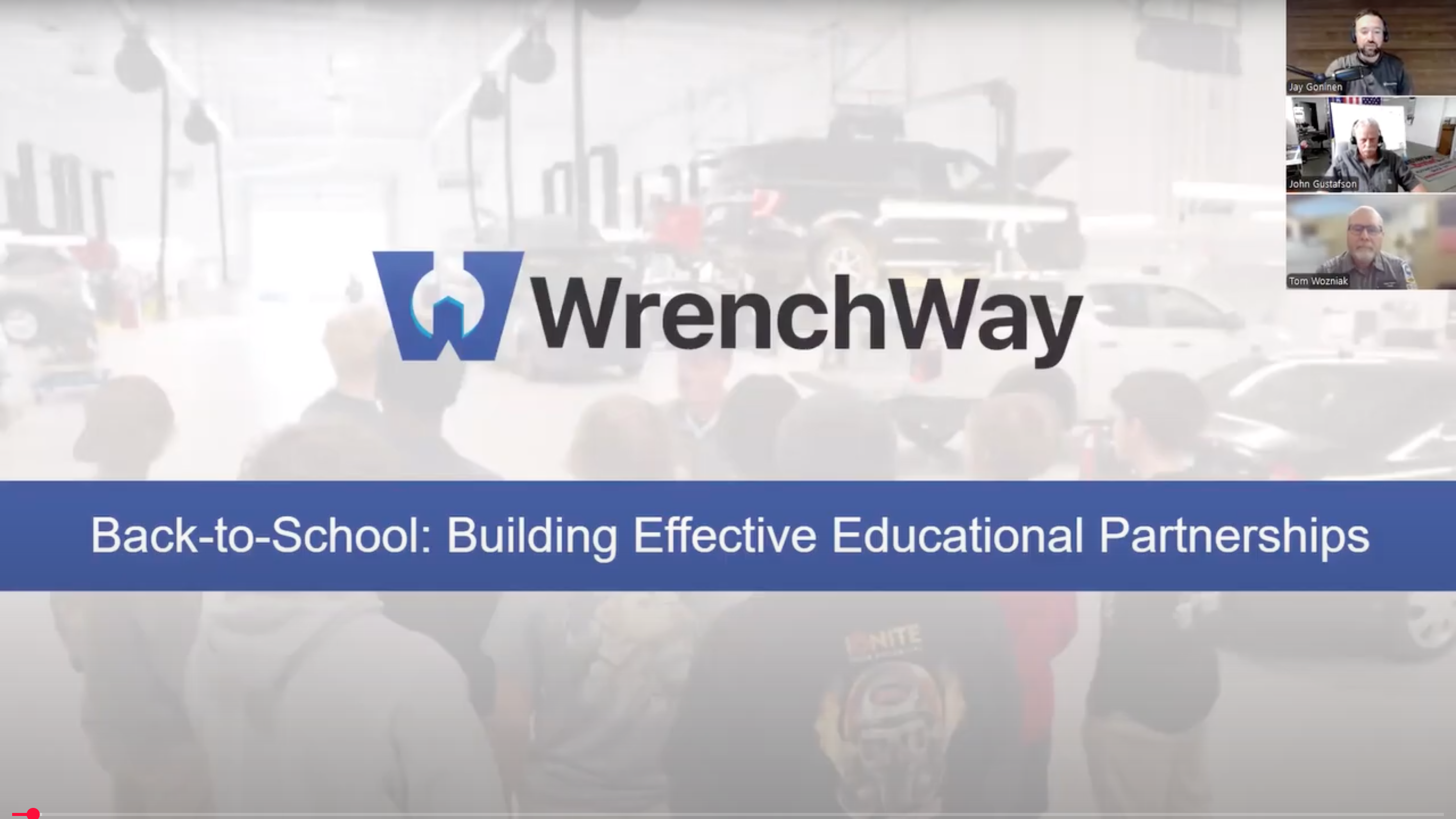 Screenshot from the WrenchWay webinar.
For shops, making a first connection with schools is paramount in getting the process rolling, but, Wozniak said, connecting with a community college and a high school program are two different things.
Colleges, he explained, usually harbor instructors with industry experience, so it’s easier for shops to obtain information here than from high schools where instructors may not have existing connections. Partnerships in those instances, he said, may stem from direct contact via cold call. Recruiting potential hires is a real impetus for shops to get involved with schools, but, Wozniak asserted, timing matters.
“Everybody has the idea that ‘I'm going to go to this community college. I'm going to go to this vocational high school [and say]…‘I want your best guy. I want your best person.’ That person's probably been spoken for for a long time,” he said.
Getting to those top recruits, Gustafson said, isn’t that easy though, and it takes time and investment on the part of shop owners. It’s a conscious business decision to be involved with local schools on a deeper level, and it may look like direct shop owner participation or delegation of a shop representative to be at schools speaking about industry opportunities, asking to bring on interns or establishing partnerships within the community to provide intern stipends.
Planning is an essential part of this process, Gustafson said, citing the vision traction organizer within the Entrepreneurial Operating System, a popular framework for business management, as helpful in organizing core values and focus.
“In that process, you begin to delegate your seats or your responsibilities and things that have to be done, and you either do it yourself from your seat as a leader, as a visionary in the system, or you delegate it to someone on the staff to go and be that person to visit the schools,” he said. “Because in the vision, you have to perpetuate the next generation.”
Navigating Turnover and Presence
Turnover on both sides of the equation, Wozniak asserted, is another hurdle for shop owners in establishing fruitful relationships with schools. Partnerships should be forged between whole organizations, not just individuals.
“If you're making a relationship with the manager of a shop, that should also be included with the owner and letting the owner or the dealer principal know exactly what's going on and being very transparent within that particular realm,” he said. “So, if that individual does happen to leave or get promoted or move to a different location, that relationship still continues and the new person that's coming in understands the importance of that relationship.”
When establishing relationships with schools, it’s beneficial to involve several instructors and higher-ups like deans or, at the high school level, principles and vice principals, Gustafson said.
Simply being present in the classroom is a simple but effective way to connect with students, Wozniak said. Not every student will end up in a technician role, so industry members should consider dropping in to discuss the ins and outs of service writing and parts and sales personnel. Bringing pizza along for these talks never hurts, he said.
Board and Committee Participation
Industry members can benefit schools by sitting on advisory committees.
“You have the direction, or you have the push to help build the programs in the way that you see fit,” Wozniak explained.
This is especially true, he said, as certain corners of the industry become more specialized, and it’s important for industry members to ask schools what their programs need in these settings. Real dialogue is critical here.
“Listen to what they are saying and actually say your peace,” he said.
Change to programs or getting ideal ones built from the ground up can be a slow go, so this is where involvement with schools looks like a long-term investment, especially when it comes to putting in the time on advisory committees.
Consistency is also a must in shop-school relationship building, Wozniak said. Attendance can’t be limited to the times when a shop needs another tech. Sometimes, advocating for a program can mean going the extra mile to make it possible.
For instance, Gustafson said, a shop may host a program, and the school might pay the instructor. Finding ways to support the longevity of a program, he said, can mean the difference between its continuation and a school losing funding for it.
Attention to school boards is also a good way to advocate for the industry, Wozniak said. Attending meetings and bringing up the subject of adding a high school automotive program can plant ideas at the district level, and it may take that level of involvement in places where trade education has slipped below the radar in favor of other programs. Talking to instructors before having these conversations, he said, can be helpful as the environment can be “intimidating” for those who aren’t used to it.
Being present at a school board meeting at times when an existing program is not in trouble is a good idea, Goninen said, adding that school boards face lots of money requests, so it’s best to draw their attention to programs before they’re in dire financial straits.
“I think there is an opportunity for those in industry that if you do care about that school, maybe show up and share some of the success stories,” he said.
Thinking Outside the Box
For smaller shops that may have difficulties dedicating manpower and resources to participation with schools, working with an association can help bridge the gap. Sometimes, Gustafson said, an association can send a liaison to engage schools.
Ultimately, thinking outside the box, beyond cash donations, when considering building relationships with schools can make the difference, Wozniak said. He encouraged shop owners to think about hands-on help and mentorship and about the benefits those things will have for students.
“You already have your great guy before they even start school, before they even graduate” he said. “Go in there and build that long-term relationship. Don't go in there and try to ‘wow’ and hit that home run right away. Go in there and ask both, ‘What can I do for you as well as what can you do for me?’”
Gustafson, too, emphasized entering the environment with humility. A tour is a great introduction to a school atmosphere, he said.
“As you go around, you'll spot things that you know you can help with,” he said. “But instead of trying to be there with a large ego…just listen to what they have to say and help them solve whatever issues they have and invite them to come back and visit your shop.”




Elizabeth Green