


Ben Bowman is quick to acknowledge how heavily he has leaned on vendors since transitioning from a dealership collision director to owner of a small independent body shop two years ago.
Bowman, owner of Cliff’s Body Repair in Scotia, New York, said the shift from a well-resourced dealer group to running an independent meant wearing a lot more hats — and that's where vendors became essential, he told panelists at the recent Collision Industry Conference (CIC).
“In a large organization, you have a guy who does this, you have a guy who does that. I’m finding out that at Cliff’s, I’m ‘the guy,’ and that guy is not very good at a lot of things,” he said.
Bowman and others on the panel discussed how collision repair shop owners and managers — no matter what their level of experience — can work strategically with vendors to improve their business. He pointed to 3M training for his prepper and painter, and a Sherwin-Williams jobber who even helped with plumbing, as examples of vendors stepping up.
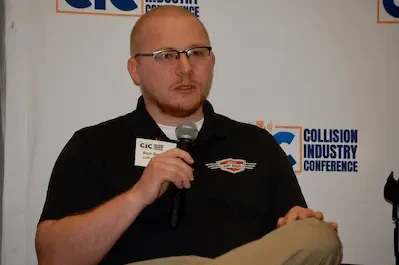 New York shop owner Ben Bowman said he thinks shop owners may miss opportunities to get help from vendors just because they don’t ask. “Leaning on vendors is not only helpful, but it allows me to focus on what we need to do in the business. It’s so important to just ask. People want to give these resources. I think a lot of the times, people are afraid to ask, not a lot of people are taking advantage of this. There are these resources out there, best practices, SOPs.”
He said the Society of Collision Repair Specialists (SCRS) “pointed us in the right direction with a marketing company that’s been very helpful.” Bowman added that I-CAR offers customizable marketing assets that can help shops look more professional without needing a design background.
Bowman said he sought out accounting help from Collision Advice given that he had to shift from using a dealership management system to QuickBooks and Nexsyis.
He said the experience reinforced how willing people across the industry are to help, even beyond direct vendor relationships. "They want to see other people succeed, which is great."
3M offers a variety of training
The CIC panel also included several industry vendors who shared some of the ways they can help shops. John Ascheman of 3M, for example, discussed what’s offered at his company’s collision repair training center in Minnesota, including a three-day body repair and a three-day paint prep and refinish class. 3M also offers a three-day training program for front-office employees.
“We have pretty much every paint line in our training center to make sure we can show people why products fail and how they succeed,” Ascheman said. “We show a lot of the problems that shops see that cause rework. We can show what’s causing it so they can fix it when they get back to their shop.”
Ascheman said that many who come have never had the opportunity to paint or to understand how to do these repairs through the whole process.
“So when they come to the training center, we purely focus on repair process and not products,” he said. “We can answer product questions if they have them, but our ultimate goal is to just give people the hands-on experience to have those conversations, to work with OEMs properly, to work with insurance companies as well.”
Kena Dacus, who co-owns two Dacus Auto Body shops in Kansas with her husband Chris, said she attended that 3M course this year.
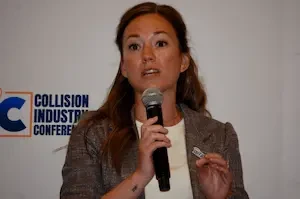 Kansas shop owner Kena Dacus said some vendors were particularly helpful when she and her husband had an opportunity to acquire a second shop location. “I found myself in an awkward position of being an owner but not having ever been a technician,” Dacus said, adding that there can be a gap it fills for those who are negotiating with the insurance companies or just working in the front office.
Dacus said that like Bowman, they turned to several vendors for a variety of help when they had an opportunity about a year ago to purchase their second shop.
“That wasn’t really something that was on our radar, and we did lean on our vendors a lot for support, and we had some that showed up in wonderful ways — and some not so much,” Dacus said. “My Akzo guy was putting repair planning tables together for me. He showed up one day and said, ‘What can I do?’ And I remember I probably had no idea what day it was, I hadn’t slept in a week and I couldn’t think of a single thing that he could do for me other than manual labor. He didn’t hesitate, and he’s not the only one.”
At the other end of the spectrum, she said, “I had a vendor that stood to gain a lot by getting the business of the second shop because they were not servicing that shop prior [to our purchase of it], and they actually made it really difficult. They put me on a credit account when I had been a customer for 12 years and never made a late payment.”
As a result, Dacus had trouble even getting supplies and getting the shop stocked. “It took them three weeks to get the proper materials into that shop. The reality is the folks [with that vendor] that I had relationships with were not the ones that had sway over some of those decisions. So it was heartbreaking, but it was also really eye-opening.”
Use ‘incentives’ with care
The panel was asked about incentives vendors may offer shops, and Dacus said that can be helpful or sometimes problematic. Her shop secured sanders and a vacuum through a loyalty deal with 3M.
“So that’s been really helpful. So there’s a lot of opportunities out there. But I would caution shops too, those deals can lock you in,” she said. “So I would proceed with caution when you're entering those agreements.”
Bowman concurred, warning shops not to chase incentives at the expense of finding vendors they can truly rely on.
"Cost is not the key driver," he said. "It is being able to go to someone and say, 'Hey, I have this problem, how can I help solve it,' and having a vendor that can say, 'Oh, I got a guy…' or 'Hey, I have a solution to this.'"


John Yoswick