


When Nikki Anderson's daughter received a total loss valuation report on her own car, Anderson went through it the same way she tells her customers to review. One of the comparable vehicles used to calculate the payout had trim falling off the back of one seat, to the point it needed replacing, and a busted air vent, damage severe enough to drag the average value down, a mismatch she raised directly with the insurer.
"I will send you date and time stamped pictures of what this car looks like right now," she recalled telling the insurer. "This car is nowhere near comparable to what you have in this report."
Anderson said she doesn't expect customers to take her word for anything without an explanation. She is co-owner of D&B Auto Body in Minnesota, which she and her husband bought in 2012 after he spent about two years working for the shop's previous owner. Anderson runs the office; her husband works in the shop.
Anderson said that when she started working the front counter, she was often told what to do without being told why, and came to believe customers, especially women, were treated the same way — "lied to, taken advantage of ... because they didn't know."
"I don't expect you to blindly trust what I'm telling you," she said. "I'm going to explain to you why we do it this way."
What AI in claims looks like from the counter
For minor damage, Anderson tells customers to expect a photo claim: an app or link that walks them through photographing the vehicle's four corners, the damage, the odometer, and the VIN. She warns them upfront what is coming.
"Something like this is probably going to be written by AI," she tells customers before they submit photos of light damage.
The reaction, she said, is a mix of surprise and resignation: "I get a giant eye roll with a 'go figure.'" She said customers are rarely shocked once she explains it, since most already assume insurers are looking for ways to cut costs.
She also shares a pattern she has tracked over time: photo claim estimates typically land at "somewhere around a third to half" of what her shop's final estimate turns out to be. She tells customers that gap does not necessarily mean they owe the difference, only that the shop still has to identify what the initial estimate missed.
Parts rights and the estimate line by line
Anderson said she raises Minnesota's rules on aftermarket parts in that same early conversation. Insurers cannot require aftermarket parts without the customer's sign-off, she tells customers, though she said she has no objection to using them if a customer prefers to. "I'm not opposed to using them if you want to use them," she tells customers, "but it is your right to not have to use them."
From there, she walks each customer through the estimate line by line, explaining terms like R&I, R&R, and refinish before repairs start. She said customers often question why replacing a fender requires taking apart an adjacent, undamaged door. The answer, she tells them, is that the paint has to be blended into the door to match, which means the door has to come apart and go back together as part of the same job.
Total loss, percentages and the right to retain
Anderson said many customers do not realize that, absent a state law, the decision to total a vehicle belongs to the insurer alone. In Minnesota, she said, an 80% repair-to-value threshold applies only to vehicles 6 years old or newer; beyond that, she said, there is no fixed threshold, and insurers can total a vehicle at whatever percentage they choose. She said certain vehicle makes tend to get totaled at a far lower percentage than others.
She walks customers through why an insurer might prefer to total a vehicle rather than repair it, even when repairs would cost less: the insurer recoups money through the customer's deductible and the auction sale, and is weighing, as she put it, "which way is going to come out more financially beneficial for them."
Minnesota allows owners to retain a totaled vehicle rather than surrender it, she said, and customers are not legally required to spend the settlement on repairs unless the damage affects safety equipment like lights. She tells customers exactly what a retention offer will look like: the vehicle's value minus the deductible minus the estimated auction recovery, with whatever remains theirs to use however they want.
She also encourages customers to request their total loss valuation report directly and check it line by line, the way she did for her daughter, looking for comparable vehicles that do not match their car's actual condition or equipment, and pushing for more recent comparables when the listed prices reflect an outdated market.
The physics lesson behind a calibration
Anderson said a recurring misunderstanding she corrects involves systems customers assume are working because a warning light behaves normally. She described customers pointing to a light in their side mirror as proof a system is functioning.
"The sensor's not in the mirror," she tells them. "The sensor's in the back bumper, and it just sends a message to the light in the mirror."
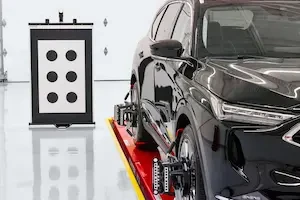
For forward collision systems, she walks customers through a rough geometry lesson: a 1 degree misalignment means almost nothing directly in front of the vehicle, she said, but the same degree of error means the system is reading a meaningfully different point 300 feet down the road, which is why a calibration center has to verify the angle rather than relying on a technician's eye.
She said she cannot skip a required calibration even when a customer says they do not personally use or trust a given safety system, because a future owner might rely on it without knowing the shop skipped a manufacturer-required step. "I can't take that liability," she said.
The gap she says other shops miss
Anderson said that in her market, most shops hand customers a printed estimate without walking through it. Her shop cut ties with its main direct repair program relationship after the insurer required a shift to a different estimating platform around 2020 to 2022; the shop kept the system it knew rather than switching. Separately, in the last year, the shop began billing customers directly for the difference between an insurer's estimate and its own.
"I feel like the biggest mistake is assuming that the customer doesn't care, that they just want their part fixed," she said.
Her advice to other shops building this into their process: compare estimates line by line against what other shops or insurers wrote, checking first whether the same repair operations appear on both, then comparing hours. She said her shop's estimating platform automatically includes items tied to an operation like a door replacement, such as removing the parts needed to transfer to the new door, that another estimating platform may require entering as separate line items, and that a shop not checking for that gap can end up shorting itself three to five hours of billable work on a job.
When a customer doesn't feel equipped to relay her explanation to a spouse who wants the same level of detail, Anderson tells them to have that person call her directly. "I will go through this exactly the same way with them that I did with you," she said.
She does not have a written procedure for how her team handles customer education, calling it "something we've always just inherently done." But she said the upfront time is worth it.
"You can't really just build trust with someone by not talking to them and just handing them a piece of paper and saying, 'Here you go,'" she said.
How Anderson builds education into every claim
Warn customers before a photo claim comes back low. She tells them upfront that AI-generated photo estimates often land at a third to half of the final repair cost.
Explain parts rights before insurance ever raises the topic. In Minnesota, insurers cannot require aftermarket parts without the customer's consent.
Walk through the estimate line by line before repairs start. Explaining terms like R&I, R&R, and refinish upfront heads off confusion when the final bill differs from an insurer's photo estimate.
Request the total loss valuation report and read every line. She checks comparable vehicles against her customer's actual condition and pushes for more recent comps when listed prices look outdated.
Explain what a sensor light does and doesn't confirm. A working indicator light does not mean the underlying radar or camera system is calibrated correctly.
Offer to repeat the explanation for a spouse or family member. A customer who understands less than the household's decision-maker can have that person call her directly for the same walkthrough.
Want to share your shop's advocacy story? Every edition of The Advocate profiles a collision repair shop that goes to bat for a customer, explains a confusing claim, or helps a customer through a dispute. If your shop has a story like this, email us at lisa@autobodynews.com to be considered for a future feature.




Lisa McArdle