



On a July morning. inside the collision shop at Thomas A. Edison Career & Technical Academy (TECTA) in New Jersey, the students crowded around a sanding table aren’t collision repair majors. They are middle schoolers with safety glasses fogging, dust-collection hoses snaking across the floor as they work an orbital sander across a scrap tabletop.
In the spray booth next door, another young student leans over a workbench, gun in hand, laying down primer under the booth lights. Instructor Joe Amabile moves between them, checking grips, adjusting respirators, and answering questions about why the surface has to be this smooth before paint ever touches it.
School let out weeks ago. Amabile is still teaching.
While repair shops may assume classrooms sit idle until August, instructors say the work behind the scenes never really stops. Summer is one of the busiest and most important seasons of the year. It’s a crucial time to evaluate the past year, update curriculum, attend training, strengthen industry partnerships, and prepare students for an increasingly complex collision repair industry.
“The first thing we do is reflect,” Amabile said after the spring semester is over. “What went right? What went wrong? What can we improve?”
Fifteen hundred miles away, Jordan Short is doing his own version of that reflection. A collision repair instructor at Meridian Technology Center in Stillwater, Okla., Short spends the final week of his contract completing grades, graduate reports, inventories, and equipment inspections, filing repair requests, and leaving the shop clean and organized for the next school year.
“It usually takes at least two full days to get curriculum set up for the first quarter,” Short said. “Every year we make tweaks to curriculum and grading rubrics, rearrange equipment to create the best learning environment, work through technology issues, and adapt to new state regulations and school initiatives.”
Preparing for a rapidly changing industry
Technology in collision repair evolves quickly, and instructors say summer provides one of the few opportunities to ensure students are learning the latest repair procedures and techniques. Amabile regularly attends industry events and professional development opportunities to stay current. Last summer he spent a week at the 3M Training Center learning about new abrasives, adhesives and repair products before bringing that knowledge back to his classroom.
This year, while attending SkillsUSA Nationals in Atlanta, he explored vendor exhibits looking for new instructional ideas and technologies. One discovery proved especially timely: with a new spray booth scheduled to replace his existing equipment, Amabile searched for ways to keep students engaged while refinishing instruction would be temporarily limited. He identified a welding curriculum that prepares students for AWS certification and explored virtual welding and spray-paint simulators that will allow students to continue building skills during the transition.
“We’re always trying to think ahead,” he said. “When September rolls around, we don’t want to be caught without something meaningful for students to do.”
Short agrees that continuous learning is essential. “To stay relevant in the collision industry, the learning never stops," he said. "Most people would be shocked by the amount of industry and teaching-related training instructors complete over the summer.”
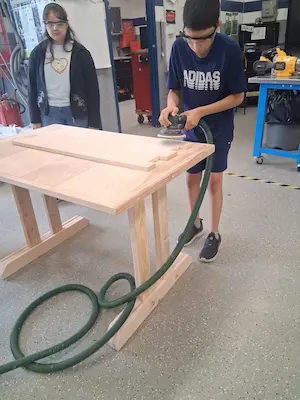
A student sands a practice tabletop using dust-collection equipment — one of the introductory skills TECTA's summer program uses to spark early interest in the skilled trades.
Building tomorrow’s workforce today
Summer is also an opportunity to strengthen the pipeline of future technicians. The middle schoolers sanding and spray-painting tables in Amabile’s shop are part of a broader exploration program that introduces younger students to career and technical education through hands-on projects such as sanding, painting, learning proper personal protective equipment, and practicing safe tool operation. The goal isn’t to repair vehicles yet, but to spark interest in skilled trades while building foundational shop habits.
TECTA also launched a voluntary summer apprenticeship program that gives current students additional one-on-one instruction. For Amabile, the smaller setting allows him to spend more individualized time with students who need extra support, helping them master skills that can be difficult to teach during a full classroom session.
Short uses his summer differently but with the same objective. He reconnects with former students now working in local collision repair facilities. “I try to get feedback from the students as well as their mentors and supervisors so that I can improve the program to better reflect the industry,” he said. Those conversations often generate practical ideas that influence curriculum and classroom instruction before students return in August.
Industry partnerships make stronger programs
Both instructors emphasized that successful collision programs cannot operate in isolation. Repair shops play a critical role by serving on advisory boards, offering internships, donating vehicles, and equipment, welcoming student tours and, ultimately, hiring graduates.
Amabile regularly visits local repair facilities throughout the summer, maintaining relationships with shop owners, recruiting advisory board members, and identifying apprenticeship opportunities. Sometimes those visits even result in donated vehicles for student training. He also encourages repair facilities to participate in I-CAR’s apprenticeship initiatives, giving employers a chance to evaluate students while providing real-world experience before graduation.
“Shops can tell us, ‘This is what we need you teaching,’” Amabile said. “That helps give students an edge.”
What shops can do:
- Serve on a program advisory board
- Offer internships or apprenticeships
- Donate vehicles or equipment for student training
- Host student shop tours
- Participate in I-CAR’s apprenticeship initiatives
- Hire graduates
More than a job
Perhaps the biggest misconception, both instructors said, is that teachers enjoy two months away from work. Instead, summer often becomes the season for catching up on everything postponed during an exhausting school year.
“For teachers, summer break isn’t really a break,” Short said. “It’s time to catch up on all the things you were too exhausted to do during the school year, while also learning new technology and tools so you’re teaching the most current information.”
Even when they do find time for personal interests, education remains close behind. This summer, Short and his wife spent part of their break driving a stretch of the Hot Rod Power Tour along Route 66, marking the highway’s 100th anniversary, passing under the Gateway Arch in St. Louis and through the whitewashed arches of the old Rainbow Bridge in Cherokee County, Kansas. Amabile, for his part, enjoys surfing, kite surfing and home renovation projects. Yet both admitted their thoughts frequently return to their classrooms and students.
Amabile stays in contact with graduates long after they leave school, checking on their careers and reminding them that his support doesn’t end at graduation.
“I tell them, ‘Just because you graduated doesn’t mean my job stops,’” he said. "If you ever need anything, we’re still here.”



Leona Scott