



When a longtime customer named Bruce stopped by Precision Collision in Winter Park, FL, recently, he wasn’t there for an estimate. He came to visit the shop dog.
It’s the kind of loyalty Precision Collision has spent years cultivating through craftsmanship, consistency, and long-term customer relationships.
Owner Heidi McDaniel has built the business around that philosophy since taking full ownership in 2017 following her father’s passing. Operating out of a 15,000-square-foot facility with a team of 15 employees, Precision Collision has remained focused on technician development, personalized customer service, and a reputation-driven business model built largely through referrals.
The shop does not participate in direct repair program (DRP) agreements, and McDaniel said maintaining independence has allowed the business to prioritize communication and repair quality in ways that align with the shop’s culture and long-term customer expectations.
But like many independent collision repair operators, McDaniel is also adapting to a market that continues to evolve rapidly.
“In all our years, we’ve never faced this,” she said. “It’s very stressful.”
Navigating a changing market
The collision repair landscape has changed significantly over the last decade as consolidation, insurer relationships, and operational scale continue reshaping how repair work flows through the industry.
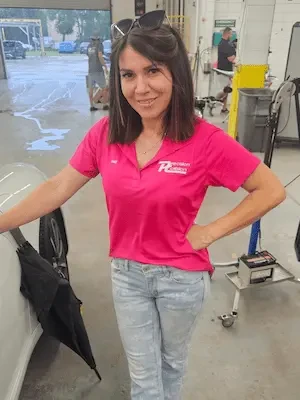 Owner Heidi McDaniel Large multi-shop operators (MSOs) now manage thousands of repair locations nationwide, often supported by DRP relationships with major insurers. Those network relationships, along with larger facility footprints and higher vehicle throughput capacity, have changed the competitive dynamics for many independent shops.
McDaniel said she has seen referral patterns shift as more customers are directed through insurer networks.
“These larger MSOs are taking a lot of the work,” she said. “Customers are being directed to DRPs.”
At the same time, operational scale has become increasingly important throughout the industry. Larger facilities may have advantages in vehicle capacity, cycle time management, and parts purchasing leverage, while smaller independent operators often focus on relationship-based service models and specialized customer experience.
For McDaniel, the changing environment has prompted a closer look at how Precision Collision continues to position itself moving forward.
Where independents can still compete
Rather than focusing on volume alone, McDaniel said Precision Collision is doubling down on the areas she believes have long defined the business: technician training, customer communication, and consistency in repair quality.
The shop continues investing in I-CAR training across its team as vehicle technology and repair procedures become increasingly complex.
“We’re trying every avenue we can,” McDaniel said.
That includes refining internal processes, strengthening customer communication, and continuing to build the type of long-term trust that has fueled the shop’s referral base for years.
McDaniel said customers often value the direct communication and familiarity that come with a smaller, independently operated shop environment. In many cases, customers work with the same staff members throughout the repair process, building relationships that continue long after the vehicle leaves the facility.
That approach has helped Precision Collision maintain repeat customers across multiple generations of vehicles and repairs.
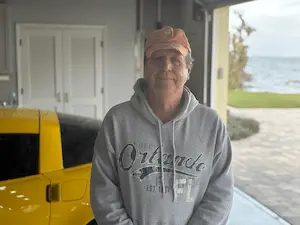
Bruce, a longtime customer, has brought several vehicles to the shop over nearly two decades, including a 1972 Mini Cooper and a rare 1995 Land Rover Defender. Repairs completed years ago, he said, continue holding up today.
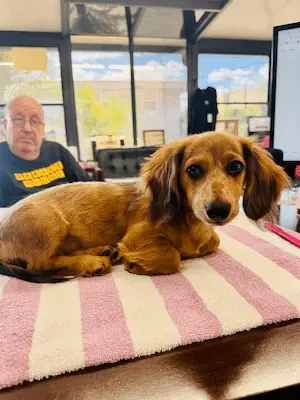 The shop dog at Precision Collision has become a familiar and welcome presence so much so that some longtime customers, like Bruce, stop by just to visit.“They don’t just make it look good, they fix everything,” he said. “When it’s done, it’s perfect.”
McDaniel said maintaining that level of consistency requires continual investment in both people and processes, especially as repair complexity continues increasing across the industry.
Weighing the options
Like many independent operators, McDaniel is evaluating multiple long-term paths as the market evolves.
In addition to continuing to strengthen referral relationships and customer retention efforts, she is exploring new opportunities to expand dealership relationships and further sharpen the shop’s market positioning.
At the same time, she acknowledges that remaining open-minded about the future is simply part of running a business in today’s environment.
“If someone came in with the right offer, I would consider it,” she said. “But I’m going to try every avenue before I even think about selling.”
For now, McDaniel remains focused on continuing to invest in the business while adapting strategically to ongoing industry changes.
At Precision Collision, that means continuing to prioritize technician education, customer experience and operational consistency, while remaining flexible about what the future may hold for independent repairers.


Leona Scott