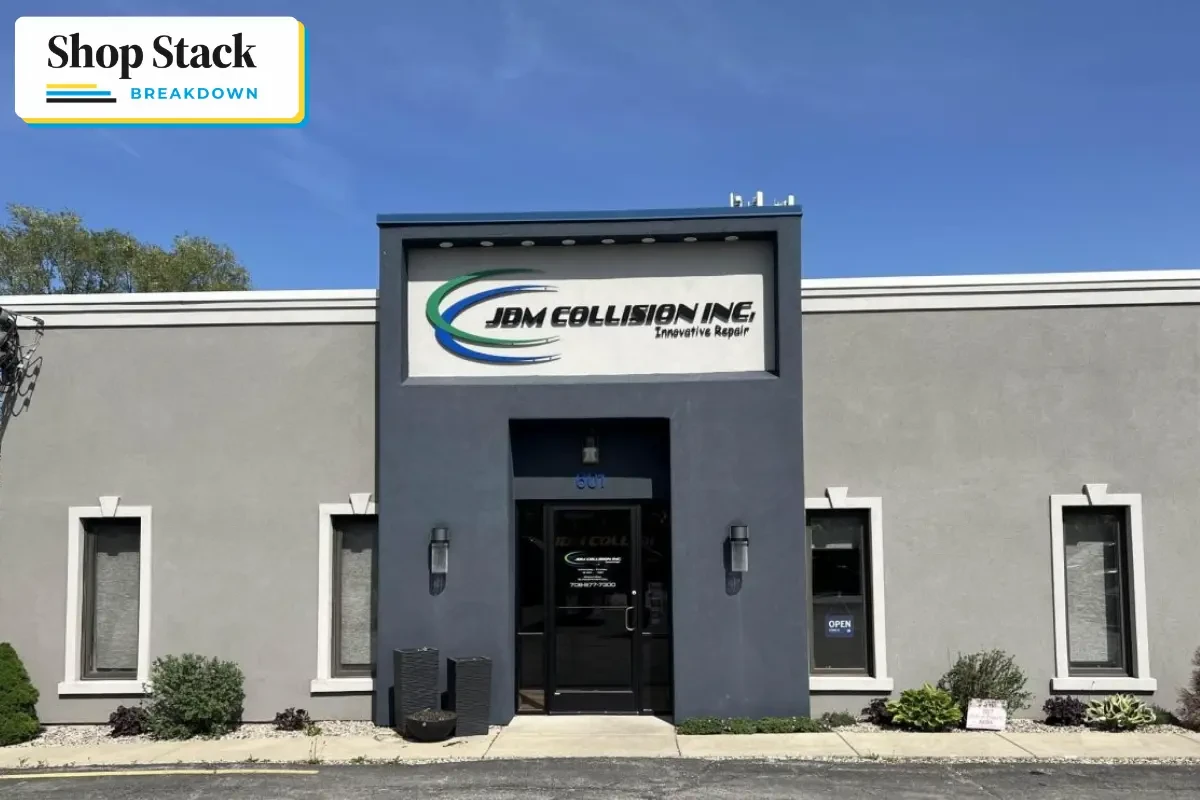
John Melendez has owned JDM Collision in Thornton, Illinois, for 21 years, buying the shop from a dealer principal in 2005 after managing it for years as part of the dealer's body shop operation. He got his start in the industry as a young man working in his father's shop, then spent decades with a dealership starting in the 1980s, eventually running three separate body shops for a dealer principal before consolidating them into a single location after Sept. 11, 2001.
That dealership background, and its General Motors affiliation, shaped the direction of the shop. Melendez said the continued education available through GM's Center of Learning helped build JDM into one of the most advanced GM centers in the Chicagoland and Northwest Indiana market, and the shop is now among a limited number certified to handle GM's electrified vehicle platforms. JDM also does all the work exclusively for six GM dealerships.
But Melendez said he was deliberate about not building the business around a single OEM.
"I didn't want to have all my eggs in one basket," he said. "Even though I do have six GM dealerships that we do all the work for exclusively, I also wanted to just make sure that we had an opportunity to be able to say, hey, you know, if I decided I want to go with Toyota, and right now we're working with driving Range Rover, that's another one that's very stringent about the equipment that is required to have that type of certification, and it's not a rubber stamp like a lot of people pay to play."
Alongside GM, JDM holds certifications with Ford/Lincoln and Land Rover.
Melendez described the operation running across two adjacent buildings, a main shop and a separate advance center down the street that isn't open to the public, totaling roughly 12,500 to 12,800 square feet combined. The shop has 10 employees.
THE STACK
Estimating and management
|
Estimating |
CCC |
|
Shop Management |
CCC |
|
Parts Ordering |
CCC |
|
Accounting |
QuickBooks |
For years, JDM ran its estimating and financial process manually. "It was just the old-fashioned way," Melendez said. "We had our estimating system, then we would do a basic spreadsheet. We have a chart of accounts. We would do it manually, and then what we do is enter everything inside of QuickBooks."
As the shop grew, Melendez said, he moved estimating, shop management, and parts ordering onto CCC's platform, eliminating the need for a separate parts trader. He credited a former Mitchell contact, who later moved to CCC, with making the case.
"He's like, 'Hey, John, I need to educate you. I know you're behind the eight ball on this stuff,'" Melendez recalled. What ultimately sold him, he said, was the ability to flag technician hours, track parts and return percentages, and manage the shop from a phone. "It's like having an extra person or two employed for the shop," he said.
Communications and workflow
|
Customer Communication |
Text, email, and phone |
|
Internal Team Communication |
CCC |
|
Photo and Documentation |
CCC |
|
Scheduling/Capacity Planning |
CCC |
|
Digital Vehicle Check-In |
No |
JDM leans on CCC's internal messaging to coordinate between its main shop and its advance center down the street, which isn't open to the public. But for customer-facing communication, Melendez said the shop stays deliberately manual, particularly on the structural and Corvette work he handles personally.
"I personally call the customer for my cell phone. They have my cell phone. I send them email correspondence, and I just feel that personal touch, doing it the old-fashioned way, is the reason why our business is in position and stays as busy as it is today."
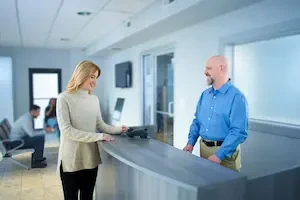
That same reasoning applies to vehicle check-in. "We still do it manually," Melendez said. "We'll go and check in the car, and we will take digital photos all the way around that attach right to the file itself." He said the shop sends the customer a revised repair plan based on that documentation.
Scheduling and capacity run through CCC as well, built around a just-in-time parts strategy. "Acquiring the parts just in time for the job is how efficient a shop can run," Melendez said.
He also uses CCC's billable-hour data to track individual technician proficiency. "For instance, if I'm going to be tied to that job with two other technicians, they could see that, well, I'm running 150 to 175 percent proficient, but yet the person that's doing the removal and installation of certain things, he's maybe 60% proficient. It gives us a good gauge... and then you pretty much could hopefully underpromise and overdeliver."
Repair and production technology
|
Scanning and Diagnostics |
GM Global Connect, asTech |
|
ADAS Calibrations |
In-house (Tru-Point) |
|
Measuring System |
Celette |
|
Paint Mixing and Color Matching |
AkzoNobel |
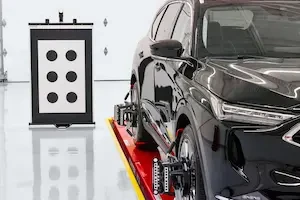
Calibration work stays entirely in-house at JDM, built around a dedicated alignment center that Melendez treats as a required step, not an optional one. "We do not farm anything out," he said. "We do have a full-blown alignment center, and the reason why we have the alignment center... is the alignment has to be checked."
That check happens early in JDM's blueprinting process. After a vehicle is cleaned, mileage is documented, and photos are staged, it goes straight to the alignment rack for a pre-repair measurement report. "In today's day and age, how complex these cars are, if you don't go through the proper inspection process, which that alignment is very vital, that car will never be fixed right," Melendez said.
The shop has added a robotic curing system in its spray booth, built specifically around electric vehicle repair. "We have a system and an arm that we program... it cures the paint in 15 minutes," he said. "And you do not have to remove the batteries. So now you're doing less invasive repair when it comes to the BEVs."
Melendez also pointed to a cautionary example: a Chevy Bolt that triggered an automatic alert to the fire department after cabin temperatures during a standard bake cycle in a conventional booth exceeded safe limits for the vehicle's lithium battery pack.
To confirm his own system's safety margin, JDM ran a gauge inside an all-electric Hummer during a panel repair. "We had it at an 88-degree temp as they were spraying, and then when the vehicle was complete, we were able to bring out the robot and cure the side of the panel, which... gets to panel temp, 172 degrees," he said. "The gauge inside of the car never exceeded 95."
What technology could you not live without?
Despite the shop's investment in calibration and curing equipment, Melendez pointed to something more basic as being indispensable. "I hate to admit this, but it's going to be your electronic estimating system," he said, noting he can still write an estimate by hand if he has to. "Especially with this last storm, we lost power. We could write no estimates. You guys are lost. I'm not. I'll take myself. Call the dealer. The parts prices. I'll make it work. This is your crutch. You cannot live without it."
Asked how he evaluates new technology, Melendez pointed to understanding the vehicles actually driven in his market. "You have to take in consideration... you got to look at your demographics," he said. "A lot of people make the mistake. They said they'll put a shop open [in] the area, but yet they haven't done their homework."
Looking ahead, Melendez said he's eyeing a robotic spray system to pair with the shop's curing setup. "I have the room in our booth to do it, and then complement it with the curing system... I've been looking into this, [and] it's pretty impressive, and the consistency on that would be very beneficial. Hopefully, as this thing, this rescaling could start producing volume without compromising quality."
Want to see your shop's setup featured in Shop Stack Breakdown? Every edition profiles a collision repair shop and the technology behind its operation. Fill out our intake form and we will be in touch.