


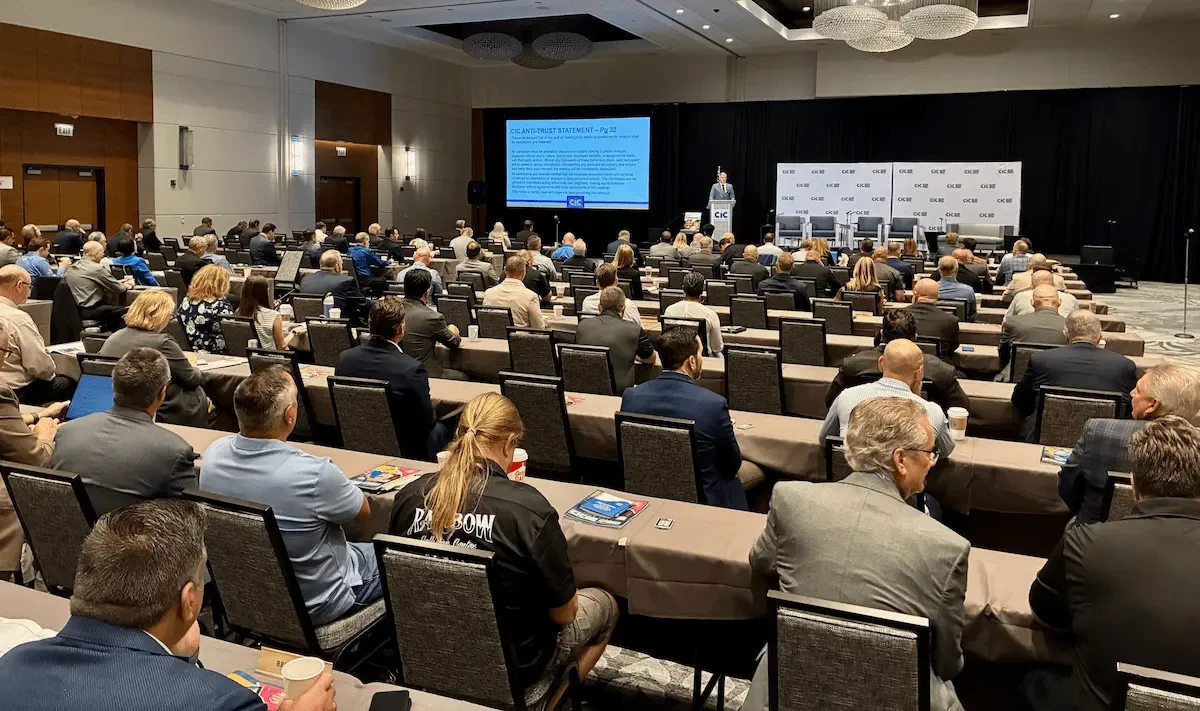
The importance and value of local association membership, choosing sublet vendors carefully, and understanding and following automaker post-crash vehicle safety inspections were all highlighted at collision industry meetings in late July.
Local association turned a last-minute bill into a five-day win, board chair says
Speaking at the Society of Collision Repair Specialists’ July 21 open board meeting in a Chicago suburb, national board chairman Michael Bradshaw pointed to a recent legislative win his regional association, the Carolinas Collision Association, had.
“We had a situation in North Carolina where there was some legislation that got proposed kind of at the last minute, and we scrambled as an association to get our voice out there and engage with our members so they could reach their [state legislative representatives] in order to make a change,” Bradshaw said. “Everybody used their voice to speak from their personal experiences to express why this legislation was bad, not necessarily for themselves, but for their consumers.”
Bradshaw said he was struck at the time that less than a dozen years ago, that association didn’t even exist, but it started because a few individuals “decided that we needed to do something on a state level in order to make a change.”
“Those three people probably never would've imagined that that decision [helped ensure] the legislation that got proposed would be killed within about five or six days,” Bradshaw said. “We were able to get that removed because our association members could use their voices collectively [in a way] that didn’t exist 10 years prior. So, what I’m really trying to say is that I encourage everybody here to get involved because your voice matters and it can make a difference.”
Shops warned to verify sublet vendors' work, not just take their word for it
During an open discussion among the SCRS board and meeting attendees of “industry issues,” Steve Dawson of Hunter Engineering said he’s concerned that not enough shops are taking seriously the need to ensure their sublet vendors are doing the needed work correctly.
“We’re not really verifying that they are doing the right job,” Dawson said. “We’re saying that we’re getting an invoice back from them that says this was completed, but did they use that OEM procedure? Did they use the right steps along that way? And then on the backside of it, do they have the right documentation to go along with it?”
During the meeting, SCRS Executive Director Aaron Schulenburg discussed the association’s recently formed “ADAS Repair Division,” saying it’s designed to give ADAS professionals the same type of thing that collision repairers have found in SCRS.
“We’ve talked here about some of the programs that we’ve launched to help small businesses in our industry,” Schulenburg said. “As a result of that, we've started to have more ADAS calibration businesses join the association to take advantage of some of those things such as our healthcare plan, our 401(k). As we have, we’ve had a lot of requests from businesses that have said, ‘Man, I love the resources that you have that are available to us, but I wish our industry, ADAS repair, the calibration business side of the industry, had its own voice and community within SCRS.’ We figured out how that could be facilitated, and made the decision to create this division and identify an inaugural governing council.”
James Rodis of OEM Calibration, who now serves on that governing council, said he was among the people who had asked SCRS to form such a division.
“A lot of people [in the calibration business] were talking about an association, and I wanted to make sure that it landed with the right group. This is the right group,” Rodis said, gesturing to the SCRS board. “There’s no agenda up here other than fixing a car correctly for the consumer. And that’s what I wanted to make sure happened, that we got to the right people so we could do this right.”
Concern about ADAS standards development
Schulenburg also discussed an ADAS-related concern at the Collision Industry Conference (CIC) held the following day at the same location, referencing another meeting focused on formulating standards within the industry for ADAS calibration processes.
“Here in this room at CIC, we have all these committees talking about the future of our industry, having conversations about how to influence it and engaging one another,” Schulenburg said. “It's worth noting that there’s another effort taking place here in this same venue this afternoon, a small invitation-only group meeting to discuss the creation of what could become a standards development organization focused on ADAS calibration documentation and communication. I think it’s something that our industry should be paying close attention to. Standards have this way of setting expectations, of influencing reimbursement, and ultimately affecting how repairs are performed. If they're developed without considering all the factors that contribute to a successful calibration, then consumers ultimately bear the risk.
“I think there's an important distinction between building consensus through the hard work of engaging diverse viewpoints, versus manufacturing alignment by only engaging voices that are likely to agree. I’m not suggesting that we judge that effort before we see where it leads. But if standards are going to influence the future of collision repair, they should be developed with broad participation and meaningful representation from all stakeholders. And it's worth asking why those conversations are happening here in this venue, yet intentionally apart from the broader industry dialogue taking place here in this room.”
Panel says skipping post-crash safety inspections leaves shops exposed
Also during the meeting, a CIC committee held a panel discussion on OEM post-collision safety inspections. Panelists noted that most automakers call for such inspections, but often a lack of clarity as to when, why, and how they should be performed contributes to friction within the industry, with insurers sometimes questioning the need for inspections, but repairers concerned about the liability of not performing them.
“I see all these committees and things popping up in our industry about calibrations and ADAS,” panelist Mike Anderson of Collision Advice said. “I think we’re minimizing the importance of these safety inspections. They’re just as important, if not more important, than an ADAS calibration. Every OEM says it needs to be done, [yet] an insurer will say they’re not going to pay for it. At the end of the day, the poor shop is stuck in the middle, and it’s just wrong. It's wrong on every level. Nobody’s indemnifying the shop.”
Another potential liability for shops: counterfeit auto parts, such as the airbag igniters that the National Highway Traffic Safety Administration has recently banned after linking them to the deaths of at least 10 people.
A one-on-one on state interview with Teena Bohi of the Automotive Anti-Counterfeiting Council focused on the risks associated with counterfeit automotive parts. She was asked how collision repairers can help play a role in helping reduce the risks to consumers.
“I think just being diligent in your [parts] sourcing, being diligent in your [vehicle] inspections, and then just always working to educate the consumer,” Bohi said. “But also don’t hesitate to reach out to the OEM or the aftermarket provider of a part that you end up with that you might think isn’t the way that it’s supposed to be. All the OEMs and a lot of aftermarket companies do have people like me within their organizations who can take information about questionable sources, about questionable products, and help provide answers and do investigations.”
Also at CIC, Trent Tinsley of Entegral was announced as the new CIC chairman starting in January. Tinsley, a longtime participant and committee chair at CIC, will succeed Dan Risley of CCC Intelligent Solutions, who has led the conference in 2025 and 2026.



John Yoswick