

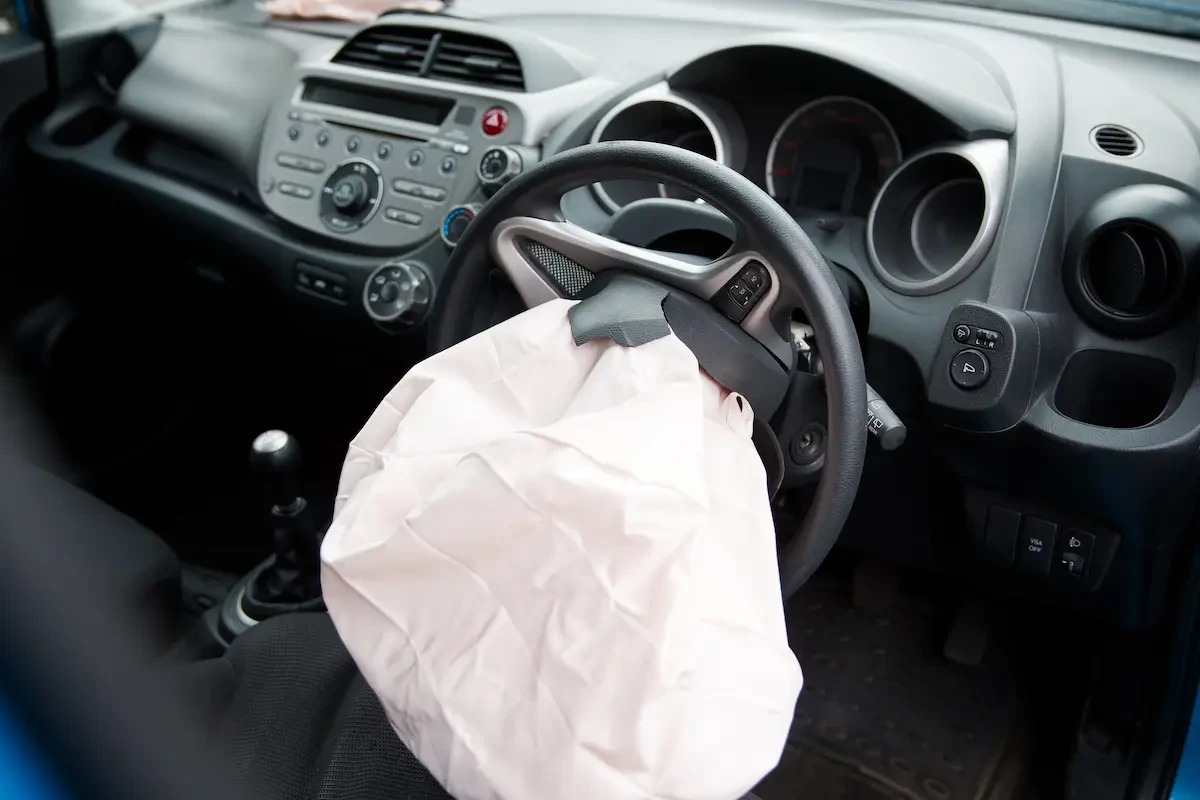
In the span of roughly 18 months, the federal death toll linked to a single counterfeit airbag inflator climbed from three to nine. The National Highway Traffic Safety Administration (NHTSA) said that inflators made by Jilin Province Detiannuo Automobile Safety System Co. Ltd. (DTN) have caused death or serious injury in at least 11 crashes.
Every vehicle involved had its original airbag replaced after a prior crash, according to NHTSA. The agency has alerted the auto repair industry to watch for these inflators and to report any information immediately, because the post-collision repair process is the documented point of entry for these parts into American vehicles.
Illegal Replacement Components in Post-collision Repairs
According to NHTSA, DTN has acknowledged on its own website that its inflators are prohibited from sale in the United States.
Despite that, NHTSA says the parts are being illegally imported and installed in American vehicles during post-collision repairs. Because these parts are installed as replacement components and not original equipment, a standard VIN lookup will not reveal whether a vehicle has one.
NHTSA Administrator Jonathan Morrison described the inflators' failure mode in a February 2026 interview with ABC15: “They're exploding like a grenade. These are not the right type of inflators for airbags or the vehicle itself, so they're overpowering and they're exploding.”
In one documented case, the U.S. Department of Justice confirmed that a North Carolina man imported approximately 2,500 counterfeit airbags bearing fake Honda, Chevrolet, General Motors, and Toyota markings into Raleigh between May 2022 and April 2024, selling them to buyers across the country through Facebook Marketplace. He was sentenced to more than a year in federal prison in December 2025.
The Liability Exposure for Shops
As previously reported, a wrongful death lawsuit filed in Florida in 2024 named body shop Jumbo Automotive as a defendant alongside a rental company, auto auction company, and used car retailer. The suit, which remains pending, alleged Jumbo Automotive installed a counterfeit DTN inflator while repairing a previously totaled 2020 Chevrolet Malibu that was later sold to 22-year-old Destiny Byassee, who died when the airbag ruptured in a 2023 crash.
Morgan and Morgan, the firm that filed the suit, says it is actively investigating at least three additional deaths involving counterfeit airbags and other defendants.
Under product liability law, responsibility for a defective product that causes harm can extend to any commercial party in the distribution chain (including the shop that installed the part) even when the shop was unaware it was counterfeit. Many states apply strict liability, which does not require proof of negligence, only that the product was defective and caused harm.
Laws that prohibit the knowing installation of counterfeit or nonfunctional airbags vary by state. Wisconsin Gov. Tony Evers signed Senate Bill 537 on March 13, establishing criminal penalties that escalate to felony classification when a violation results in bodily harm or death.
Similarly, Idaho Gov. Brad Little signed House Bill 688 on March 20. The law takes effect July 1, and prohibits anyone from knowingly manufacturing, importing, distributing, selling, leasing, or installing counterfeit or nonfunctional airbags in Idaho.
What Shops Should Do Now
The Automotive Service Association addressed the exposure directly in its 2024 industry bulletin, advising shops to inspect suspect vehicles and do business only with reputable parts vendors.
Avoid airbag modules purchased through online marketplaces or priced significantly below market. Request documentation of part origin from distributors.
Shops should also consider:
Inspecting any vehicle with prior airbag deployment. Vehicles arriving with a salvage or rebuilt title, or with evidence of a prior crash involving airbag deployment, should be inspected for a DTN inflator before any replacement module is installed. This aligns with OEM procedures and with NHTSA's published guidance. Document the inspection in the repair order.
Recovering inspection costs and documenting denials. If an insurer declines to reimburse for a post-collision airbag inspection, document the denial in writing. A repair order showing the shop followed OEM procedure with a paper trail showing it sought reimbursement provides a stronger legal position than no documentation at all.
Reviewing coverage. Shops should confirm with their legal counsel and carriers whether their current general liability and products liability policies cover claims arising from the installation of unknowingly counterfeit safety components.






Lisa McArdle