


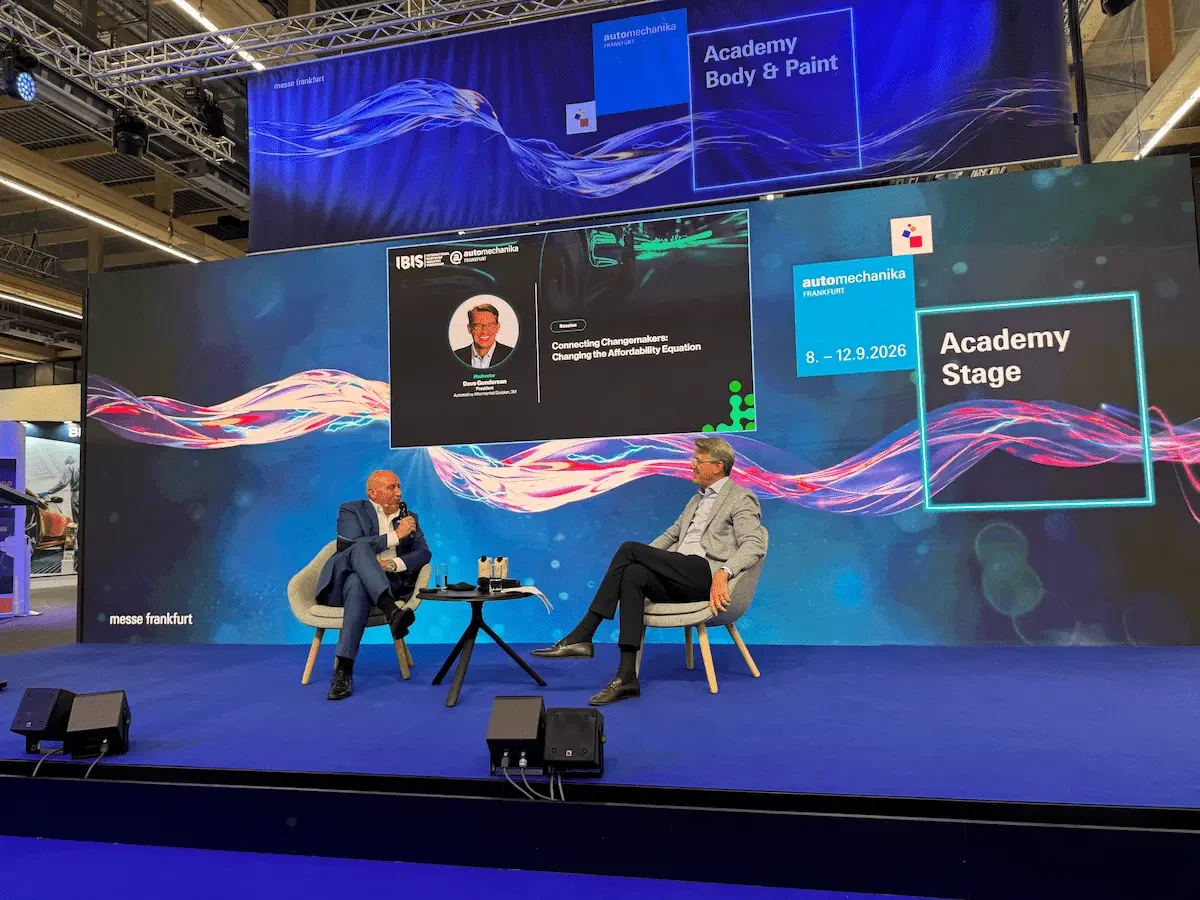
The collision industry has never faced so much change, with new technologies like AI, robotics and automation continually being introduced, according to Robert Snook, CEO of Business Success Global. This is leading to both challenges and opportunities for businesses.
In early September, at the Automechanika Frankfurt trade fair in Germany, Snook invited internationally respected industry leaders to share their perspectives and offer insight into the technologies, market forces, and strategic priorities influencing the sector. The conversations were part of the International Bodyshop Industry Symposium (IBIS) global theme “Connecting Changemakers,” shared across major international Automechanika trade fairs.
During the event, Dave Gunderson, president of 3M’s automotive aftermarket division, discussed how leadership is evolving and how businesses can lead through change and challenging times.
Over Gunderson’s 38-year career, he has held multiple roles and become an integral part of the collision industry. Snook described Gunderson, who retired on Sept. 30, as an industry changemaker, someone who helps define the industry and embodies industry values.
“They shape it for others, and they leave the industry in a better place than when they found it,” he explained.
Affordability is pushing consumers out of the repair market
One of the most pressing challenges, according to Gunderson, is affordability. Consumers often can’t afford to repair their car after an accident, and insurance typically increases. He used the example of his son who graduated college, found a great job, and purchased his first car. After getting into an accident, his insurance rose about 30 percent.
“He decided that it was too expensive to repair the car and exited the industry,” Gunderson recalled. “We have a lot of people who can't afford a $400 repair, let alone a $1,000 deductible, so they are electing not to repair their car.”
Gunderson stressed the importance of repairers recognizing this challenge and working together as an industry to address it.
Otherwise, he said the outcome will be a two-tiered industry.
“We're going to have people who can afford insurance and have their cars repaired the right way and then we're going to have others who are not going to repair cars,” he said.
Looking back to the COVID-19 pandemic, Gunderson recalled how the industry was dramatically impacted with a steep drop in vehicle miles traveled. At the same time, shops had fewer technicians while labor and parts costs rose.
“We got into this cost-plus mentality,” he said. This is when businesses set prices by adding a fixed markup percentage to internal production expenses. Gunderson explained that costs often fall outside a shop’s control and are set by external forces.
Snook said the cost-plus mindset is a growing risk and threat that is being ignored and is helping to create the affordability issue. He stressed the importance of industry changemakers connecting to remove siloed thinking, as well as the barriers to changing the affordability equation.
He challenged the industry to consider why it has not already tackled these risks and threats.
“We, as a connected industry, need to take back control of our future wherever it is in our power to do so,” said Snook.
Another challenge Gunderson identified is the lack of demand, especially in developed markets.
Snook noted the same pattern and pathway is becoming clear worldwide.
“Repair volumes are reducing, while repair complexity and average repair cost are increasing,” he explained. “Reinvestment, resilience, and adapting to change have become success-critical factors and skill sets for repair shop owners and their teams.”
Snook mentioned that repair capacity was once a critical factor for a repair shop’s potential to succeed. Today, as new brands, battery electric vehicles (BEVs), and ADAS-equipped and 360-degree connected vehicles reshape increasingly diverse and aging car parcs around the world, capability is fast becoming the defining factor in a repair shop’s potential to succeed.
“This is not a fad. It is not a blip,” he said. “This is a sea change transformation in our industry.”
At the same time, Gunderson acknowledged how data is not being used effectively. “All of us in this industry have our data sources, but how many times are we sharing it?” he questioned. “How do we work together as an industry with our customer partners and share that data?”
The shops that will ultimately be successful, he said, are the ones who figure out how to use data to drive up productivity.
Vehicle technology and AI open new paths to productivity
Gunderson brought up two major industry changes that are areas of opportunity. One is vehicle technology, which he said isn’t slowing down.
“While the car parc is getting larger and more diverse, the industry is working to keep pace with new technology,” he said. As these technologies are introduced, Gunderson said the industry has opportunities to improve the repair process and OEMs are an integral part of this.
“There are a lot of opportunities there, especially with the Chinese OEMs… Some are doing it better than others, but that's an opportunity as an industry for us to say, ‘How can we help you be able to repair these cars?’”
Another shift is how AI is reshaping workflows.
He used ChatGPT as an example of an AI assistant collision repair businesses are increasingly using. “When you start entering information, it starts to learn about you,” he explained. “If it learns your organization, it can help you figure out where the waste is.”
Snook pointed out how shops worldwide are incorporating AI into their call centers, to prepare estimates and order parts. “There are major MSOs around the world that are automating more than 90% of every single part they order,” he noted. This is leading to more accuracy and efficiency with less leakage and waste.
With these changes occurring, Gunderson mentioned that every body shop needs to understand the best way to drive standard repairs. One of the biggest opportunities he identified is boosting productivity without adding labor so more cars can get out the door.
Snook added that increased productivity should not compromise auditability and hidden liability. “If you can’t prove you did it, it didn’t happen,” he said. He also shared that AI-identified and AI-driven productivity opportunities can significantly increase net profit for repair shops.
Strategic partners help shops win more sustainably
During his meetings with industry partners, Gunderson often talks about the advantages of companies working together. “That's where the power is,” he said. “You can win by yourself, but you can win more and more sustainably when it's done in a true sense of partnership.”
In times of change, Gunderson said the industry can solve some of the most pressing problems, such as a lack of skilled labor.
“My team is a great team and they have great skill sets, but they can't do it by themselves,” he shared.
While some independent shops and models are performing well, he said it’s not in isolation. He advised shop owners to work together with industry partners to help the industry grow and design the body shop of the future.
He also recommended challenging suppliers to do more and be part of this effort.
“A strategic partner is just not by your side,” he noted. “A strategic partner is with me and my partners.”
Snook suggested having quality conversations with suppliers and partners and ensuring they understand the business strategy.
“How can they be an effective strategic partner if they don't understand your strategy because you've never sat them down and told them?” he shared. A team, he said, is more than the people on your organization chart. Instead, it includes the business’s bank, accountant, lawyer, supplier partners and others.
“In the future, not all the people on your team will be humans,” Snook pointed out.
Gunderson also talked about the advantages of building a team of people who don’t necessarily tell you what you want to hear. Some of the great partners he works with challenge the status quo to address business challenges and be innovative.
He recommended shop owners and managers have a customer-first mindset and work alongside their partners.
At the same time, Snook encouraged the industry to be open to change and adapting. “It's change that brings new models, new revenue streams, and new ways of looking at what we're tackling every single day,” he said. “Without change, we would inevitably commoditize ourselves and our industry to death.”



Stacey Phillips Ronak