

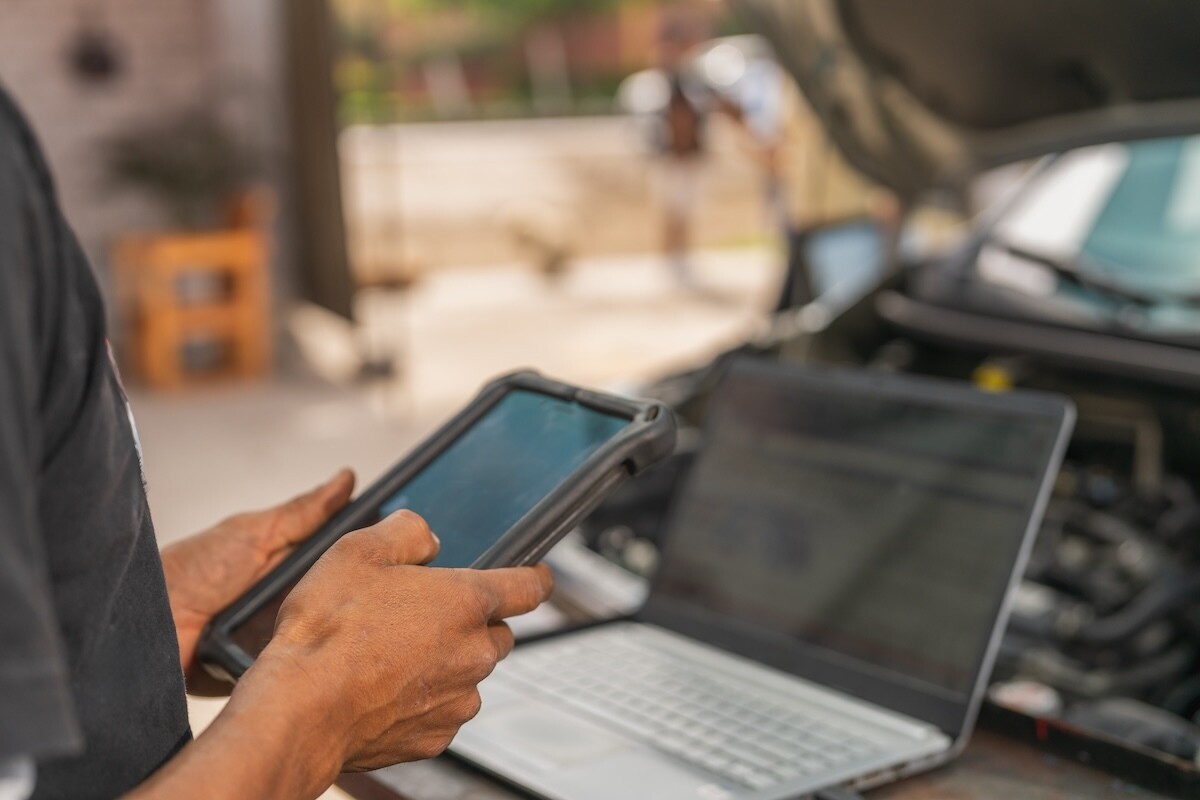
For many collision repair businesses, adopting new technology, especially AI-driven tools, can feel risky. Owners may worry about disrupting production, overwhelming employees, or investing heavily without clear results.
Sebastian Torres of the CARSTAR Torcam Group, part of Driven Brands, says those concerns are justified. But his organization’s experience implementing mobile inspection technology across multiple locations suggests modernization does not have to be chaotic if it’s approached methodically.
Rather than deploying technology overnight, the group followed a structured process of experimentation, validation, training, and phased rollout. The result was measurable operational improvement (including more predictable scheduling), stronger performance metrics, and progress toward paperless operations.
CARSTAR Torcam’s approach offers a practical blueprint for other collision repairers evaluating new tools or processes.
Start with exploration
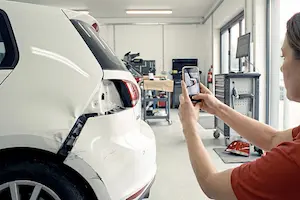
Unlike many technology initiatives, CARSTAR Torcam did not begin with a specific operational gap when piloting Solera’s mobile inspection app and Visual Intelligence (VI) tool.
“When we first started with the mobile inspection, we didn’t really know what to use it for,” Torres told Autobody News. “We were given a solution to a problem we didn’t know.”
The tool was originally marketed as a response to estimator shortages, an issue the company was not experiencing. Only after hands-on testing did the team identify a meaningful use case. After several weeks of experimentation, they discovered the technology’s value in handling non-drivable vehicles, where a preliminary estimate did not need to be perfect but needed to be fast. This pivot turned a generic estimating tool into a scheduling solution.
Use structured phases and pilot in a controlled environment
Torres describes technology and AI implementation as a multi-stage process rather than a single event:
1. Brainstorming phase: Identify potential problems and solutions
2. Trial phase: Test ideas freely, including unconventional approaches
3. Evaluation phase: Analyze what worked and what failed
4. Procedure development: Draft a formal standard operating procedure (SOP)
5. Training phase: Prepare staff for consistent execution
6. Phased rollout: Expand location by location
Only after real-world testing does the company formalize procedures. In addition, all major initiatives begin at the group’s original location.
“We know that shop inside out,” Torres said, adding that he and his parents all started their careers at that location.
Piloting in a familiar environment allows leadership to interpret results accurately and troubleshoot quickly. It also prevents disruption at newly acquired locations still stabilizing operations.
Let data drive decisions
A turning point came when scheduling patterns changed dramatically.
Before implementing the mobile inspection tool, drop-offs were uneven: heavy early in the week and sparse later, forcing constant catch-up. After adopting the new process for non-drivable vehicles, work volume leveled across all days.
Instead of counting vehicles, the team tracked labor hours and revenue entering the shop.
“If you can control what’s coming in, you can plan what’s coming out,” Torres said.
As scheduling stabilized, other performance indicators improved:
- Higher touch time
- Reduced rental length
- Increased throughput
- More consistent production flow
“The validation was the metrics,” he said.
Developing internal “procedure champions”
Rather than relying on top-down enforcement, the group designated staff members who helped develop the process to train others.
“Because these guys trialed it, brainstormed it figured it out, applied it at the main location, and saw the benefits of it, these two people became my ... procedure champion,” said Torres. “And as we onboarded a store, and that store got comfortable .... now we don't have two people to help. Now we have four, and then you move into the next location, and that other store has four people they can call. And that's kind of how we band together to make sure that those procedures are following through.”
As each location adopted the system, the number of knowledgeable employees grew, creating a support network across the organization.
Training and rollout phases
Not all staff members are comfortable with technology. Training therefore focuses on individual needs rather than uniform timelines.
“If somebody's not really computer literate, then [it’s] just really sitting down, holding their hand and being patient, and then however long they need to get comfortable, so that we ensure that they can continue in the direction that the company is going,” said Torres.
Because procedures are mandatory, the organization commits to helping every employee reach competency.
But the technology itself was not the biggest challenge; consistent execution was.
“It takes about six to eight weeks to create habits,” Torres said. “If you want to create a habit, you’ve got to do it every single day.”
Torres said that employee resistance to implementing the new technology was minimal because leadership clearly explained the purpose behind the change and emphasized that it was intended to make jobs easier, not harder.
From pilot launch to full deployment of the mobile inspection across the group, it took approximately eight to 10 months. Meaningful performance data appeared earlier — about six months for the first two locations — but scaling required additional time.
This timeline reflects the realities of multi-shop operations, where consistency matters more than speed.
Moving toward paperless operations requires infrastructure
Beyond the inspection tool itself, the company is implementing tablets across the organization to eliminate paper-based workflows.
Every employee will eventually use a company-managed device for:
- Work orders
- Time tracking
- Internal communication
- HR functions such as vacation requests
To support this, the IT team deployed mobile device management software to track inventory, usage, and location. During the device onboarding process, tablets were temporarily removed from shops, producing immediate performance decline.
“Once you get people used to using technology as a tool [and] you take that technology away, and all of a sudden, you're in a bit of trouble,” said Torres. “But that's not to say that you operate worse without the technology.”
In other words, operations did not collapse, but efficiency dropped, highlighting how deeply the tools had become embedded in daily workflows.
Remote intake aims to improve customer experience
The group is also preparing to implement remote intake for drivable vehicles, allowing customers to submit guided photos instead of visiting the shop for preliminary evaluation.
Traditionally, the company used a “triage” model requiring customers to visit twice — once for assessment and again for repairs. Remote intake seeks to eliminate those extra trips.
AI accuracy has improved significantly since initial testing, increasing confidence in this approach. The system will not replace in-person service entirely. Customers will still be offered a choice.
“We have to cater to all populations,” Torres said.
A blueprint for manageable modernization
CARSTAR Torcam Group’s experience shows that successful technology adoption in collision repair is less about the specific tool and more about disciplined implementation.
Key elements included:
- Experimentation before commitment
- Data-driven validation
- Clear procedures
- Structured training
- Gradual rollout
- Ongoing support
Most importantly, leadership treated change as a long-term operational evolution, not a quick upgrade. For shops weighing modernization, the lesson is clear: transformation does not happen overnight, but it does not have to derail operations either.
For more with Torres, see his recent episode of the Collision Vision podcast.




Lisa McArdle