



Alex Crays wants it to be spring.
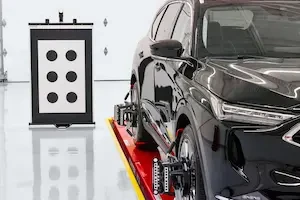
The collision program he co-directs with Andrei Cojuhari bought a $45,000 John Bean ADAS calibration system last summer, and he’s ready to start teaching it.
“We didn’t have time last year,” Crays said. After training in December, “we’re about to teach it in May for the first time.”
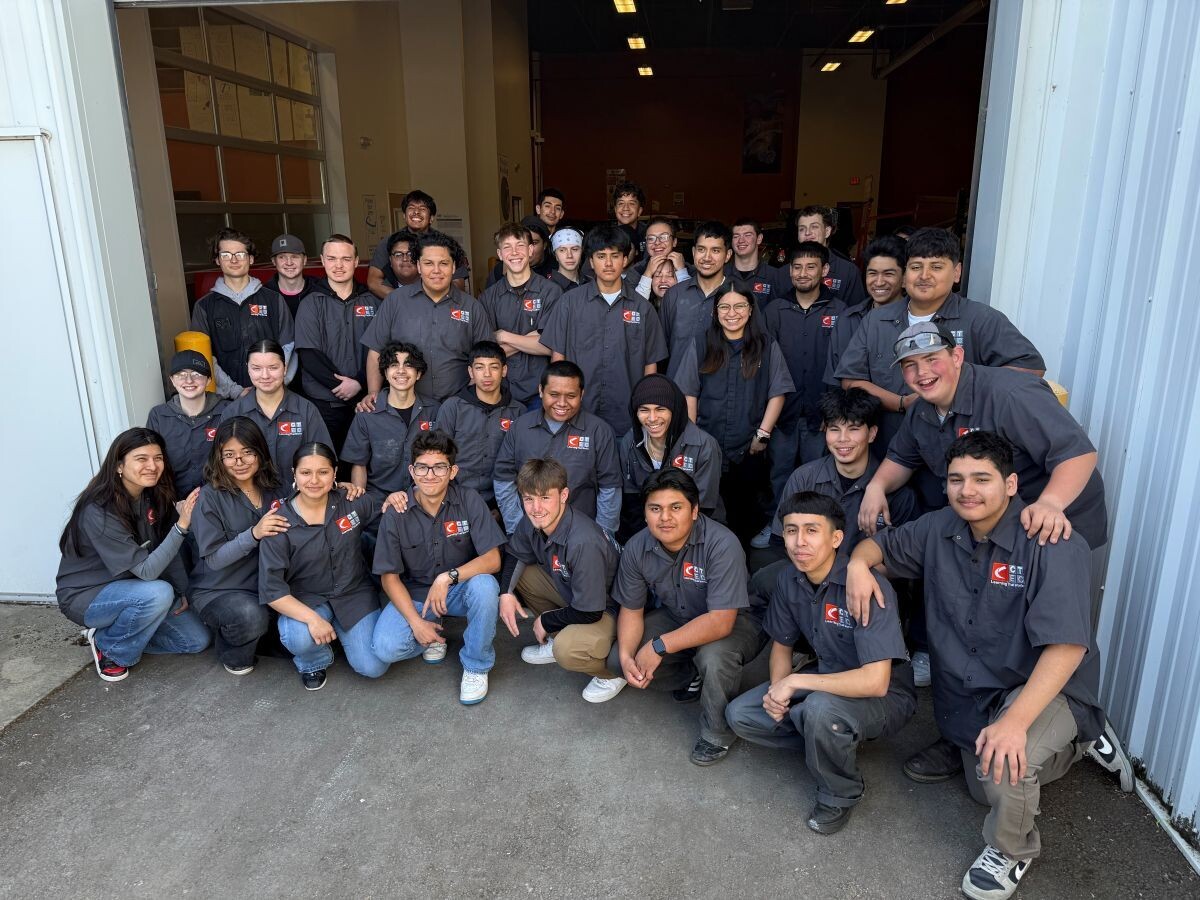 Students in Salem-Keizer's popular CTEC program.Crays and Cojuhari lead auto body instruction for Salem-Keizer School District’s Career Technical Education Center in Oregon. They have 97 students — “97 employees,” Crays corrected — and CTEC is like an incubator or accelerator of vocational teaching.
Six high schools feed into the two-year program; Crays said 100 more students want in. “We have close to 200 applicants for [each year’s] 50 new spots.”
Nineteen of the current 97 ‘staffers’ are female. Students work on 25 cars a year for real clients.
“They see what their managers’ expectations will be,” Crays said. “We push deadlines: ‘The customer’s coming for his car today.’”
Repair plans, software, shop welder, EV Mini
Crays figures he was also first in on RepairLogic’s pilot program for schools.
“I love it: get the students access to the OEM repair procedures so they’re in the habit of doing that.”
Each student has a CCC account. Time pressures put the focus there, though Mitchell also offered access free of charge. A local body shop donated a spot welder, which students use for hands-on projects involving sectioning and welding. CTEC is also affiliatedwith I-CAR Academy.
Four years ago, the program bought a $65,000 Switch EV — the three-wheeled car “about two-thirds the size of a Prius.” It gets built each year and then torn down for the next term.
“They learn systems from the ground up,” he said. “By the end of it, we have a running car.”
When he started teaching seven years ago after 35 years in the industry, the program still lacked basic software, such as ALLDATA. Since then, providers “have been amazing” donating products, including management tools.
The push began a few years earlier, when a local donor bought and refurbished the building in a $14 million effort. “A couple years ago he sold it to the district for a dollar and told us it was the ‘biggest return ever on one of his investments.’”
He wasn’t blowing smoke, Crays added, accounting for “the results of students starting high-paying careers.”
Play the game: VR in theory and practice
Virtual reality in collision repair training is moving from concept to reality.
When VR emerged a decade ago, it was all about consumer users, marketed primarily for entertainment like gaming or live sports viewing. But businesses quickly adopted it for training purposes, from demonstrating medical procedures at trade shows to preparing oil rig workers before deployment to training heavy equipment operators without machinery.
Now, VR knocks at your door — and believe it or not, technical colleges are getting systems, too. I-CAR will launch 16 ADAS and EV courses via VR this year; Southeast Technical College in South Dakota got a new VR paint sprayer set-up.
Gamification is a second new equipment avenue for both schools and body shops.
Chris Craig, leads RockEd tech content training development. He said the smartphone-based app, which incorporates gaming — competition, role-playing, achievement — into ‘soft skills’ training offers seven hours free coursework to “any student at some sort of automotive level. We’ve had instructors put it in a syllabus; students find us and download it directly to their phones.”
Craig said schools can buy nine more hours, and another 10 are coming this year.
A third new ‘equipment’ course, of course is AI, often in software. A spokesperson said via email that over the last 15 years, CCC has given about $75 million via in-kind donations of CCC One to schools through CREF.
A Mitchell spokesperson emailed that it offers free access to Mitchell Cloud Estimating for students at 129 schools in 38 states. It brings high school students to its research facility for work with 3-D measuring and ADAS. The company’s in-kind donations to the schools total more than seven figures.
CREF said 10,000 students in 2024 got access to training on CCC, Mitchell, and Audatex software.
What’s your play here?
For repair shops, the path forward is relatively clear.
There is no need to rush into every new technology. Evaluate what’s coming, ask your questions, and test solutions before committing.
Schools benefit from partnerships with industry stakeholders who can help them obtain modern equipment. Support can come from state associations, local I-CAR committees,, or groups of shop owners working together.
Help schools get new equipment and work alongside students on it. You can even help them when they need to get rid of the old stuff.
Software is an easy connection here, for instance. Partners can come in for an hour to show students the tips and tricks they have learned in navigating programs in their own shops.
All this is also a low-key way to get to know students, which reconnects to running a more successful shop. As students are absorbed in learning, you can see how they act and react and respond, interact with others, and their attitude and approach to the work — long before you are interviewing for apprentices.
It doesn’t always help
It sometimes seems schools are doing okay. CREF gives grants for new gear. There are always new scholarships here and there. National retailers donate millions for “the trades,” tool companies donate tools, and carmakers give cars.
But it doesn’t always help. SUNY-Morrisville in New York got new electric vehicles and other equipment to help train auto body students, but it didn’t spare the program. A spokesperson said it’s ending, with current courses being taught through next year and no new students admitted.
Two classes (one required, one elective) will be part of the mechanical program.
Shawsheen Valley Technical High School in Billerica, Mass., recently weighed whether to eliminate its collision repair teaching, “despite the school’s investment in infrastructure items such as new welders, spray booths, lighting, and textbooks,” a report said.
A local governing body in late October voted 9-1 to give the program a reprieve for one year, including it in current expansion plans submitted to the state.
While the trades in general have grown for most of Shaw Tech’s two dozen programs, about five students out of 1,200 remain in collision repair, according to Brian O’Donnell, who cast the only vote against including it.
O’Donnell told Autobody News resources must go to growth. “We’ve supported the program with capital [but] there are things causing retrenchment in auto body,” he said, citing insurance and other areas. Massachusetts is also a difficult environment for collision repair, with appraisal regulations and a labor rate cap that operators say drives kids to other disciplines that pay better.
“As an independent self-sustaining program, the numbers aren’t there,” he said.
For shop owners, new technology alone is not the cure-all. The latest equipment can be appealing, but success depends on how it is used and integrated into training.
You don’t have to buy a bot, but not training is not an option. Virtual reality is just a new delivery system. ADAS and EVs are here. Schools are vital lifeblood to the collision repair ecosystem.
What’s old is new — and essential
So, what’s the key?
Adopting new tools requires time, testing and resources, but effective training ultimately depends on fundamentals such as communication and workflow understanding — and even by unconscious, indirect example via things like the organization of the program itself.
“They’re reading OEM procedures and writing SOPs, a ‘keys-to-keys’ [mode] to give them exposure and take them deeper,” Crays said. “Students ‘choose their major’ — body techs, painter, detailer, estimator, office work,” learning along the whole workflow: from blueprinting and disassembly to calibrations and quality control.
Academic subjects are integrated as well. Students take English and social studies courses tailored to collision repair, learning to write technical documentation and studying the history of automotive technology and repair methods.
“If you’ve taken four years of English, you do it again,” Crays said. “As I’m teaching it in the shop, they teach it in the classroom.”
So for you …how will people respond to new equipment entering their workflow, and VR training or “gaming” on the job? They might even enjoy it.
What will it do for company culture? Possibly improve it.
What skills and experience can you share with students as their eyes goggle and minds boggle?
Well, answering that might take the rest of your life.



Paul Hughes