



As vehicles continue to advance, the collision repair industry is recognizing the need to stay up to date with the latest automotive technology. The CES event, held each January in Las Vegas, Nev., offered a firsthand look at the technologies that will likely shape the next generation of vehicles. Organized by the Consumer Technology Association, the show highlights new products and technologies across industries, including automotive.
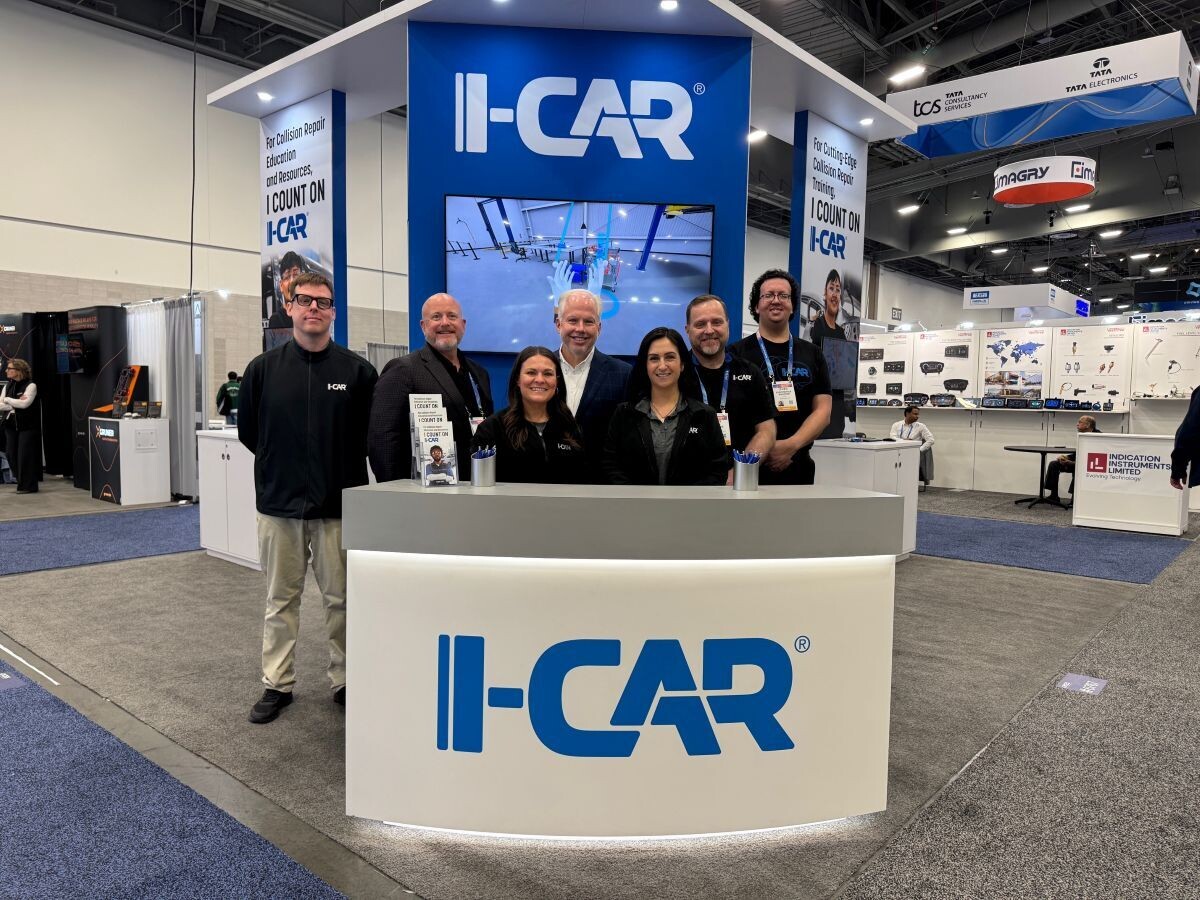 This is the second year I-CAR team members have attended CES to learn about new vehicle technology and determine how to develop training that addresses the repair of modern vehicles.For the last two years, I-CAR team members have attended CES to learn about new vehicle technology that collision repairers will likely encounter in their shops and to speak directly to the engineers who are creating it.
“As we're thinking down the line about the training that we're developing, we make sure that we're ready for the next advancements in vehicle technology,” said Arianna Sherlock, I-CAR’s vice president of marketing. “I-CAR is continually looking at how to be more responsive to evolving technology with different manufacturer systems and equipment to expand the breadth of its training.”
I-CAR previews virtual and mixed reality training for ADAS and EV repairs
During CES, I-CAR showcased its latest training advancements, including 16 new on-demand interactive and virtual reality courses that leverage Meta glasses to train technicians on advanced driver-assistance systems (ADAS) and electric vehicles (EVs). There are four ADAS courses and 12 EV courses, with a three-day hands-on event. Both types of training use Meta glasses.
The virtual reality courses are scheduled to launch in 2026. In the meantime, the prototypes have been tested at I-CAR’s Chicago Technical Center in Vernon Hills, Ill., as well as in California, Florida, and Orlando shops.
The four online and hands-on ADAS training courses were created for every skill level to help collision repair professionals safely repair and calibrate today’s vehicles. They include classes such as Incorporating ADAS in Your Business and Calibration of Front-Facing Cameras and Front Radar.
“As vehicles become more advanced, collision repair professionals face new challenges, especially with ADAS now standard in over 90% of 2023 and beyond model‑year vehicles,” said Sherlock. “Understanding how these systems work and how to properly diagnose, repair, and calibrate them is no longer optional.”
“The main focus with dynamic ADAS training is that we are actually focusing on the fact that learners will virtually go drive the car and confirm that the repairs and the calibrations have been done correctly,” explained Michael Mertes, I-CAR’s director of learning technology. “That is something that's obviously not easy to do, even in a hands-on course, because of all the different variables involved.”
Additionally, I-CAR is offering 12 online and hands-on EV courses, such as Understanding High-Voltage Safety and EV Damage Analysis.
“There are a lot of reasons why the EV training is so cool and there is obviously a safety element to being able to learn how to disconnect a battery,” noted Sherlock.
I-CAR uses both virtual and mixed reality in its courses. Virtual reality is an artificial environment experienced through sensory stimuli, such as sights and sounds, provided by a computer, and one's actions partially determine what happens in the environment. Mixed reality is a combination of virtual reality and augmented reality, an enhanced version of reality created by technology that overlays digital information on an image of what is being viewed through a device.
“When I put on the latest version of Meta’s new display glasses, there is a built-in high-resolution screen in the lens for visual AI feedback, such as text notifications and live captions,” said Mertes. “The display model offers augmented features like teleprompter modes and visual AI answers.”
Mertes said the overall response to virtual and mixed reality courses has been extremely positive. “Even the detractors who try it and have not been fans of virtual reality training have recognized the benefits and have found it is a really innovative way to learn,” he said. This includes long-term technicians, as well as students.
One of the most valuable aspects of the training they recognized during the piloting process was the use of the cart that simulates the high-voltage systems of an EV. Students first utilized virtual training to learn the process. Then, the instructor asked them to follow the same procedure hands-on. “They went right to it,” said Mertes. “The instructor was so taken aback, he said that out of all the years he has done this, he could not believe how confident they were to start working on this after utilizing VR.”
Some of I-CAR’s prerequisite courses will be delivered virtually in the future, which Sherlock said will decrease the amount of time needed to spend on in-person training. “They can do it at their time, at their pace and in their location,” she shared.
Adaptive learning aims to reduce downtime and meet technicians where they are
In addition to these 16 courses, Sherlock also discussed I-CAR’s new adaptive online courses, which are intended to optimize the training experience by meeting learners where they are and adapting the course length to their level of knowledge. It will be available to the industry later this year and can be utilized in shops, schools, and other places where I-CAR’s curriculum is used.
“I think these courses are going to be really well received by the industry because they are more responsive to learners,” said Sherlock. “If you're more skilled, you can move past something, and if you need to spend more time on a specific element of the training, it will match your pace and slow down to make sure that you are ready to move on.”
As part of the adaptive learning, Mertes said the lessons will include a series of questions to assess the learner’s knowledge of the topic, whether it’s how to pick up a tool or the proper method for disposing hazardous waste. In addition, the training focuses on issues that will help address their deficiencies. Mertes said this not only will save time, but it will also acknowledge the knowledge they have.
Sherlock said the courses will also help reduce downtime at the shop.
As vehicle technology continues to evolve, Sherlock said I-CAR will continue to adapt its training to meet the industry’s needs.
“We want to ensure that all the folks who touch a vehicle are properly trained,” said Sherlock. “That is very consistent with I-CAR’s mission and vision.”
Crash Champions sees CES as a window into future repair demands
CES also provided I-CAR the opportunity to talk to attendees in the collision industry.
“It was really exciting to see people from the collision repair space at this year’s show,” said Sherlock.
 Crash Champions, the primary authorized repair partner for Sony Honda Mobility’s AFEELA vehicle, had the opportunity to visit the auto manufacturer during CES.This included team members from Crash Champions. The MSO has attended CES for the past three years, primarily as an authorized repair partner with Sony Honda Mobility and its AFEELA vehicle.
Danny Briones, Crash Champions chief marketing officer, said the MSO is familiar with I-CAR’s virtual/mixed reality courses.
“I was really impressed by I-CAR’s forward-thinking approach to apply technology from outside our industry to the collision repair process,” he noted.
Briones said that anytime a real-world experience is created using technology, it creates a true benefit.
“As technology continues to evolve in the wearable tech space, we believe there will be more applications for integrations with learning and information for everyone,” he added. “There was definitely a sense of pride to see fellow industry representatives like I-CAR at one of the largest technology events in the world.”
From a collision repair perspective, Briones commented on how vehicle technology has advanced more in the past 10 years than the past 50.
“We’re always thinking about what’s next, and attending CES gives our leadership team a rare glimpse into what the future looks like,” said Briones. “Spending time at events like CES is an investment that allows us to get a first-hand look at the innovation that is right around the corner, and most importantly, prepare our teams to be at the cutting edge.”
The Crash Champions team had the opportunity to see innovations from legacy and new manufacturers. This included Sony Honda Mobility, its upcoming AFEELA 1 and newly announced SUV. Crash Champions is the primary authorized repair partner for the AFEELA.
Briones shared three dominant themes spotlighted at this year’s show: the expansion of wearable technology, the rise of new automotive manufacturers and next-generation vehicle technology, and rapid advances in robotics.
As an MSO, Briones stressed the importance of shops keeping up with new automotive technological developments.
“It’s critical,” he said. “Not just for the business, but for the responsibility we have to the people who trust us.”
Briones acknowledged how cars today are no longer just metal and paint but instead are rolling computers.
“ADAS, sensors, cameras, software, and advanced materials are now part of everyday repairs,” he mentioned. “If a shop isn’t keeping up, they’re not just falling behind, they’re putting safety at risk.”
That’s why the MSO makes it a priority to attend events like CES. “It’s not for the headlines, but to learn,” Briones explained. “Our responsibility doesn’t stop at attendance. It’s bringing that knowledge back to our team through advanced training, proper tooling, and continued investment in our facilities so our people are equipped to do the job the right way.”
Crash Champions believes training is not optional.
“It’s a duty,” he emphasized. “We owe it to our technicians, our customers, and the families riding in these vehicles.”
If collision repair facilities expect their teams to grow, lead, and win, Briones recommended giving them the tools, education, and confidence to work on today’s vehicles safely and correctly.
“That’s how we stay relevant,” he stressed. “That’s how we protect the trade and that’s how we make sure the next generation sees this industry as a place where they can build a future, not just get a job.”
Independent shop owner gets first look at emerging vehicle tech
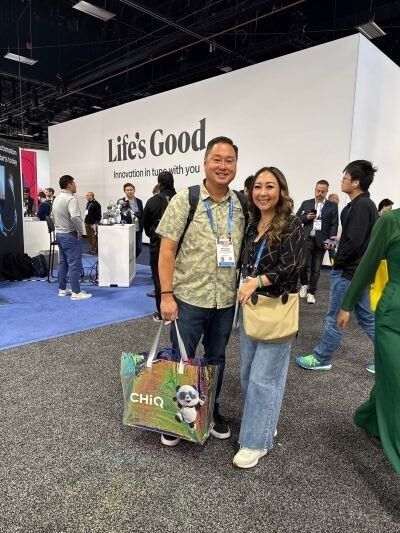 Brandon Okahara, a partner at Oka’s Auto Body in Hawaii, attended CES with his wife, Leila, to learn about new technology and help him prepare to repair future vehicles.It was the first time that Brandon Okahara, a partner at Oka’s Auto Body in Hawaii, attended CES. “I have always been interested in attending but now more than ever, seeing the technology that’s coming down the road today will allow us to better prepare to repair the vehicles of tomorrow,” he said.
There were several highlights at the show for Okahara.
“Autonomous vehicles are definitely here!” he said. “It’s amazing to see the quantity of sensors and cameras in some of these prototype vehicles.” He said it was also interesting to see how lidar works in person. Some of the gadgets he found memorable include tiny note-taking devices the size of a credit card that can record a meeting, translate into different languages, and then provide an AI-driven summary, and smart glasses that can take photos, browse the web and have talk-to-text translation.
“We cannot continue to grow if we don’t plan for what’s to come,” Okahara emphasized. “Technological advancements, new equipment, better processes … they all start with educating ourselves. Attending CES is one step forward with the goal of continuous improvement.”



Stacey Phillips Ronak