


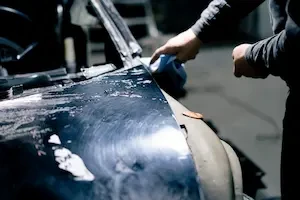
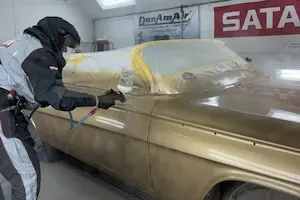
In 1974, a young Dan Dutra stood in his uncle’s shop washing cars and sweeping floors, happy just to be earning a paycheck. The scent of fresh paint hung in the air, and the rhythm of sanders and spray guns echoed through the bays. What began as a job quickly became an obsession.
“I was just happy to be working and earning money,” Dutra recalls. “Then I got hooked.”
Hooked on painting first. Then body work. Then estimating. Then the business itself. Over the next 17 years, Dutra immersed himself in every corner of collision repair, determined to master not just one craft, but the entire operation.
“I learned all aspects of the business and could do a pretty good job at any of them,” he says. That curiosity and hunger to understand the full picture would become the throughline of a 50-year career spanning shop floors, corporate boardrooms, and industry leadership.
From the shop floor to the corporate side
After nearly two decades in operations, Dutra transitioned to the supply and corporate side of the collision repair industry, working for a paint company and expanding into industry relations, including participation with CIC. The move broadened his view of collision repair beyond a single shop’s walls.
Eventually, he combined everything he had learned — technical expertise, business acumen and relationship-building — and co-owned shops in Hawaii with a partner until selling in 2021.
Today, Dutra remains deeply engaged through the Collision Career Institute, where he focuses on fostering careers using workforce intelligence tools and strategic partnerships. He also serves on the board of PACE, an ADAS company based in Nashville, and is working with Erin Solis at Square One Systems to launch a new Elite 20 group focused on ADAS. At the same time, he is collaborating with industry leaders to establish meaningful ADAS standards.
For Dutra, evolution has never meant stepping away — it has meant stepping up.
A commitment to people and principles
Ask Dutra what has been most rewarding over five decades in collision repair, and the answer isn’t financial success or expansion.
“Knowing that I had a part in helping people advance and change their lives,” he says. “It has always been important to me to feel I am making a difference.”
Whether guiding a technician into management, mentoring an emerging leader or helping a business solve operational challenges, Dutra measures success in impact.
That mindset is rooted in personal discipline. His advice to newcomers reflects lessons forged through opportunity and hard work.
“I have been fortunate to have had many doors opened for me,” he says. “Once they were opened, I still had to step through and perform. I always wanted to exceed expectations.”
His formula is simple but demanding: work smart, be persistent, solve problems rather than become one. And above all, pass what he calls the two “A’s” test: Attitude and Aptitude.
“If you have the right attitude and the right aptitude, you can conquer anything. But you need both,” Dutra says. “The most important is attitude.”
Another guiding principle has become something of a personal mantra: “Look internal before looking external.”
When projects fall short or problems arise, Dutra conducts a personal root-cause analysis.
“If something fails, I ask myself, ‘What did I do to cause this outcome? How could I have made it better?’” he explains. “Take responsibility for losses and failures. Don’t blame others when things go south.”
Over time, that habit shaped how others experienced him — as someone accountable, honest and solutions-focused. “Doors will open for you if you are consistent and people see you that way,” he says.
Culture, standards, and the road ahead
Dutra has witnessed sweeping changes since the 1970s, from hand-mixed paint to advanced driver assistance systems. While many speak of a technician shortage in collision repair, he sees a deeper issue.
“I believe there is a shortage of great shop cultures and environments for technicians to flourish and grow,” he says. “Greatness and quality attract greatness and quality.”
For him, culture isn’t a buzzword; it’s a strategy. Build an environment centered on learning, progress, and career development, and talent will follow.
Yet today, his focus is even more urgent.
“We are on the verge of a completely new paradigm,” Dutra says. “The industry is confused right now. It is a time for true leaders to emerge.”
At the center of that call to leadership is ADAS calibration. Dutra views it as the single most critical issue facing collision repair.
“Done wrong, it puts the consumer in danger,” he says. “We need standards. We need disciplined ethical leadership.”
He believes the acceleration of technology has created opportunity, but also confusion and the potential for bad behavior. Even good companies, he notes, can make poor decisions when understanding and standards lag behind innovation.
“This idea of coming together as an industry and saving people’s lives energizes me,” Dutra says. “It is beyond a profit motive.”
That sense of urgency carries into his personal life as well. He is completing the restoration of his father’s 1970 Chevy C20 extended bed pickup — an emotional project decades in the making.
“My dad is 94 and doing great,” he says. “But there’s a sense of urgency. I want to get it back from Hawaii and take him for a ride.”
It is fitting that after half a century in collision repair, Dutra’s focus remains both forward-looking and deeply personal, advancing technology and standards while honoring the past.
From washing cars in 1974 to shaping conversations around ADAS standards today, Dan Dutra’s career reflects a consistent theme: growth with purpose.
“I am more committed now than ever before,” he says. “My focus is clear and intense.”
For an industry navigating rapid change, that clarity, and that commitment, may be exactly what is needed.
Frame by Frame is an ongoing industry spotlight series from Autobody News, highlighting the people whose experience, leadership, and commitment continue to shape the future of collision repair.



Leona Scott