



“The number-one thing, the first thing you must do, is completely change your mindset,” Louie Sharp said.
We’re talking about collision industry owners and operators and their insurance company woes, and the owner of Sharp Body Shop in Illinois has blown my mind, or maybe blown it up, to start rebuilding from scratch both my mind and my ideas about how collision work works, as he did with his mind and body shop — and as you can do in yours.
It began with insurers, with whom he was having a helluva time some 15 years ago. (We know this story. Maybe you live it.) He’d spent about four years in the Marine Corps in the late 1950s, right out of high school, then apprenticed with a body shop starting in 1981 with “$500 and a toolbox, no heat, no running water.”
He “moved a couple times, expanded, bought a piece of property, big addition,” yada, yada. You know this part too.
Then “a couple of things happened.”
He had the Direct Repair Programs (DRPs) — yes, including State Farm, which, after 15 years, tightened its program and cut him from it because, he said, his shop offered free loaner cars.
He’s grateful for this. The move pushed him to change, well, everything.
Serious as a heart attack: Get right or get left
“I dropped all DRPs,” Sharp said. “I didn’t have to be taking all this grief and BS.”
 Sharp turned to Barrett Smith for internal advance work to help overhaul his business.He found a fellow named Barrett Smith for internal advance work and an attorney specializing in collision, Patrick McGuire, for what might come next, from the outside.
Smith, an ex-estimator and shop owner, now runs Auto Damage Experts Inc. in Florida. Working with a dozen or so clients at any one time who want “to do the right thing in the right way for the right reasons” and in some significant sense are doing so (by having the right equipment, for instance), Barrett Smith helped Louie Sharp overhaul … Louie Sharp.
“Each client’s different,” said Smith, who learns and discerns “what they’re doing or not doing [and] let them know there’s another way. Louie was adamant he wanted to run a better shop, to provide higher quality. There are shops willing to take that risk.”
As an owner, Smith had been to the same place Sharp now was: “to either stay in the business doing it right or get out. They need to understand their ultimate choice … to edify and empower customers [and themselves], to establish their rights and get what they’re entitled to,” he said.
“Customers are entitled to full and proper restoration of their vehicle,” Smith said, while shops “are entitled to be fairly compensated for their efforts.”
Sharp’s expectations on this score aren’t high, let alone out of line. He’s got 6,000 square feet; three techs, one of whom also paints; and a detailer, parts guy, GM, and part-time bookkeeper. Six-point-five bodies, all in.
“I live at about a $35,000 weekly sales goal,” Sharp said. At one point, he had to repair a dozen vehicles each week to hit his income targets. It’s now under five. “Car count is down, sales are up. I don’t need 20 clients a week.”
Look out the window, saying no
That means being willing to say no.
“I don’t have a desire to fix a car for everyone who comes through my door,” Sharp said. “If I can’t fix the car the right way, you can take your car somewhere else.”
“Not every situation turns out good, but there’s always a solution,” Smith added. “The customer chooses to take their car elsewhere.”
And still it starts inside an operator — but not so much with the man in the mirror. We often have a general sense of who we are, even if we feel stuck or trapped. We have an idea of the problems — the external ones, anyway: pushback from insurers, daily battles about price, wanting to work well, seeking safety, frequent failure. Instead of looking just in the mirror, we should look out the window: knowing what it could be and finding a future that looks different.
Sharp said he wasn’t angry. He’d just become “aware [of] a game you can’t win.”
You, on the other hand, might be a bit frosted, a little miffed, and reactions start: “In a perfect world” … “Must be nice” … “What will happen to me?”
But Sharp’s only an outlier in what he decided to do: high school grad, jarhead, decades in collision in a sub-10,000-square-foot shop looking to do maybe $2 million a year. His name’s mud anytime he doesn’t play the game. “‘Sharp Auto Body doesn’t know what they’re doing,’” he might hear customers say. “‘Charges for things no one does.’”
Sharp sees you, and so does Smith. “A lot of guys were the same, risking their reputation, alienating insurance companies,” Smith said. “Shops need to assert themselves. Not everyone feels they can do that.”
‘I work for the client’
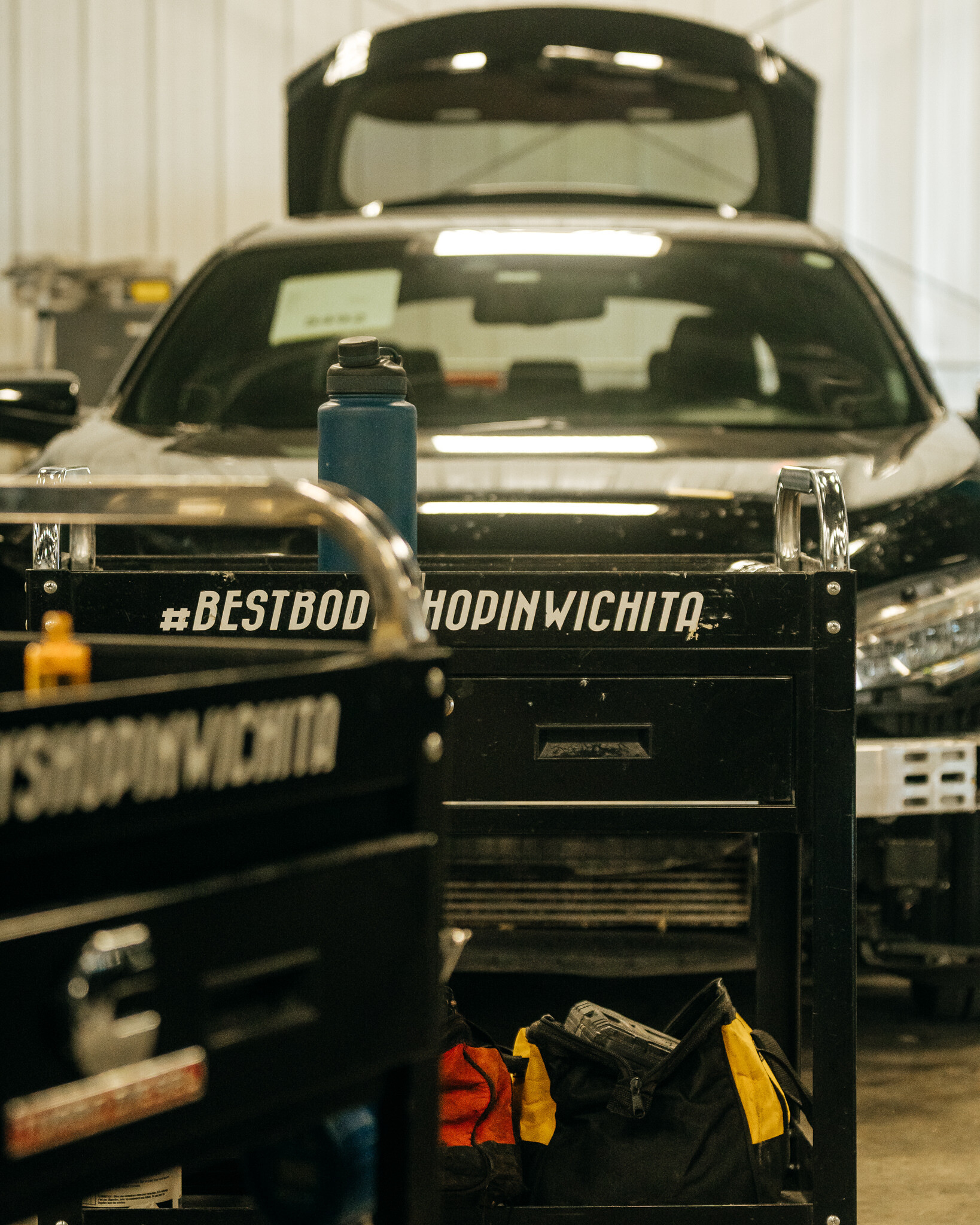 Clay Hoberecht of Best Body Shop in Wichita, KS worked with Sharp to turn his shop around.Smith tells of initially turning away a shop owner he later worked with: Clay Hoberecht of Best Body Shop in Wichita, KS.
“We talked for a while — talked several times — he wasn’t ready,” Smith said. “We didn’t take him on the first time.”
Hoberecht returned with proper equipment and OEM procedures and protocols. “He wanted to, or I don’t think he would’ve called me,” Smith said. “Then he showed he had the commitment to step up and do it. Clay’s a great example of someone who turned his shop around.”
“[Smith] helped, guided, supported, educated, and most importantly believed in me,” Hoberecht said, citing Smith’s wisdom, support, and experience. “Two to three years of heavy training.”
And he went looking for more, in a paradoxical place.
“Vehicles are becoming more like humans every day,” Hoberecht said. “What else is complicated and gets repaired? The human body.” So he studied hospitals and doctors, who, of course, could also complain about insurer issues.
One change from this: “We don’t have big toolboxes” in the shop. Hospitals have small carts, specialized for a task. “Nurses have one, doctors have one — or none — anesthesiologists have one.” He added, “Can you go into a hospital and say, ‘What do I need, and how much will it cost?’”
The fewer than 20 weekly customers Sharp serves also “understand how and when and why” he works the way he does.
“At this point, I don’t care what insurance companies say or do,” he said. “I work for the client.”
‘Body shops are the problem’
Sharp saw the prior problem inside both himself and other body shop owners. He now podcasts, consults, and speaks with those owners under The Gifted Leader, a business he began as he got his collision repair mind right.
“Owners live in this messed-up place where they want the whole world to be their client,” he said. “That’s not how you want to do business.”
“You have to take the word ‘insurance’ out of your mouth,” Hoberecht said. “If it didn’t exist, could you run your shop? If not, you don’t have a viable business model.”
“Don’t learn ‘how to argue,’” Hoberecht tells shop owners. Start with you, then focus on the customer, their car, and your team.
“You have to be willing to step into the danger zone and put the relationship ahead of your comfort,” he said. “If the relationship is bad, the business is bad.”
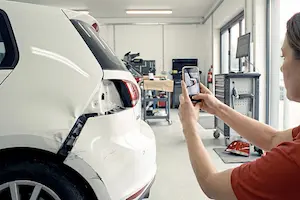
Best Body Shop records any conversation on office lines, takes a lot of pictures, and talks to their customers — “an abundance of transparency … We broke it down, made it super simple.” But he doesn’t speak to insurance companies “except as a courtesy. We answer questions, send what they need, but if they tell us how to repair the car, it’s like a surgeon. Legally, they have no right to dictate repair. They have no liability on it, and they have no say.”
Sharp concurs.
“Get rid of the mindset you owe the insurance company anything,” he said, noting he takes 30 to 40 photos of a vehicle before teardown. Within the law, “I can do what I want with my business. Copies of invoices? Show me in the statute where I have to do that. [We] tell the insurance company what’s going to happen.” He added, without rancor, “I’m not going to argue with them. I call the car owner.”
As with Sharp’s cheerful refusal, Hoberecht said his team isn’t rude. But all these phone calls?
“Why are you doing that?” Hoberecht asked pointedly. “[Because] every system and process benefits our client, their car, and my team.”
No more blame game or bemoaning the industry. Do the one thing you’re meant to do: repair cars.
“Stop trying to change the industry, and you’ll see your success,” he said. “Body shops are the problem.”
Resources for a growing movement
The car-and-customer focus sounds obvious, but if it were easy, everyone would be doing it. And if they were, there’d be fewer complaints about fighting insurance companies — and fewer fights. More owners are full-bore focused on quality and customers, and the mindset work and personal development undergird this.
And there are resources: finding someone to work with, developing true in-house mentoring.
Hoberecht found help in the emotional intelligence work of Daniel Goleman and the entrepreneurial leader pivot of personal finance guru Dave Ramsey. When it comes to developing teams and oneself, he follows Patrick Lencioni’s vision of staying “humble, hungry, smart.”
Sharp’s leadership consulting grew from involvement with Jack Canfield’s success principles. He’s also written a book, Car Cents, for vehicle owners.
Hoberecht said of the work in his shop, it’s the “genuine love we have for each other.”
Sometimes, that’s a tough love: saying “no” and saying it in writing if needed. Hoberecht and Sharp emphasize knowing your state’s laws, such as the right to appraisal and having the confidence to insist on it.
“Anything in an accident, we’re invoking the RTA, because the insurance company’s going to short pay,” said Sharp, noting his shop has lost only one of those in four years. He also gets creative in talking up how to make the legislative lives of shops better, pressing the point, for instance, on how much tax revenue is lost and what other industries are adversely affected when collision repair work is incomplete and cheap.
“We’ve gotten to know the district attorney’s office,” Hoberecht said. And, as mentioned, Sharp found the attorney McGuire, who has three decades of collision legal experience. McGuire’s resume includes repping shops and vehicle owners and extensive speaking throughout the state, both in-person and virtually.
“My firm is basically a boutique policy holder firm” for insurance of all kinds, he said. He’s also worked with the Alliance of Automotive Service Professionals of Illinois (AASPI), a collision trade group, and does an annual seminar series — educational, not legal advice — on the state’s insurance and repair environment for body shops.
The series covers “what they have to comply with, different types of claims, day-to-day business, liability issues repairing now very sophisticated vehicles, total loss situations, post-repair rights and remedies, [and] how to enforce.”



Paul Hughes