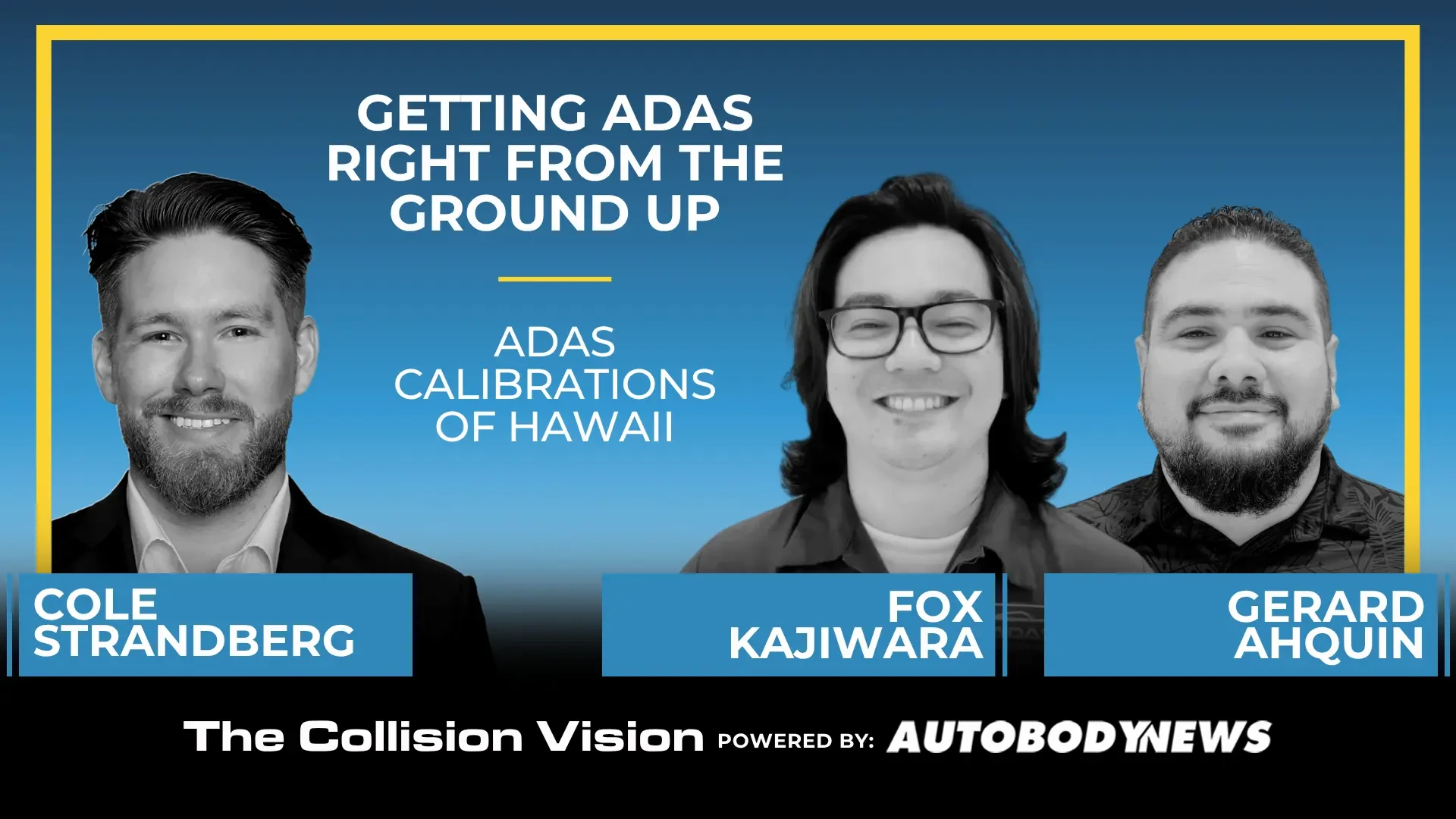
Few areas of collision repair have evolved as quickly, or carry as much responsibility, as ADAS calibration. On a recent episode of The Collision Vision, host Cole Strandberg sat down with Gerard AhQuin and Fox Kajiwara of ADAS Calibrations of Hawaii, a Honolulu calibration center operating as a Car ADAS Solutions licensee and built from the ground up around one purpose: performing OEM-compliant ADAS calibrations correctly.
AhQuin spent two decades as an auto repair technician before moving into collision repair in Honolulu about six years ago. "We see the worst of the worst accidents. We're dealing with people in their worst time, and you really want to figure out ways to make it easier on people.”
Kajiwara came from an entirely different field. "I went to college for molecular bio. I was doing a lot of research with cancer cells, a lot of mice work," he said, before moving into calibration work.
Both landed on the same operating principle. "You're calibrating cars first and foremost for safety, because every car you touch and calibrate, there's a potential that it's going to be next to a vehicle of a family member or a loved one," Kajiwara said.
The conversation covered why the two built a dedicated calibration center instead of adding it to an existing body shop, what it actually takes to create an environment capable of accurate calibrations, and why they believe process, not equipment, is the real foundation of a successful ADAS business.
The facility is the foundation
AhQuin said partnering with Car ADAS Solutions gave him the structure to build the business correctly from day one. For AhQuin, that meant investing directly in the physical space before ever touching a vehicle. "We spent a lot of time working on our facility here to just do that: leveling floors, covering all the metal on the walls, making walls that shift around to cover metal, to make sure that we are doing everything 100 percent correct and we're not cutting corners."
Kajiwara described the physical space in the same terms. "The preconditioning of the vehicle and the facility itself is the foundation upon which you're going to build the calibration itself. If you start with a rotten foundation, your cornerstone is bad on your building ... you can never say 100 percent that it’s going to be precise and correct.”
Key Takeaway: Before either operator talks about hardware or software, they talk about the room. A calibration is only as reliable as the space it happens in
Even a small floor slope throws off the math
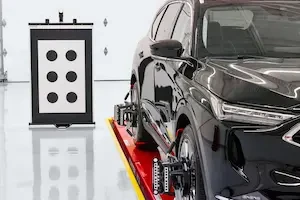
The building was previously a warehouse with an uneven floor and exposed rebar from old shelving anchors. Kajiwara explained why that mattered for target placement. "If I'm measuring out a radar target 4,000 millimeters out in front of the vehicle, if I've got a 2% slope on my ground, or I got a little divot in the ground and my target's not sitting square, you're just setting yourself up for failure at that point." Getting the space ready took a cement grinder, weeks of angle grinding rebar studs, crack filling, epoxy flooring, and repainting the walls white to reduce visual distractions before a single vehicle came through the door.
Key Takeaway: A floor that looks flat to the eye can still be off by enough to throw off a calibration. Shops considering an in-house build should test actual floor levelness against OEM tolerance, not assume it.
Sizing a space to fit every manufacturer
Asked how much room proper calibration actually requires, Kajiwara gave a specific number. "If you took the maximum space required for every manufacturer and took the largest ones, you would need about a 60x40 clear space, no metal, level floor, a 2-millimeter difference, I believe, in floor height.
Key Takeaway: A 60-by-40-foot, metal-free, level footprint covers every OEM's requirements at once. Most shops evaluating an in-house build should measure their available space against that number before assuming they can handle it.
Equipment choices come down to throughput and OE access
The shop's primary calibration tool is the Hunter Ultimate ADAS® system. "Having a piece of equipment like the Ultimate that can measure floor height by itself and put lasers on the ground to show where to put targets, the efficiency of the whole process is expedited so much that it allows us to handle the throughput that we expect,” Kajiwara said.
OE software is the default, but not the only option. "We have some aftermarket scan tools as backups for those cases" when a manufacturer's servers go down and a customer's vehicle can't wait, he added.
Key Takeaway: OE software is the standard, but a shop running any real volume needs a documented backup plan for when that access isn't available.
Preconditioning takes longer than the calibration itself
Before targets go up, the team documents the vehicle's condition with photos of all four corners and the odometer, then works through a checklist: adjusting tire pressure to OE spec, adding weight plates over the fuel tank to simulate a full tank, sweeping the car for extra cargo weight, and running a pre-calibration scan for trouble codes.
They also run a thrust angle alignment check before touching a single target. "It doesn't make any sense to calibrate your front radar if your car is pointed into the other lane next to you," Kajiwara said.
Key Takeaway: The steps before target placement, not the placement itself, are where a rushed calibration is most likely to go wrong. Vehicle condition has to match OE factory standard before the calibration starts.
Reading OE procedures word for word is treated as a technical skill
Kajiwara said following manufacturer documentation precisely, rather than working from memory or habit, is central to how the shop avoids liability gaps. "As far as the OE procedures go, I personally really enjoy reading through them, and that makes me kind of an outlier," he said, citing his molecular biology background as an advantage here.
He also makes sure that discipline extends to the rest of the team. "I make sure that they're able to understand and read through these documents accurately and correctly, and that we can replicate whatever procedures they're trying to describe to us."
Key Takeaway: Treating OEM procedure documents as required reading, not a reference to skim, is what the shop points to when asked how it stays defensible.
Calibration is a real investment, not a line item
AhQuin was direct about the cost of building the business. "It's an investment, let's just say that" he said, citing recurring costs for targets, software subscriptions, and new equipment as OEMs update requirements. He tied the spending back to the same safety framing that opened the conversation. "We're doing something to save lives essentially. This is how I see it."
Key Takeaway: Ongoing target and software costs are part of the calibration business model, not a one-time buildout expense. Shops evaluating the segment should plan for continuous investment.
Shops choosing a sublet vendor should vet it like a customer would
Asked how shop owners should decide between building in-house and using a sublet vendor, AhQuin said the answer starts with a site visit. "If I were going to see a sublet vendor now, I would go in the shop and really look at it." He didn't soften his view of what that process often turns up. "I would never keep doing it the way some shops do now. I mean, we've seen it all across the board. And it's kind of scary how you see some calibrations happen." Construction on the Honolulu facility itself took about a month and a half, starting around the turn of the year.
Key Takeaway: Whether a shop builds in-house or sublets, the standard should be the same: verify the space, training, and process in person before trusting the result.
Static, target-based calibration is regaining ground on dynamic
Kajiwara said the industry had leaned toward dynamic, drive-based calibration for a stretch, but some manufacturers are walking that back or offering the static option again. He explained why he trusts physical target placement more.
"There's something about physically placing a target and being able to physically be precise with that placement that really, at least to me, and some of my peers, reinforces our confidence in that calibration happening correctly and accurately."
A dynamic calibration, by contrast, offers little visibility into whether it worked. "It's pulling signal off of passing street lights and cars and things, but you can't see it. It's just a progress bar."
Key Takeaway: The confidence gap between static and dynamic calibration is about verification, not just accuracy. A physically placed target gives a technician something to check; a dynamic drive largely doesn't.
Calibrations are becoming more relevant than ever
Both AhQuin and Kajiwara expect the volume of ADAS work only to grow from here, and AhQuin said the plan is to expand ADAS Calibrations of Hawaii's own footprint across the islands in the years ahead.
As the episode closes, the framing lands on the same point AhQuin and Kajiwara returned to throughout: calibration succeeds or fails on process, documentation, and facility discipline well before it comes down to the equipment on the wall.