

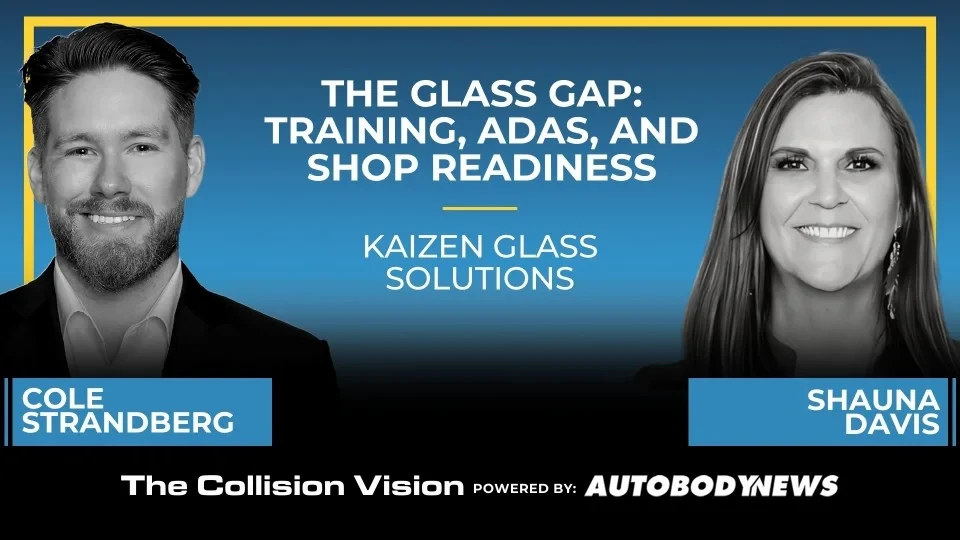
A recent episode of The Collision Vision featuring Shauna Davis, founder and CEO of Kaizen Glass Solutions, offered collision repairers a timely look at why auto glass can no longer be treated as a disconnected specialty.
Davis, whose career began in a dealership service department and later evolved through auto glass training, sales, and leadership roles, built her company around one core idea: collision shops need more independent, practical support if they want to bring glass work in-house the right way.
Her conversation touched on training, liability, ADAS, cycle time, and recruiting, which are all topics that increasingly matter to body shops navigating tighter margins and more complex repairs.
Auto glass is no longer a side job
Davis emphasized that auto glass plays a far more critical role than many shops may realize, particularly as vehicle design and technology continue to evolve.
Modern windshields are not just barriers against the elements. They are structural components that help maintain vehicle integrity in a crash and play a key role in safety system performance. “They’re actually a big structural piece of a vehicle … it helps the roof from caving in on somebody when they have a rollover accident. It helps airbags deploy,” Davis explained.
Windshields have also become central to today’s advanced driver assistance systems (ADAS), housing cameras and other sensors that support features such as lane keeping and collision avoidance. Davis described them as “rolling technology,” noting how closely tied they are to the vehicle’s broader systems.
As a result, glass replacement is no longer just a standalone task. It is directly connected to vehicle safety, calibration, and overall repair quality, making it a much more critical part of the repair process than many shops may have historically considered.
Takeaway for shops: If you’re still treating glass as a simple remove-and-replace step, you’re behind. Every windshield job now touches safety systems and liability. That means you need tighter process control, better documentation, and a clear understanding of how glass work ties into calibration and final delivery.
Shops may be overlooking a revenue stream already sitting in their bays
Davis argued that for many body shops, the opportunity is already in-house.
Instead of outsourcing all glass work to sublet vendors, shops should look at the vehicles already coming through their repair process and evaluate whether more of that work can be retained internally. Glass may represent a logical expansion at a time when many repairers are under pressure to protect margins and find new revenue.
“It’s one of the best things that shops can do today,” she said.
Her broader point was not that every shop should immediately fire its glass vendor, but that owners should take a hard look at how often they are subletting glass-related work, how much they are spending, and what that is costing them in both revenue and control.
Takeaway for shops: Pull your last 90 days of RO data and calculate how much you paid out in glass sublet. Then compare that to what you could have billed. If the gap is meaningful, you’re giving away margin on cars already in your shop.
Cycle time is a major part of the equation
If a repair cannot move to the next step until a vendor removes or reinstalls glass, the shop is stuck waiting on someone else’s schedule. That becomes even more disruptive during busy weather events or seasonal surges, when glass vendors are stretched thin.
“Imagine peak season you have a hail storm that’s coming in your area, you have all these damaged vehicles and you’re waiting for the glass company that you’re working with to fit you in the schedule,” she said. “That just causes a major delay within days, maybe even weeks, too.”
Bringing at least some glass capability in-house can help reduce those delays, improve workflow, and give shops more control over repair timing.
Takeaway for shops: Audit where repairs stall if you’re serious about cycle time. Bringing even partial capability in-house can remove days from repair time.
Subletting does not eliminate liability
Another important takeaway from the episode was Davis’s blunt point on liability: even when a shop sublets the work, the vehicle is still being returned under that shop’s name.
That issue has become even more serious as windshields have become tied to ADAS performance. If a replacement or related procedure is done incorrectly, the shop may still be exposed to risk even if another vendor performed the physical work.
“So why not make sure it’s done correctly with your own people or yourself?” said Davis.
Outsourcing does not automatically mean risk has been transferred. In many cases, it just means the shop has less direct oversight over a critical repair step.
Takeaway for shops: If your name is on the invoice, you own the risk. Either verify your sublet partner’s procedures in detail or bring more control in-house.
Training is a bigger barrier than many shops realize
Davis said one of the biggest gaps she identified in the market was access to training, and how that training is delivered and supported over time.
She described an environment where many options are tied to specific requirements, whether that’s working for a company, becoming a certified shop, or attending product-focused training.
“A lot of training classes … you have to be a certified shop in order to go through a training program. You have to work for a company … or it’s a tool manufacturer that wants to do product training,” she said.
That structure, she explained, can make it harder for shops to simply learn the process and build confidence on their own terms. Her approach was built around creating an independent path, with an emphasis on meeting shops where they are and continuing to support them beyond the initial class.
“I really wanted to create a space that was independent of all of that… we will help you get where you want to be the right way,” Davis said. “Our support doesn’t end after the class is over … our instructors still answer the phone … they call them when they need help.”
For many collision shops, the challenge is learning the steps and understanding how to apply them in real-world situations. Davis said shops often have questions about tooling, materials, and process, but the bigger issue is having reliable guidance and support once they begin doing the work themselves.
Takeaway for shops: Don’t just send a tech to a class and expect results. Training works best when there’s follow-up, support, and real-world application.
Collision technicians are not incapable of glass work; they are just unfamiliar with it
Davis noted that hesitation around glass work is common among collision technicians, even though they routinely perform complex structural repairs.
“What’s funny to me … is that the body guys, they’re scared of glass,” she said. “You’re welding and you’re taking all these pieces and making sure that everything’s structurally sound … but a lot of them are terrified to touch the glass.”
The hesitation often comes from unfamiliarity rather than a lack of capability, she said. She explained that many of the challenges are tied to understanding proper procedures and tool usage, particularly to avoid causing damage during removal or installation.
“I wouldn’t say that there’s much of a gap,” Davis said. “I think it’s just the learning curve … learning how to do these procedures.”
For shops evaluating whether to expand into glass, that distinction matters. In many cases, the technical ability already exists within the team. What’s needed is the right training and experience to build confidence and consistency.
Takeaway for shops: Your technicians are likely more capable than you think. Start small, train properly, and build confidence before scaling.
Auto glass could become a stronger recruiting pathway
The episode also touched on workforce development, and Davis raised a point worth watching: glass could become a more attractive entry point for younger workers or new technicians.
Because many collision and auto tech programs spend relatively little time on glass, it remains an underdeveloped skill path. Davis suggested that for some recruits, especially those interested in technology, ADAS, and vehicle systems, glass may offer a compelling hybrid role.
It also presents a different kind of work environment than some traditional mechanical or body repair jobs, something that may appeal to a wider range of candidates.
For an industry still wrestling with technician shortages, that is not a minor point.
Takeaway for shops: If you’re struggling to hire, stop chasing the same talent pool. Glass and ADAS-related roles can attract a different type of employee — especially younger, tech-oriented candidates.
Collision and glass are moving closer together
If there was one larger theme running through the conversation, it was this: the line between collision repair and auto glass is getting harder to justify.
“Glass and collision are finally working together again,” Davis said.
As vehicle technology evolves, glass is becoming more integrated into diagnostics, calibrations, structural repair planning, and delivery quality control. Shops may still choose to outsource some or all of that work, but the old idea that glass is separate from collision is becoming harder to defend.
That shift is creating both pressure and opportunity. Shops that ignore it may find themselves increasingly dependent on outside vendors for a critical part of the repair process. Shops that evaluate it carefully may find a path to better workflow, more revenue, and tighter control over repair quality.
Takeaway for shops: The industry is moving toward integrated repair, whether you’re ready or not. The longer you treat glass as “someone else’s job,” the more control and profit you give up.
Final takeaway
Davis did not argue that every body shop should immediately become a full-service glass business. Her recommendation was more practical than that: look closely at what you are already subletting, what it is costing you, and whether bringing some of that capability in-house makes sense.
That kind of evaluation may be especially important now, as repair complexity rises and shops look for ways to improve both profitability and operational control.
For collision repairers, the podcast’s core message was clear: glass is no longer someone else’s problem.



Lisa McArdle