



At a time when the industry is struggling to attract new talent, high school auto body programs nationwide are struggling to recruit students, source up-to-date tooling and equipment, and secure support from body shops. According to a joint study by CCC Intelligent Solutions and the Collision Repair Education Foundation (CREF), many students are interested in joining the collision repair industry but lack access to information about the job, the industry, or opportunities for advancement.
Ben Sikora is an example of a passionate and dedicated instructor who balances teaching, industry involvement through his students’ participation in the SkillsUSA program, and partnering with local body shops.
With a background as a shop owner, structural steel technician, and plastic repair specialist, Sikora leads the two-year auto body program at Santana High School in Santee, Calif. He teaches four classes a day: two dedicated to first-year students and two for those in their second year. In addition, he teaches an auto body class as part of the Career Technical Education (CTE) program, where students explore five technical pathways.
Students in the auto body program can participate in their sophomore/junior years or their junior/senior years. Those who start as sophomores have the option to become teaching assistants during their senior year.
While there is a maximum of 38 students in each class, Sikora said that it can be challenging to have so many. Not only is it costly to have a full set of tooling for everyone, but ensuring their safety is also a priority.
“Having that many kids in one teacher shop can be a little hectic,” explained Sikora. “By limiting the number to about 26, they get a higher-quality experience.”
The Fix Auto owner who got Sikora the job
One of the program’s biggest advocates is Gary Leger, owner of Fix Auto Poway, Fix Auto Lemon Grove and Fix Auto Downtown San Diego in Calif.
“He is extremely supportive and has hired multiple students of mine,” said Sikora.
The two met and became friends when Leger brought his 1970 Bronco to Sikora’s shop for restoration. Through Leger’s involvement with the Santana High School auto body program, he learned in 2021 that the teacher would not be returning and highly
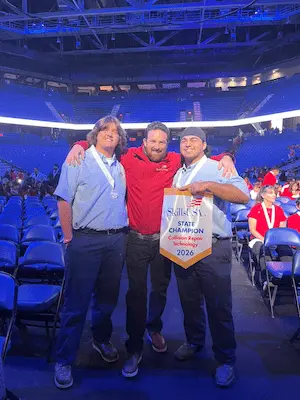
Abraham Espino (right) placed first in the SkillsUSA competition this year in the category of Collision Repair Technology and received a UTI scholarship, while Ben Siekert (left) received Silver. Last year, Siekert received Gold and Espino received Silver.
recommended Sikora be hired in his place.
When Sikora took the position that year, he found that the body shop was run down. “There were no tools, no equipment, and no cars to work on,” he recalled.
In response, he reached out to the industry for support and has spent time since then growing the auto body program. A new shop is being built next to the existing one and construction is scheduled to be completed before the fall semester.
Although the auto body class is popular, Sikora has found that about 10% or less take it seriously. “The rest of them don't necessarily want to do this for a living,” he said. “They took the class because it sounded cool.”
Many students sign up for the program with no outlook for the future or have an interest in auto technology, which isn’t offered. “It's my job to convince them that this is a good route to go with your life,” he said.
On the first day of class, Sikora tells students that it doesn’t matter what their ultimate career will be because they will be learning transferable employability skills. This includes real-world hands-on experience, soft skills, and professionalism. They are also exposed to shop owners and technicians in the field.
“We like to call them grown-up listening, working hard, and being on time,” he explained. “All those things are what's really important.”
Sikora works hard to educate students so they can work in shops and join a post-secondary trades program while letting them know their value, even if they don’t fit a certain mold. “My number one goal coming in here was to replace myself, not as a teacher, Ben, but as the technician,” he shared.
From run-down shop to recruiting pipeline
To help find qualified technicians, Sikora advises shop owners and managers to find a local auto body program and get involved. That doesn’t necessarily mean financial support. “Obviously, with public education, we're always looking for money, but what can be more valuable to the students is their time,” he said.
Sikora often finds that having a third party come in to help teach a lesson, be a guest speaker, and/or evaluate their work is invaluable. “The students love showing off their work to real industry professionals,” he noted.
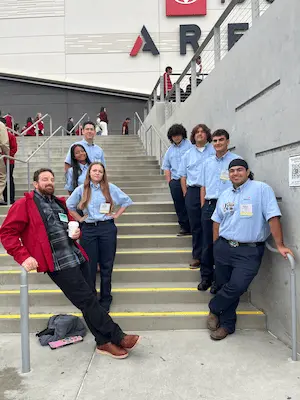
Ben Sikora and students at SkillsUSA: L from bottom to top: Summer Milburn, Ariel MacPherson, Aspen Van
R from bottom to top: Abraham Espino, Jerry Vanderhyde, Ben Siekert and Aaron Sapien.
He acknowledged that it can be difficult for owners and managers to leave the shop. “We're all trying to stay in business and support our families,” he said.
However, he said the potential benefit is that the shop owner/manager might meet a student who works for them for the next 20 years. “Help us hook these kids,” he emphasized. “You have to recruit them when they’re young.”
Sikora also recommended providing opportunities for new entrants to learn and grow.
“The days of hiring an 18-year-old kid out of high school and having them sweep floors and wash cars for two or three years are over,” he said. “If you are not willing to invest in these kids, they will go somewhere else.”
Leger pointed out that the workforce has been aging out for quite some time and there is a great opportunity to attract the younger generation by showing them that any skilled industry can be highly lucrative and very fulfilling. Many of Sikora’s students have worked in Leger’s shops, including Abraham Espino, who has helped at the Lemon Grove location.
“I wish I had more time to spend with the kids but I do what I can and thoroughly enjoy it,” he said.
Sikora's pitch: skip college, learn to take criticism
Sikora’s message to students is direct. “You have to put in the time and the hard work,” he said. “You're not going to make $100,000 your second year working in a body shop.”
To be successful, he recommended that students expand their skills while learning how to take criticism. “Our workforce is going away and the opportunities have never been better,” he said. “You just have to take the bull by the horns and go for it.”
He has observed students often being told that they need to go to college.
“We still have that crazy mindset that college is the destination. It is not,” he shared. “It's a good tool for some of our students, probably only about 20% of them.” He also pointed out that with the increasing use of AI, many jobs won’t exist. “Someone needs to be the voice telling these kids it's OK to not go to college,” he added.
“I believe it's very important to educate the school, parents, and kids that college is not needed for everyone,” added Leger. “There are many skilled positions in our workforce that are high paying and extremely respected.”
Three competitions, two medalists, one UTI scholarship
This is the third year Sikora’s students have taken part in the SkillsUSA regional event in California. There are three separate competitions as part of the program, all of which are eight hours long: collision repair technology, automotive refinishing technology, and collision damage appraisal (estimating).
In 2024, two of Sikora’s students competed in the automotive refinishing part of the competition. Sikora found it was out of date and didn’t align with the national-level competition.
As a result, he and the other instructors talked to the organizers and suggested areas of growth. Although the schools compete against each other, the instructors are working together to raise the level of competition for everybody and make it the best program it can be.
This year’s state competition was a four-day event held at San Bernardino Valley College in San Bernardino, Calif. Four of Sikora’s students competed in the refinish category, held at the PPG Business Development Center in Ontario, Calif., and three competed in collision repair technology.
“Saturday is competition day and it is the hardest those kids have ever worked,” said Sikora.
Last year, Ben Siekert received the Gold medal, a scholarship to the Universal Technical Institute (UTI) and the opportunity to advance to the national competition. Abraham Espino received the Silver medal. This year, Espino placed first in the SkillsUSA competition and received a UTI scholarship, while Siekert received Silver.
“They're good buddies and they've been in class together, so they're going to go up there together to UTI in the fall and be roommates and take all the classes together,” said Sikora.
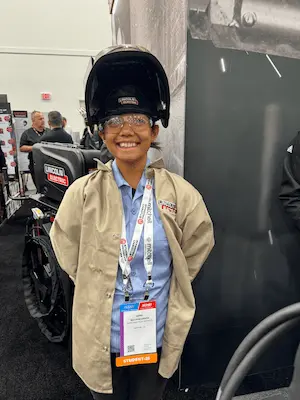
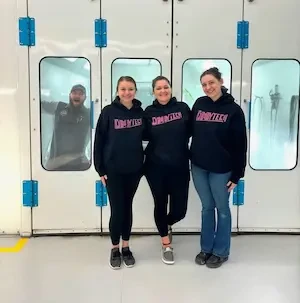
Ariel MacPherson, a student in Santana High School's auto body program, during the SEMA Show.
In addition to the possibility of receiving a scholarship, Sikora said the competition is primarily focused on giving students the opportunity to get out of the classroom and experience the professional side of the industry. Not only can they network, but they can also see how everyone dedicates materials and time to make it a worthwhile experience.
“It's something that your typical high school kid would never know exists,” he said.
Sikora strives to give all his students an opportunity to participate in SkillsUSA. Part of his recruiting technique includes showing pictures from the competition and the students smiling with their medals. He tells his classes that they all have the potential to be there.
With five students interested in taking part in the next competition and only three spots available, Sikora will hold an internal competition to decide who will progress to the regional event.
An important part of being able to participate in the competition is to raise enough money to attend. Industry involvement made that possible.
Lauren Morello, manager of Bridgewater Collision Repair in New Jersey, and Rich Porcelli, vice president of operations at Porcelli’s Auto Center in Rhode Island, were searching for programs in the San Diego, Calif. area that would make a meaningful impact on students as part of the AkzoNobel Acoat Selected Titanium for Tomorrow. Leger from Fix Auto and Arica Carranza, regional business director from CCG, encouraged them to connect with Sikora at Santana High School.
“After speaking with Ben and learning more about the program’s history, we were genuinely inspired by his commitment and perseverance,” said Morello. “It was clear to Rich and me that this was more than just supporting local students; it was also supporting the resilience and the future of our industry.”
Morello and Porcelli worked closely with Ben to understand where they could make the biggest impact.
“His focus was immediate — his students,” recalled Morello. “He talked about what it means for them to earn a spot at SkillsUSA and the pride that comes with competing at that level. That really stuck with us.”
With the support of other body shops, they raised $6,378.54 to provide students with the opportunity to compete in SkillsUSA and to build on the momentum Sikora and his students created. “It was great,” said Sikora. “It exceeded our fundraising goal for the competition this year and we were able to bring the kids there, brag about them and have them network with so many people.”
“Supporting students and getting involved with high school auto body programs is vital to the long-term health of our industry,” noted Morello. “Many students aren’t fully aware of the opportunities available to them through trade careers, and that path is often overlooked when they’re deciding their future.”
Morello said it also brings visibility to those opportunities and opens doors for students who may not otherwise have considered this field.
From a business perspective, they said it’s also an investment in the future workforce.
“Today’s students are tomorrow’s technicians, and by helping provide strong educational foundations and real-world exposure, we’re strengthening the talent pipeline,” said Morello. “With many experienced technicians nearing retirement, it’s more important than ever to prepare the next generation to step in and continue moving the industry forward.”
Stacey Phillips Ronak