
Progressive's new "Accident Response" feature is already tracking crashes for 1.5 million policyholders through smartphone sensors, potentially compressing the timeline between collision and first notice of loss for repair shops nationwide.
The Mayfield Village, Ohio-based insurer partnered with telematics provider Cambridge Mobile Telematics (CMT) to launch the AI-driven crash-detection service Nov. 18, which automatically contacts drivers after detecting likely crashes to offer towing, emergency services and claims filing assistance, according to a CMT press release.
The service is free to download and activate, though actual towing and emergency service charges remain subject to policy terms. The offering is not available in California, where telematics-based insurance pricing and data collection face ongoing regulatory scrutiny.
How the Technology Works
The system uses CMT's DriveWell Fusion platform, which aggregates data from smartphones and in-vehicle sensors to detect collisions. When the platform detects a likely crash, it automatically reaches out to the driver through the Progressive app to coordinate immediate response and begin the claims process.
The platform can detect a crash and reconstruct collision details within minutes for claims staff, accelerating adjuster deployment and claim processing. For insurers, connecting this data directly into the claims process promises lower adjuster cycle-time and improved driver satisfaction, according to a Yahoo Finance analysis of Progressive's technology strategy.
Telematics Market Growth Signals Insurer Strategy Shift
The launch arrives as insurers rapidly expand telematics capabilities across their portfolios. The global insurance telematics market reached $6.8 billion in 2024 and is forecast to grow at an 18.9% compound annual growth rate through 2034, according to Global Market Insights. Separate projections from Market.us place 2024 market size slightly higher at $7.2 billion, with growth to over $41 billion by 2034—a 19.1% CAGR reflecting similar bullish forecasts across analyst firms.
Progressive is not alone in expanding telematics capabilities. GEICO has publicly acknowledged making "rapid strides in telematics" as it competes for market share, according to Berkshire Hathaway executives at the company's 2025 annual meeting.
For collision repair operators, this trend signals that telematics-driven claims management is moving from pilot programs to mainstream deployment. Shops without digital intake infrastructure or insurer portal integration may find themselves deprioritized in carrier referral networks. As carriers gain richer crash-behavior data, their claims-management strategies and repair-payment frameworks may shift, potentially impacting shop-insurer negotiations and network preferences.
Faster FNOL Could Reshape Shop Scheduling
Near-instant crash detection and automated claim initiation will compress the first notice of loss timeline for Progressive claims. That compression could influence shop scheduling patterns, insurer-shop communications and overall repair-cycle timelines.
Automated crash detection may drive more immediate tow truck bookings, vehicle drop-offs and repair scheduling. For collision centers, this could translate into heavier periods of intake volume or fundamental changes in drop-off patterns. Shops that can align with insurer or OEM telematics data streams could gain speed advantages or priority placement in referral networks.
This shift places new demands on intake speed and digital infrastructure. Shops with streamlined digital intake, insurer portal integration and smartphone scheduling capabilities will be better positioned to handle accelerated claim flows. Those lacking these capabilities risk falling behind in cycle-time metrics that increasingly influence insurer network decisions.
ADAS Calibration Readiness Becomes More Critical
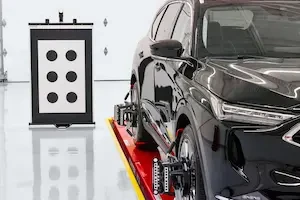
As insurers and telematics services increasingly detect and categorize crash severity in real-time, collision centers face mounting pressure to reinforce capabilities around ADAS calibration, OEM repair compliance, and post-crash diagnostics.
Rapid crash detection compresses the time window between collision and vehicle arrival at the repair facility. Given the rising complexity of advanced driver assistance systems and manufacturer-specific repair procedures, shops must maintain efficient pre-repair scanning processes, diagnostic workflows and calibration sequencing to avoid bottlenecks.
Shops with documented ADAS compliance protocols and direct integration into insurer FNOL systems will gain advantages as carriers steer more traffic through preferred networks. The ability to match insurer speed expectations while maintaining OEM repair standards has the potential to become a key differentiator.