



Radar or camera misalignment, incomplete calibrations recorded as complete, and lack of documentation are three common risks related to advanced driver assistance systems (ADAS) that body shops can overlook during the course of collision repairs, according to Joel Adcock, director of partnerships and business development for ADAS calibration software company Revv.
Speaking during an Automotive Service Association (ASA) webinar Sept. 17, Adcock added that other risks include customers being unaware that their ADAS is no longer properly functioning, as well as silent system failures, referring to systems with degraded safety despite no warning lights or codes.
Adcock called on shops to be mindful of these risks, especially because a missed calibration can cost shops in excess of $1 million in legal bills or settlements, and because ADAS are installed in a growing majority of on-road vehicles.
“If you don't think ADAS is in your shop now, it certainly will be in the very near future,” Adcock said.
An average lawsuit or settlement can cost shops $200,000 to $1 million or more when they skip ADAS calibration for whatever reason, and nearly half of all U.S. shops miss required post-repair calibrations, he noted, representing high liability for repair shops.
Missed calibrations most frequently are associated with windshield replacement, fender removal and installation, and suspension and alignment repairs, though such errors can also relate to bumper repairs, side mirror replacement and roof repair, according to Adcock’s research.
He presented a five-pronged ADAS calibration checklist to help prevent post-repair system failures. Those five elements are:
• Pre-Scan – Assessing what was wrong with ADAS before the repair, including by capturing sensor data.
• Functional Test – Manually confirming system behavior and checking ADAS availability on infotainment menus.
• Post-Scan – Verifying no introduction of new diagnostic trouble codes and validating integrity of programming of modules.
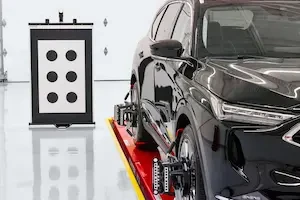
• Performing a static (in-shop), dynamic (on-road), or hybrid ADAS calibration, depending on OEM guidelines, and confirming success with documentation.
• Final road test when possible, which is particularly important for lane departure warning, adaptive cruise control, and lane keeping assist functions.
Attaching documentation of successful calibration, reasons for calibration, and environment where calibration was performed can help shops avoid undocumented system failures, Adcock said.
“Calibrations aren't necessarily complete without verification. So, completion doesn't necessarily equal success,” he added. “It’s important to do that road test and verification.”
The number of lawsuits dealing with ADAS calibration rose from three in 2018 to 61 in 2024.
“I can only surmise that it's going continue to grow and increase,” Adcock noted. “I’m hearing it a lot more on social channels and podcasts and things that I listen to in terms of having more legal experts getting further into this, and understanding exactly the ramifications of miscalibrations and how it could potentially be a huge risk for a lot of folks involved.”
Consumers have needed more than 4.3 million ADAS calibrations so far in 2025, and more than 85% of new vehicles have at least one active ADAS feature, so ADAS will become a more important focus area for shops in the future, Adcock indicated.
It will behoove shops to educate their customers about the ADAS work done on their cars as these systems become more commonplace and because customers primarily use ADAS for their safety benefits.
“Include calibration explanation in your estimate,” Adcock said. “Talk about how a static calibration is done; talk about what a dynamic calibration is; talk about … doing that road test verification just so that you're doing a quality control check and making that part of the conversation, if for nothing else, I think your customer will appreciate that.”
He added, “More than likely, they're going to say, ‘Hey, we haven't heard this from any other body shop that we've gone and got estimates with. We want to go with you guys.’”




Brian Bradley