


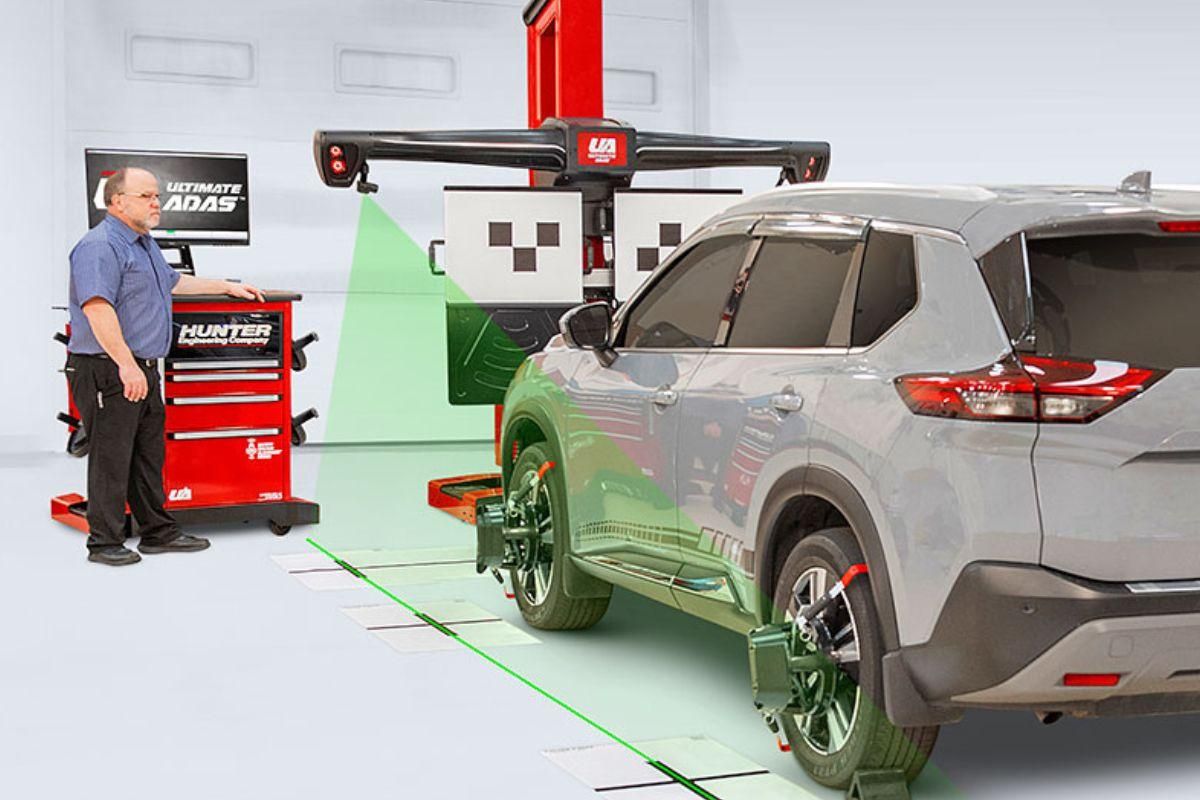
Shops looking for ways to improve process efficiencies and their bottom lines can look into equipment that could bring in-house two services that are part of many repairs: ADAS recalibrations and alignments.
David Henry, a senior sales development manager based in the training center at Hunter Engineering’s global headquarters in Bridgeton, MO, recently appeared on an episode of The Collision Vision podcast, driven by Autobody News and hosted by Cole Strandberg, to talk about how that equipment can play a critical role in modern day repair planning, where shops can fall short when it comes to calibration and what smart operators are doing to tie all of this together and stay ahead.
Alignments are frequently a “check in the box” for collision shops, Henry said, and usually the last step in a repair plan, which means it sometimes delays delivery of the vehicle, particularly if sublet to a third party — potentially affecting customer satisfaction.
More shops are looking at bringing alignments in-house, Henry said. While profitability is always important, the main reason is improved cycle times.
Purchasing alignment equipment means the shop can “do that [post-repair] inspection with that blueprint of the alignment machine and make sure everything is right before they finish that job,” he said.
Some shops hesitate to purchase that equipment because they don’t want to lose the production space. However, Henry said, shops that don’t are giving up control of the repair quality.
“That's my biggest concern with the auto body shops,” Henry said.
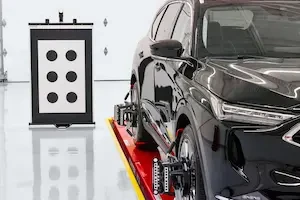
By purchasing an alignment machine, like Hunter’s HawkEye Elite, shops can inspect a vehicle’s suspension and undercarriage as part of the initial estimate process, ensuring a more complete repair plan.
“That's going to save us a lot of time instead of sending it to a shop, after we have all the things done, and then finding those problems,” Henry said.
It also saves shops time when they no longer have to return a vehicle to a third-party vendor to correct mechanical repairs. Henry said “most of the people I talk to in the aftermarket repair or collision centers” that use outside shops have told him they have to do that often — for instance, if the steering wheel feels a little crooked.
“Think about the time involved, and the steps,” Henry said. “It involves going back and forth between those shops. Whether you use a rollback tow truck to communicate back and forth, or you use to your technicians, maybe to transport that car back and forth multiple times. Man, this is the time we need to jump into alignments, get those things in there so we can cut down those labor costs. Not only that, but decrease those cycle times.”
Trends in ADAS in Collision Repair
As ADAS becomes more complex — and prevalent — in new vehicles, collision shops need to be prepared to repair those systems.
Documenting ADAS recalibration procedures is crucial, Henry said, but not all third-party vendors provide that. However, the shop’s “stamp of approval” is on the third-party vendor’s work when it delivers the vehicle to the customer.
“If you have a competent mechanical person in your shop and you have the aptitude to get it done, I think you should jump into ADAS in your shop,” Henry said. “Maybe you tiptoe into it, maybe just doing some dynamic resets to start with, and then jump into the static.”
Henry said nearly every shop should consider doing ADAS recalibrations in-house, unless they repair a very low volume or are in a small market that doesn’t see many newer vehicles.
There’s been a “big change” in facility requirements to perform ADAS recalibrations in-house, he said.
In the past “we had to have a perfectly level concrete slab. We had to have a perfectly clean or stale environment for these resets,” Henry said. “But we found out that, with some of the tools that we're having now and some of the complex measurements we can do, we can make adjustments for uneven floors. We find the live plane of the car. We can make sure we're setting those targets properly without that pristine environment.”
Bringing ADAS equipment in-house also means shops can be proactive — rather than reactive — in their repair processes, by being able to anticipate which sensors or other parts may need to be replaced or recalibrated before beginning the repair.
Henry said performing pre-repair inspections can contribute to streamlining the entire repair.
“I think preparation and planning processes is a big part of it,” he said. “My big thing is processes — the less steps to get the same job done, we're going to be better at it.”
When to Invest in New or Upgraded Equipment
Henry said shop operators should consider purchasing new or better equipment if they can ensure it will increase productivity: “If there's enough time savings in the process that it makes sense to invest.”
Some equipment is required to achieve certain OEM certifications, Henry acknowledged. In that case, it makes sense to invest in it if the shop sees a certain number of that OEM’s vehicles.
Henry said Hunter Engineering has business consultants who can help shop operators calculate ROI on equipment purchases.
“The big thing is to look at the big picture,” he said. “The average ADAS reset is about $240. If we look in the past, that used to be a couple-hour procedure. But with some of the new technology we have out, target placements can be done in a matter of minutes and then the reset. So…if we're doing, say three, four ADAS resets a week, we probably need to look at getting into the business.”
Henry said one of his customers owned a large body shop in Arizona that provided collision repairs for a lot of local dealerships. The shop would send vehicles to the dealerships’ service centers for alignments, until the owner invested in his own alignment machine to “eliminate that hiccup in his process.”
Later, the owner decided to invest in Hunter’s Ultimate ADAS for that shop, and moved the alignment machine into one of his slower shops.
“Now he's doing alignments and ADAS with the same machine,” Henry said. “He told me he paid off that alignment machine in a matter of months — not even years. So he had no problem investing in Ultimate ADAS, where he can do alignments and ADAS with the same machine. It was just an amazing turnaround when he got into alignments and now into ADAS.”
Henry said Hunter’s business consultants talk shop owners through processes that could improve efficiency. There’s also an ADAS portal on Hunter’s website, hunter.com, that examines processes that “help the collision centers be more profitable and more proactive on these resets, and really grab the bull by the horns and make sure we're prepared for the cars — not only that are in our shop today that we might be subbing out, but the ones that are coming in tomorrow,” Henry said.
The key to improving processes in a shop is to break them down into simple steps, he said, from the best way to receive a customer, write an estimate and so on throughout the entire repair.
Then operators can look at each step and figure out how to make it as efficient as possible.
“Sometimes it's stocking more fasteners. Maybe it's making sure we have the right guys at the right time when that car needs a certain process,” Henry said. “Look at everything as a process. Break those processes down into palatable steps and then just refine them. Find everything that'll make you better.”
Hunter offers in-person training and support to its customers, but it also offers an online Learning Management System on its website that’s available to anyone in the automotive industry.
Strandberg asked Henry what would be the “one mindset shift that you could recommend to shop leaders across the country to improve their efficiency.”
“I think we just need to open our mind, and then listen to listen to other ideas,” Henry said. “Don't be afraid to change and try something new.”
He said shop owners should also be continuous learners, who are “always pushing the boundaries and testing new procedures and processes, just to make sure you're better every day.”






Abby Andrews