

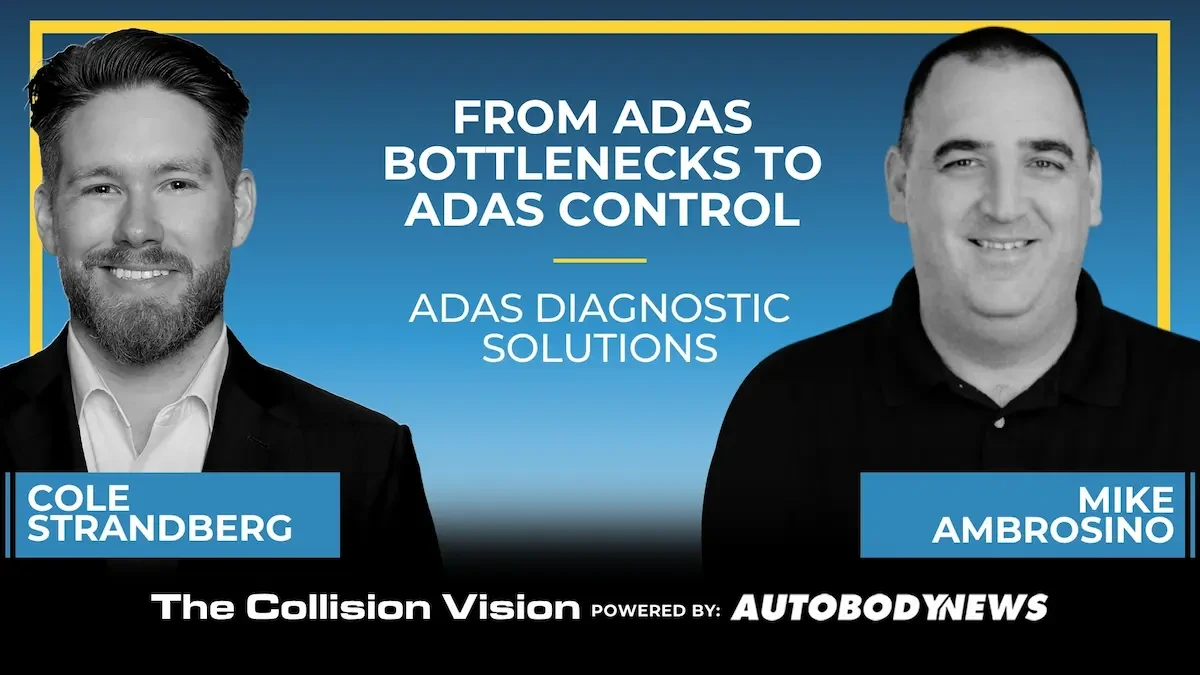
After nearly 25 years in the collision industry, Mike Ambrosino has worn a lot of hats: Independent appraiser, estimator, and, by his own description, the technology guy behind the shop's IT, scanning, and eventually its ADAS operation. It was that technology focus that helped push him into bringing calibrations in-house.
That idea has grown into ADAS Diagnostic Solutions, an operation now doing about 20 calibrations a day. On a recent episode of The Collision Vision, Ambrosino gave his unique perspective on what’s actually happening on the ground and what’s required to do the work correctly.
ADAS Must Be Threaded Through the Entire Repair Process
One of Ambrosino’smost consistent themes throughout the conversation was that ADAS needs to begin the moment a customer walks through the door. That means informing customers upfront that repairs may take longer and could require added mileage for dynamic calibration.
During blueprinting, technicians need to identify which systems were directly damaged, and which are triggered by disassembly itself. Part sourcing decisions carry ADAS implications too: some aftermarket headlights don't produce the brightness required for windshield camera systems to function correctly, and certain aftermarket bumper covers can interfere with radar signal.
Even paint, body work, and reassembly decisions need to account for ADAS, including whether a bumper should stay off the vehicle until calibration is complete.
Key Takeaway: ADAS awareness has to start at vehicle intake and stay present through every stage of the repair, from customer conversation and blueprinting to parts sourcing, body work, and reassembly. Treating it as a final step is one of the most common and costly mistakes shops make.
You Have to Go All In for ADAS
When asked why dabbling with ADAS is more dangerous than either going all in or subletting to a specialist, Ambrosino’s pointed to the gap between proficiency and understanding.
"I think there's a difference between a technician who can just run a calibration and a technician who understands why it matters what they're doing. You want to know why it matters, how the system works, what you can do to prevent problems in the setup and the calibration,” he said.
Getting educated before picking up the equipment isn't optional. Jumping in without knowing what you're doing risks messing up systems. That knowledge comes from proper training, having the right equipment, and having the right resources to fall back on when something doesn't go as expected.
Key Takeaway: Shops that approach ADAS calibration without proper training, equipment, and process put themselves and their customers at real risk. Going all in means understanding the why before touching the equipment, not just learning the steps.
Documentation Is Your Insurance Policy
Shops tend to think about calibration documentation primarily as a billing tool, but Ambrosino reframes it as liability protection first and payment enablement second.
The goal is to be able to prove that the work was done correctly and that the systems were confirmed functional. ADAS photographs the vehicle's VIN, license plate, and odometer on every job, documents the full calibration setup, and captures results for both successes and failures.
On failures specifically, Ambrosino made a point that resonates across the industry. Shops shouldn't fear failure results; they should document them, investigate the cause, and correct it. Proper documentation of that process is exactly the record a shop needs if questions ever arise down the road.
"That’s why calibrations are in place – — to correct the problems,” he said.
Key Takeaway: Documentation isn't just how you get paid; it's how you defend your work if a vehicle is ever involved in an incident after leaving your shop. Capture everything: vehicle identification, setup photos, and calibration results including failures. A documented failure that was investigated and corrected is evidence of a thorough process, not a shortcoming.
Space Requirements Are Still Significant
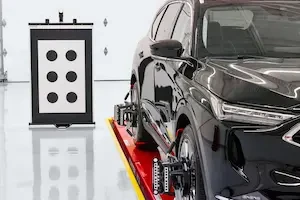
When asked whether space requirements for ADAS are evolving, Mike's answer was honest: not really. Portable systems continue to improve, and manufacturers are working to build flexibility into their setups, but a proper calibration environment still demands a large, flat, level floor; controlled lighting; and enough depth and width to place targets accurately.
“You want to be able to set up a very accurate setup for your calibrations,” said Ambrosino. “Just because you have a successful calibration doesn't mean that it’s a correct calibration. If you don't have a level floor, you could be getting a successful calibration but now that camera’s aiming a few inches to the right or up ... and down the road 200 meters is going to cause a problem with that system.”
Key Takeaway: Space remains one of the most significant barriers to in-house calibration, and the requirements haven't shrunk as much as some shops may hope. A dedicated, properly configured environment is what separates a calibration that passes from one that's actually correct.
Build the ADAS Process Before You Buy the Equipment
When asked what should be true before a shop brings ADAS capability in-house, Ambrosino's answer was unambiguous: the process needs to come before the equipment.
That means having a system in place to identify calibrations, know where certain repairs need to happen, and understand which parts need to be ordered before the first calibration is ever attempted in-house.
His warning for shops that skip that step was direct: trying to attack everything at the end of the repair without the process already in place is going to create chaos.
“Whether or not you’re doing it in-house, you need to have that process in place to identify calibrations, to know where certain repair can be done, where certain parts have to be ordered,” Ambrosino said. “I think before you start doing the calibrations, that process needs to be there so that when you do bring the equipment in to do the calibrations yourself the process is just going to flow.”
Key Takeaway: The equipment is the last thing you bring in, not the first. Build the process for identifying and managing calibrations on every job before you ever pick up the tools —, whether you're planning to go in-house or not. Shops that reverse that order tend to find themselves overwhelmed at exactly the wrong moment.
Technician Development: Culture Over Credentials
ADAS has pulled calibration technicians from body shops, mechanical backgrounds, and, in the early days, people who had never worked on a car. Mike was candid that the green technicians were easy to train to the process. But things got harder when diagnostics became more advanced and the team didn't yet have the depth to handle it.
That pushed ADAS to evolve how they hired, bringing in trained technicians from body and mechanical backgrounds who didn't have ADAS experience yet, and teaching the ADAS side from there. The bigger priority was building a team environment where knowledge compounds. Ambrosino said he'd rather have multiple technicians working together on a job than one working alone, specifically so that learning is always happening.
“We want learning to be happening every day in the shop so that we get better as a team,” Ambrosino said.
Key Takeaway: Background matters less than the ability to learn and the environment you put people in. Building a culture where people learn from each other every day is what turns a calibration team into a real diagnostic operation.
The Fundamentals
The takeaway across everything Ambrosino shared is straightforward: process before equipment, training before tools, and documentation as protection rather than paperwork.
That means starting the ADAS conversation at intake, not at the end of the repair. It means building a team that understands why calibrations matter. It means documenting every job, and recognizing that a calibration that passes on the screen is not automatically one that’s correct.
As Ambrosino said, it all requires a process and a committment to doing the work correctly. Shops that internalize those ideas are the ones best positioned.





Lisa McArdle