

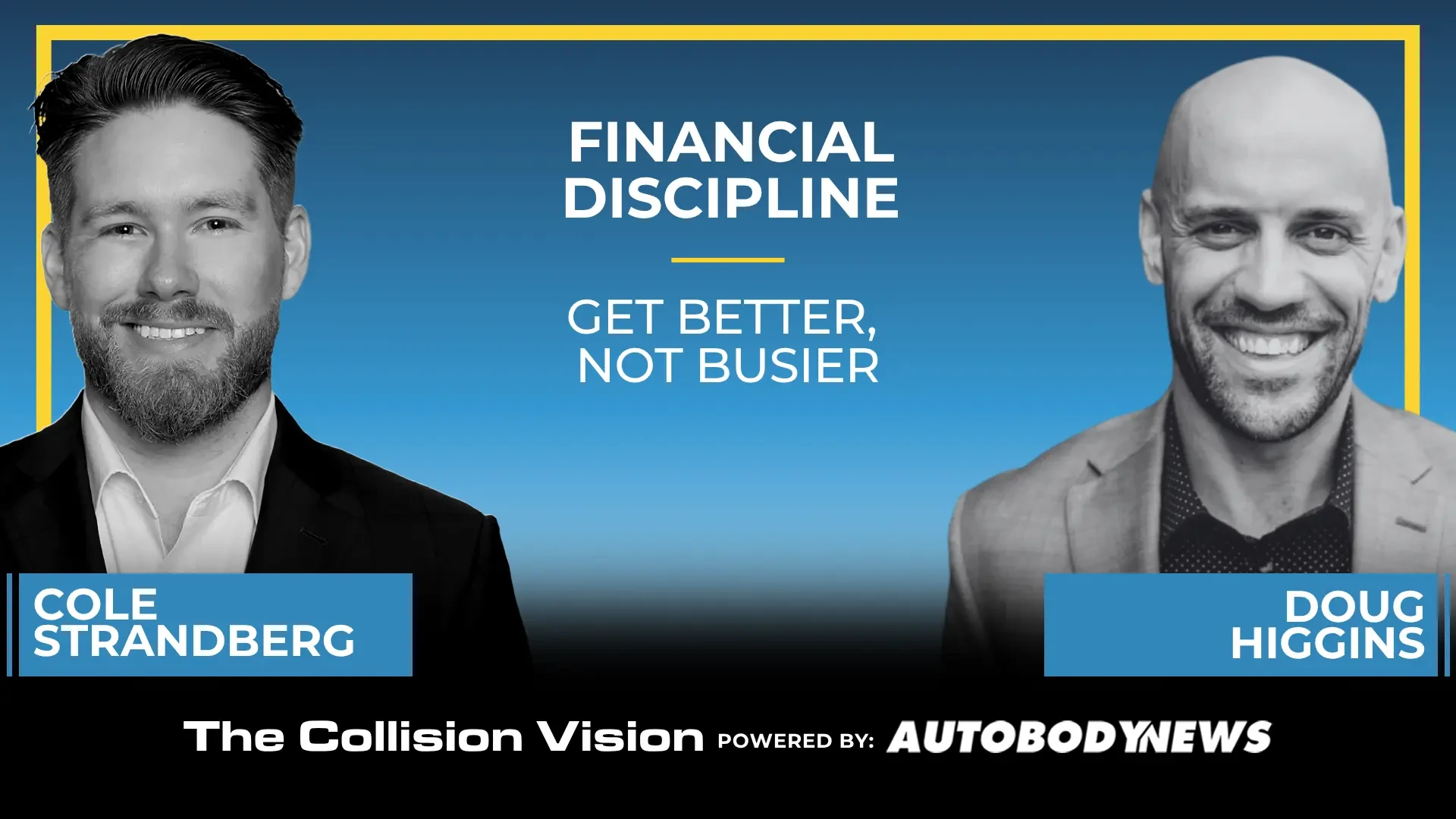
On a recent episode of The Collision Vision, host Cole Strandberg sat down with Doug Higgins, founder of Collision Advisory and former CEO of TAG Auto Group.
Before entering collision repair, Higgins spent more than a decade at Kroger, where he rose to CFO of the grocer’s Midwest division and later led strategic finance work at its Cincinnati corporate office. He then joined a multi-location collision group as CFO and later served as CEO.
On the episode, he discussed financial discipline in collision repair, where shop numbers fail to line up, and why he believes independent operators are well positioned right now.
Planning is the biggest gap Higgins sees in collision
Asked what stood out when he first looked at how shops were run financially, Higgins said he noticed it right away. “You don’t know what to focus on that has the most impact,” he said. “That right there translates to not having a budget oftentimes because that budget should be a product of .... what your strategic goals are.”
He described working backward from one-, three-, five-, and 10-year goals to an annual revenue target, then splitting that target across 12 months using two or three years of history to account for seasonal swings between quarters.
“From what I’ve seen that is the biggest opportunity ... simply that planning function that is often pushed by someone like me in an organization ... by a CFO,” Higgins said. He added that accounting-focused staff may want a budget, but it often isn’t strategic.
He admitted he faces the same challenge running his own company, borrowing a friend’s term for the condition of spotting too many opportunities at once. He said he looks at “all these 50 opportunities” and asks himself, “which one do I want to do?”
Higgins said owners also struggle with a more basic question: what they want to be doing every day. “We need someone to ... push us and say, ‘Hey, look around the corner and let’s plan for what’s coming or what we don’t know is coming in some cases,’” he said.
Key takeaway: Higgins said a strategic budget, built backward from long-term goals, is the biggest gap he sees in collision businesses.
Shop management systems and the books often tell different stories
Higgins said he is in a discovery phase with a handful of shops, and the mismatch he has found surprised him. “The gap between what their management system is telling them and what their financial system is telling them is massive. It is a just a canyon between those two things,” he said.
As an example, he described shops whose management system shows a 33% parts margin while their financial system shows 23% or 24%. He said he asks those shops whether every part they order gets added to the repair order, and they admit they may miss a few. “When you go to pay the statement, that’s going to make it onto your financial system, and it’s missing from your management system,” Higgins said.
He said the problem is less pronounced at midsized operators and far larger at small shops. “I feel for these folks because they’re making decisions around one answer and it’s not the right one,” he said.
Higgins added that many of those shops work with a generalist accountant or CPA who produces correct financials but doesn’t connect the numbers back to operations. What’s missing, he said, is someone who can explain “the reason for that gap is this, you need to fix this operationally so that you can get a good answer in your management system so that these two things basically tell the same story.”
Key takeaway: Higgins said some shops he has reviewed show parts margins about 10 points higher in their management systems than in their financial statements, a gap he tied to parts left off the repair order.
Creative workarounds are worth building on
Asked where operators are doing well despite a difficult 2025, Higgins pointed to the problem-solving he sees across the industry. He described one group that isn’t paperless and has its calibration technician drive around each day, collecting completed repair orders in folders, and bringing them back to the central office.
He said the financial side of him sees an opportunity there, but he respects the approach. “I respect the fact that this industry and every entrepreneurial gritty organization solves problems in the most creative ways,” he said.
Higgins noted that with claim counts down in recent years, operators have been working every angle to find new business.
Key takeaway: Higgins said many growing shops have already solved their problems with workarounds, and the next step is taking those fixes to the next level.
Accountability loops turn a plan into results
Higgins said Andy, who built TAG Auto Group, had grown the business to 12 to 13-plus collision centers along with calibration, fleet, and towing operations before Higgins arrived. The challenge was translating a company-wide sales goal into targets for each shop across several acquired brands.
He said much of his work focused on how the leadership team operated. “We spent a lot of time working on how we work together as a leadership team and how to create accountability loops with, you know, down through operations,” Higgins said, describing company priorities as “rocks,” a term from the EOS framework.
He said every company priority eventually lands on operations, so goals have to be broken down and tracked at every level. “That planning piece of it is great, but if you don’t have the execution loops below it ... a spreadsheet will only get you so far.”
Key takeaway: Higgins said the work he is most proud of from his time at TAG was building that accountability structure, which he said came down to how the company operated.
Awareness is driving calibration volume
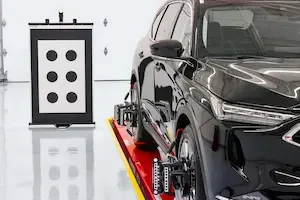
Higgins said calibration was a major reason he entered collision repair. When he researched the industry, he estimated roughly 7% to 10% of vehicles were being calibrated, a figure he put at 30 or 40%, today.
He attributed the growth more to awareness than to an influx of vehicles needing calibration. “I think they weren’t getting calibrated before and now they are because people are aware that it’s an issue,” he said.
Key takeaway: Higgins said rising calibration volume represented a clear business opportunity, and TAG expanded its calibration operation somewhat during his tenure.
Most shops need CFO thinking without a CFO salary
Higgins said he left TAG after Andy wanted to return to a more active role, and the two agreed to make the switch. His thesis for Collision Advisory came from his MSO experience: “If it existed at pretty mid- to large-sized MSOs, it probably exists at the mid- to low-sized MSOs and single shops almost assuredly.”
He described collision as an unusually complex business, citing multiple revenue streams, insurance dynamics, skilled labor that’s hard to hire and keep, and capital-intensive equipment. “It’s a manufacturing that is variable. You’re not manufacturing the same thing every time,” he said.
Higgins said his ideal clients typically generate at least $2 million to $3 million in revenue, and some of his current clients bring in $40 million to $50 million or more. He said single-shop owners face the same blind spots as MSOs but feel them faster because “there’s nowhere to hide.”
“Neither of them can really justify a full-time CFO at $250,000 a year. It just doesn’t work in the model,” he said.
Client needs vary, he said. Some have solid financial infrastructure and want help evaluating acquisitions. Others need to close the gap between their systems. One owner he is talking with asked him to look at AI tools for finance, concerned his controller wouldn’t raise options that could reduce the controller’s own role.
Key takeaway: Higgins said most collision operators need more financial sophistication than a bookkeeper provides but can’t support a full-time CFO salary.
Collision’s scale economics differ from grocery’s
Higgins said he believes many in the industry misunderstand the reasons behind consolidation. Drawing on his time at Kroger, he explained that grocery consolidated around economies of scale in purchasing. “What’s interesting about collision is those economies are somewhat minimized compared to grocery,” he said.
He agreed with Strandberg that administrative costs and paint purchasing offer savings at scale, but said parts tend to be regional. He said labor makes up about half of a collision operator’s revenue and is an area where scale efficiencies aren’t available. Strandberg said some industry leaders would challenge him on the labor point, and that he would push back on them.
Key takeaway: Higgins questioned whether collision will consolidate as far as some expect, since labor and parts don’t offer the scale advantages that drove grocery consolidation.
Independents have speed and local recognition on their side
Asked about the industry’s blind spots, Higgins said independent operators have more access to information and tools than ever. “The barriers to making decisions with information are now gone,” he said, adding that this applies to finance, legal, and technology alike.
He said independents hold two advantages over large operators. “They have massive speed. They can change something,” he said, contrasting that with how hard it was to change direction at Kroger.
The second, he said, is recognition in their local market. If independents “can figure out how to operate ... financially as efficiently or nearly as efficiently as the big guys, they’ll be there forever because they can connect with the customer in a different way than the larger operators can.”
Key takeaway: Higgins said independents who tighten their financial discipline can compete with larger operators by pairing that efficiency with faster decisions and local customer ties.
Higgins’ advice starts with a plan and books that match
Higgins’ message to owners throughout the episode centered on a few steps: set long-term goals and budget backward from them, make sure the management system and financial statements agree, and build accountability so plans reach the shop floor.
He said he publishes a newsletter every Friday through the Collision Advisory site and is active on LinkedIn.






Lisa McArdle