


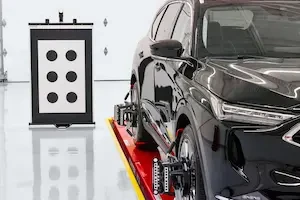
As Congress considers legislation that would expand independent repair shops' access to vehicle repair data, a separate industry effort is targeting a problem that access alone won'tsolve: getting shops to identify, perform and document Advanced Driver Assistance System(ADAS) calibrations consistently.
Interviews and public remarks point to different diagnoses of the same underlying issue, and to a live disagreement over how that documentation effort should be built.
A bill already dividing opinion on data access
The Motor Vehicle Modernization Act of 2026 (H.R. 7389) awaits a House floor vote. The bill cleared the House Energy and Commerce Committee on a 48-1 vote in May, but does not advance the broader REPAIR Act in its original form.
Instead, it codifies two existing industry agreements on vehicle data access, a 2014 agreement covering vehicles 14,000 pounds or less, and a 2015 agreement covering heavier commercial vehicles. The 2014 agreement requires independent shops to get the same diagnostic and repair information automakers give franchised dealers.
Aaron Schulenburg, the executive director of the Society of Collision Repair Specialists, has argued thatframeworkalready gives shops what they need. He pointed to OEM service portals and third-party aggregators such as Alldata and RepairLogic as evidencethe system functions in practice.
He previously told Autobody Newsthat repair businesses can subscribe directly to OEM information systems for calibration procedures, position statements, wiring diagrams, and diagnostic requirements. He said the statistic most often cited by REPAIR Act supporters, that roughly 70% of vehicles are serviced by non-dealer repair businesses, "is actually proof that it works in practice" rather than evidence of a gap.
Adi Bathla, co-founder and CEO of Revv, an ADAS repair research platform, offered a different read. He told Autobody News the bill is "a pretty big win for shops and ultimately for drivers," but said "it's not a complete win." He said shops already have paid access to repair documentation through third-party aggregators today; his concern is speed and cost, not availability. New-vehicle repair information can take "a year or more" to reach those aggregators after a model launches, he said, and the legislation would make that data faster and free.
Bathla said the time shops currently spend manually researching repair procedures has a direct cost. "That's a time that is going to essentially be wasted labor hours," he said. "It's going to get the shops frustrated, the customer frustrated, the consumer frustrated as well." He said closing that gap isn't something legislation alone accomplishes. "I believe that the onus is on businesses like Revv, or other software providers that shops already use, to be able to fill that gap," he said.
He described how Revv attempts to do that today. "We basically have this knowledge graph, a proprietary kind of knowledge engine, and we've processed millions and millions of repairs through it," Bathla said. He said thousands of shops use the platform, feeding data back into the system as they work, with Revv's own technicians reviewing the results. "There's a human in the loop component to it," he said.
Even with faster legislative access, Bathla said shops would still face a separate problem: telematics, the data a vehicle transmits directly to its manufacturer, which he said the pending legislation doesn't address. Two identical vehicles of the same year, make and model can end up equipped differently over their lifespans, he said, and repair manuals alone can't tell a shop what's actually installed on the specific vehicle in the bay.
"What factors into completeness of the repair that needs to be done on the car is what is actually equipped in those particular cars," Bathla said.
Not everyone agrees telematics is the missing piece
Schulenburg told Autobody News in a July report on the pending legislation that shops do not need telematics access to complete a repair. "Repair procedures don't require access to telematics data to fix vehicles," he said.
Schulenburg argued that independent shops already have adequate access to OEM repair information and that the real obstacles to proper repairs are economic, driven by insurer pressure to cut costs, rather than a lack of data.
"The primary obstacles to safe and proper repairs are not access-related, but rather economic and systemic pressures that incentivize cost-cutting at the expense of OEM-required repair procedures," he said.
The disconnect isn't identification
Another framing, that having data isn't the same as being able to use or prove it, came up independently during a June 18 CIECA webinar on ADAS calibration. James Spears, head of automotive artificial intelligence at Tractable AI, said visual AI tools can already identifylikely vehicle damage from a photo early in the repair process, sometimes before a vehicle is torn down.
"We're not yet taking advantage of the technologies that we have at hand," Spears said, arguing the industry's gap isn't a technology gap so much as an adoption gap.
Joel Adcock, director of strategic partnerships at Revv, made a related point on the same panel: shops often aren't struggling to identify that a calibration is needed. "There are a lot of shops that are performing the right work, doing things correctly when it comes to execution or sublet, but they're not being able to prove it afterward," he said. "I think that's one of the biggest struggles for them."
An industry group is trying to fix the proof problem
That proof problem is what Dan Dutra, a partner at PACE-ADAS, formerly known as Precision Automotive Calibration Experts, and senior vice president and partner at Collision Career Institute, is now working to address, though he told Autobody News the effort has shifted in both approach and language since a recent closed-door meeting in the Chicago area with industry leaders he described as "significant movers and shakers."
"We shouldn't be using the word ‘standards,’ because the OE creates the standard for repair," Dutra said. "I never thought that standards was going to be such a hot button for people."
Dutra is co-leading the group with Erick Bickett, a co-founder of CIECA and a business partner of Dutra's in a Nashville-based ADAS calibration company. They are calling the effort a safety compliance process rather than a standard.
It's built around four elements Dutra first outlined publicly on the CIECA webinar: process, whether the OEM procedure was identified, followed and documented; environment, whether calibration conditions were appropriate; training, whether the technician was qualified; and equipment, whether the tools used met OEM requirements.
A public rebuttal from inside the same room
The reaction wasn't limited to private pushback. The following day, at the Collision Industry Conference held at the same Chicago-area venue, Schulenburg addressed the closed-door meeting directly, without naming Dutra or Bickett, calling it "a small invitation-only group meeting to discuss the creation of what could become a standards development organization focused on ADAS calibration documentation and communication," according to a July 27 Autobody News report.
"Standards have this way of setting expectations, of influencing reimbursement, and ultimately affecting how repairs are performed," Schulenburg said. "If they're developed without considering all the factors that contribute to a successful calibration, then consumers ultimately bear the risk."
Schulenburg drew a distinction between "building consensus through the hard work of engaging diverse viewpoints, versus manufacturing alignment by only engaging voices that are likely to agree," while stopping short of criticizing the effort's outcome before it becomes public. "I'm not suggesting that we judge that effort before we see where it leads," he said. "But if standards are going to influence the future of collision repair, they should be developed with broad participation and meaningful representation from all stakeholders."
SCRS has separately moved to organize its own presence in this space, recently forming an ADAS Repair Division with an inaugural governing council aimed at giving calibration-focused businesses a dedicated community within the association, according to the same report.
An industry Bathla has also called fragmented
The tension isn't new to the industry, or unanticipated. In his interview with Autobody News, Bathla pointed to fragmentation as a reason collision industry initiatives, legislative and otherwise, tend to move slowly.
"Legislation has been very slow in the collision world because, in my opinion, the crux of the matter is the industry is extremely fragmented," he said. "There's a lot of voices, but the voices are not pointing in one direction, which makes things move way slow, or not happen at all."
Revv has made its own attempt to consolidate industry voices around ADAS specifically, launching the United ADAS Collective, or UAC, which held its first leadership summit at SEMA Garage in Detroit. Bathla described the group as intended to feed into the work of existing organizations, naming SEMA and SCRS specifically.
What the numbers show, and what's a guess
Dutra estimated that roughly 37% of collision repairs currently include an ADAS calibration, a figure close to CCC Intelligent Solutions' own reported data: calibrations appeared on 35.6% of DRP appraisals in the third quarter of 2025, up from 26.9% a year earlier, according to CCC data reported by Autobody News in December. Diagnostic scans appeared on 87.7% of DRP estimates in the same period, consistent with the range Dutra cited.
Beyond that, Dutra was explicit that his figures are estimates. He said he believes the true share of vehicles needing calibration is closer to 80-90%, and guessed, by his own description, that as few as 10% of current calibrations are performed and documented correctly. He said his hope is that a documented process would push calibration rates toward 50-60% and compliance quality toward 30-40%, but called both numbers his own judgment rather than sourced data.
Liability follows the keys, not the sublet
Dutra reiterated a point from the CIECA webinar: shops that sublet calibration work still carry liability for it. "It doesn't matter who your sublet is," he said. "You are responsible." That concern echoed elsewhere in the industry that same week: at the same SCRS meeting where Schulenburg discussed his concerns, Steve Dawson of Hunter Engineering separately warned that shops often aren't verifying that sublet ADAS vendors actually followed OEM procedure and documented it properly, rather than simply accepting a completed invoice.
Documentation has a financial upside too, according to Bathla, whose earlier point about reimbursement runs parallel to Dutra's and Dawson's concerns about proof. He said the same documentation Revvgenerates for a repair doubles as what a shop submits to an insurer.
"That's the same document that you're going to use to submit a claim to the insurer," Bathla said. "So the insurer knows that you did it, this is why you did it, and there's no back and forth, and you can get your claim paid out on time."
What a small shop can do now
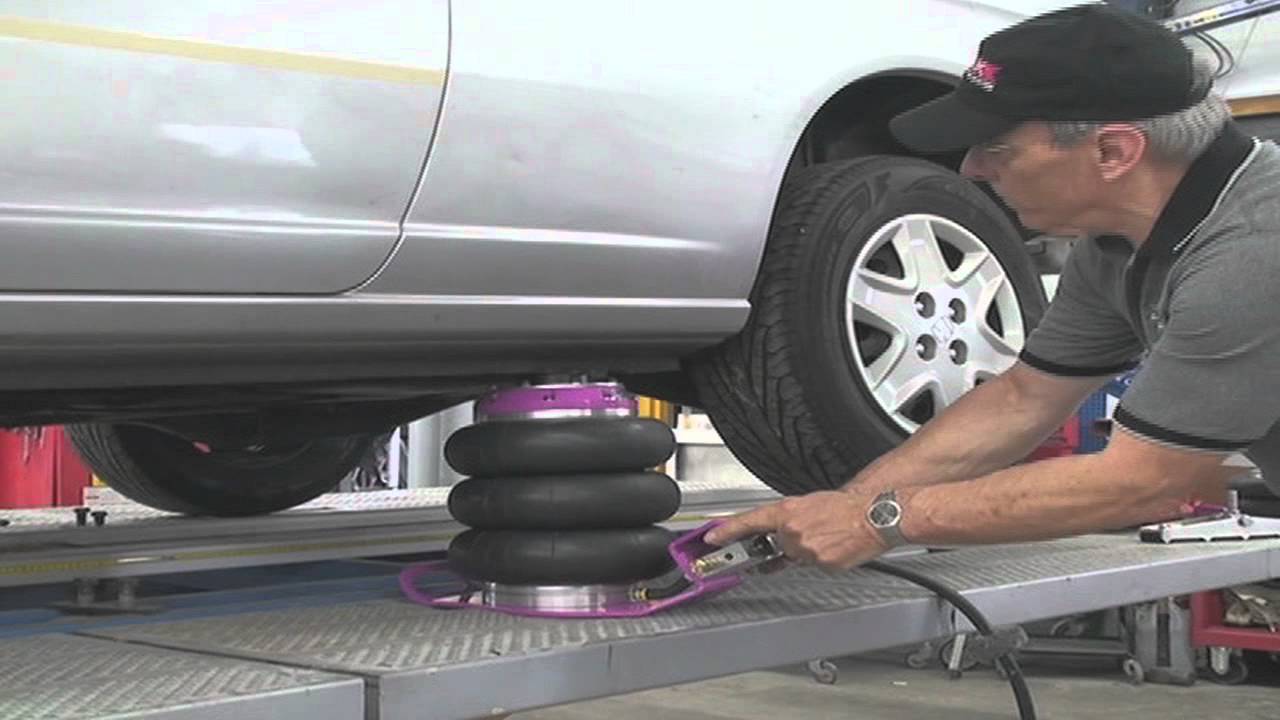
Asked how a single-location shop with limited staff should approach the framework, Dutra said the decision to bring calibrations in-house shouldn't be driven primarily by declining repair volume. He said shops doing roughly $300,000 to $600,000 in monthly sales are typically large enough to support a full-time in-house ADAS technician, while smaller shops may be better served identifying their two or three most common vehicle lines, investing in equipment for those specifically, and vetting a sublet partner, dealership or independent, for the rest. The primary and most important consideration is having the proper environment to perform the calibrations as the OE requires.
"Find a capable, competent sublet vendor that knows and understands how to do it properly following OEM procedures," Dutra said.
He said the industry is actively expanding its ADAS education and credentialing infrastructure. I-CAR has developed important foundational ADAS training, while Collision Career Institute is building a modular certification program and ASE is developing an ADAS-focused credential. The next opportunity, he said, is to better connect and sequence these efforts so the industry can provide a clearer progression from general awareness to role-specific knowledge and demonstrated technical competency.
What's next
Dutra said he and Bickett are moving forward with an initial framework intended to help the industry increase both the accuracy and the percentage of confirmed, properly performed OEM-required recalibrations. He acknowledged that many organizations and industry leaders have been working toward the same objective, but said the efforts remainfragmented and progress has not kept pace with the rapidly growing need.
Rather than wait for perfect consensus before taking action, they plan to develop and share a high-level working document, invite broad technical and industry review, and strengthen it through informed feedback.
“This is not about competing with existing organizations or diminishing the work already underway,” Dutra said. “It is about bringing greater urgency, alignment and clarity to an issue that directly affects vehicle safety. We believe this effort can reduce risk, improve repair outcomes, and ultimately help save lives. We welcome anyone who shares that commitment to participate and help us get it right.
Bickett said CIECA's board has expressed a willingness to review and help standardize how the resulting documentation is formatted and exchanged once the process itself is defined.
CIECA's annual CONNEX conference is scheduled for Sept. 29 to Oct. 1 in San Antonio.

Lisa McArdle