
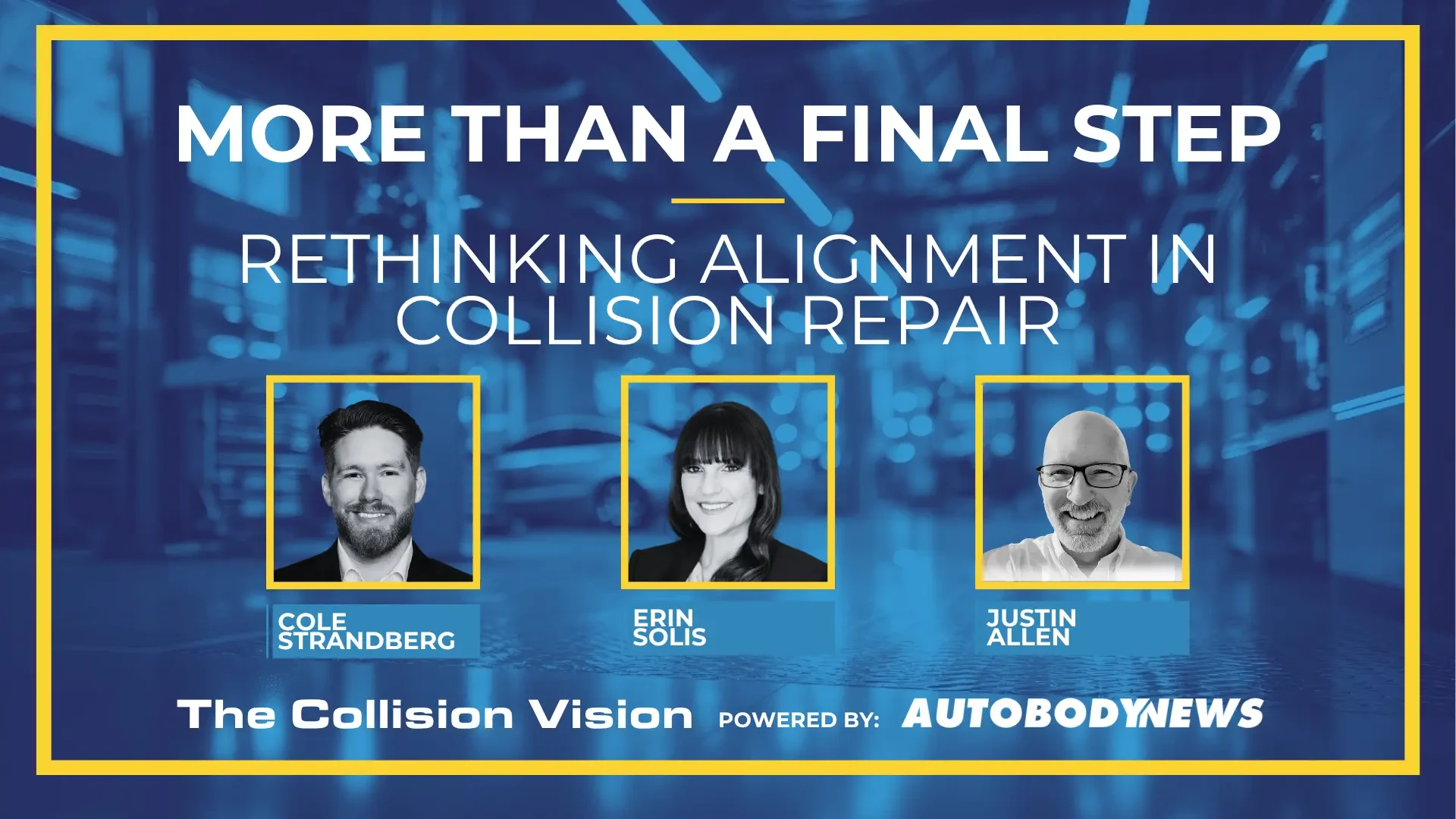
The conversation Cole Strandberg started with Dan Stander on The Collision Vision raised a question the industry hasn't fully answered: if alignment is a precondition for ADAS calibration, why are so many shops still treating it as a final QC step? To dig deeper, Strandberg brought in Erin Solis, a regular industry panelist, and Justin Allen, a field training representative for Hunter Engineering Company, for a roundtable that moved from philosophy to operations and back again.
What emerged was less a debate than a convergence: alignment's role in collision repair is no longer optional, isolated, or back-end, and the shops that haven't caught up yet are paying for it in cycle time, comebacks, and calibration quality.
Alignment's Underappreciation Has Deep Roots
Allen traced the industry's still-common instinct to sublet alignment back to how the work was structured for decades. For most of automotive history, alignment was one technician's domain, equipment that was easy to knock out of calibration and complicated enough that no one else wanted to touch it. When that technician was on vacation, work stopped.
"Everybody was subleting because, frankly, they thought it was going to be too big of a headache to do it themselves," Allen said.
That institutional memory lingered even as the equipment evolved and became significantly easier to operate. The result is a gap between where the technology is and where shop practices remain.
Key Takeaway: The resistance to bringing alignment in-house often traces back to a perception formed when the work was genuinely difficult and the equipment genuinely fragile. That perception no longer matches the reality of modern alignment systems.
Calibration Requirements Are Forcing the Conversation
Solis noted that alignment is coming up more frequently now than it was five years ago, and the driver is ADAS. As calibration requirements have grown across more makes and models, the alignment check has moved from an optional step to a procedural prerequisite that shops can't ignore without risking the integrity of the calibration itself.
"There's so much that has to be done on the calibration side that requires the vehicle to either be properly aligned first," Solis said, "or the alignment checked first."
Key Takeaway: For shops that have already invested in ADAS calibration capability, alignment verification belongs in the same workflow. The two services are procedurally linked, and treating them as separate creates gaps in documentation and repair quality.
Waiting Until the End Creates Problems That Didn't Have to Exist
Both panelists returned repeatedly to the operational cost of treating alignment as a final step. Under the traditional model, alignment was a supplement added on the last day, after the car was already deep into the repair process. If alignment revealed a problem, the shop was now ordering parts on a Friday afternoon with a customer expecting pickup.
Solis described the operational cascade: "It affects everything, not just cycle time, but the customer experience, the whole thing."
Allen framed it in terms of data timing: "If we want a car to leave with everything pointing in the right direction when we're done with it, we probably should find out where everything's pointed as early as possible."
Key Takeaway: Alignment findings late in the repair process are operationally expensive. The same information gathered at intake or blueprinting is an asset. The data doesn't change; when you collect it does.
The Blueprint Isn't Complete Without It
Solis was direct about where alignment needs to appear in the repair sequence: it can't wait for teardown, and it can't follow blueprinting. It has to be part of it.
"I don't think you can do a complete and proper blueprint without having that alignment checked," she said. "You never know what's going on with the car."
Her example: once suspension has been replaced, alignment needs to be checked again. And if an OEM procedure calls for alignment verification before a specific calibration, the shop doesn't have discretion on timing; the procedure sets it.
Key Takeaway: OEM repair procedures, not shop convention, should determine when alignment happens in the repair sequence. For many makes, that means before blueprinting is finished, not after.
The Equipment Is Only as Good as the Operator
Allen was clear that Hunter's equipment doesn't override the need for technician understanding. The platform reduces setup time and guides the process, but a technician who doesn't understand what they're measuring and why will still produce bad outcomes.
"A Phillips screwdriver is only as good as the operator of the screwdriver," Allen said. "But if you have a technician who is not familiar with the ‘why’ of those processes, they're going to have troubles."
Key Takeaway: Equipment investment without training investment produces storage, not revenue. The shops seeing returns on alignment have committed to both.
Training Is the Differentiator
Solis and Allen agreed that the gap between shops leveraging alignment effectively and those still subletting or not doing it at all comes down to training, and specifically to whether leadership is invested enough to learn the work themselves.
Allen pointed to Dan Stander from the previous podcast as the model: he learned alignment himself, understood the why, then brought that knowledge back to his team. Solis noted that Stander then extended training beyond technicians to estimators and writers — anyone who touches the repair process.
Allen runs alignment training programs across the Southeast, including trade shows like Vision ASTA. He also pointed to a week-long session his facility hosted for a group organized through Mike Anderson's organization. Allen said the collision technicians took to the material quickly, describing them as phenomenal to work with — skilled and artistic people who, once they applied some geometry to the alignment work, were all over it.
Key Takeaway: In-person, hands-on alignment training is available through Hunter's regional trainers, trade show programs, and industry organizations. If technician skill is the barrier, that barrier is addressable.
Calibration Can "Succeed" on a Misaligned Vehicle
Strandberg asked how often calibration failures are really alignment or setup failures. Allen's answer reframed the question.
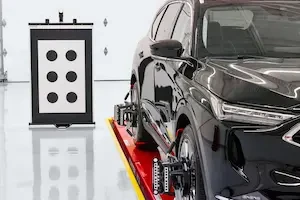
A calibration can complete successfully on a misaligned vehicle. The system will confirm completion. But if the vehicle's thrust angle is off, the sensors being calibrated to the body are now pointing at something other than what they should be. At operating distances, like 100 to 300 feet, a minute misalignment at the sensor translates to significant error in the field.
Solis added that the bigger misunderstanding may actually exist outside collision shops. Mechanical shops performing alignments without triggering calibration requirements are creating confusion in the market and sometimes with the vehicle owner.
Key Takeaway: A completed calibration is not confirmation of a correct calibration. Shops performing ADAS work without verifying alignment first are documenting outcomes they can't fully stand behind.
Subletting Alignment Means Surrendering Control
Solis made the case for in-house alignment less as a revenue argument and more as a quality control argument. The shop performing the repair has read the OEM procedures, blueprinted the damage, and knows what was replaced. The shop down the street, or the tow truck destination two miles away, has none of that context.
"You don't know now what they know," she said. "You're not there to ensure that it was done properly."
Allen put numbers on the logistics: two-person trips, transport both ways, scheduling around another shop's availability, and the occasional discovery on arrival that the vehicle needs suspension parts before it can be aligned at all. It’s work the collision shop's technicians are fully capable of doing, but now won't, because the car is already somewhere else.
Key Takeaway: Subletting alignment transfers revenue, removes quality control, and introduces variables that no comeback policy can fully recover. For shops with the volume to support in-house capability, the case for bringing it inside compounds with every car that goes out the door.
The Profitability Picture
Allen was direct on alignment's revenue potential. Before 1998, getting accurate measurements took 15 to 20 minutes of setup. Equipment improvements collapsed that to roughly four minutes. The price of an alignment didn't fall proportionally.
Today, when a vehicle is alignable and the process runs cleanly, it can be completed in 15 minutes at whatever the shop is charging for alignment work. Add non-factory-adjustable situations like aftermarket control arms, eccentric bolt kits, or additional correction hardware, and the per-vehicle opportunity grows further.
"When a vehicle is alignable," Allen said, "it is extraordinarily profitable."
Key Takeaway: With claim volume down and total-loss rates up, per-vehicle revenue is more important than it has been in years. Alignment is a high-margin in-house service that most shops are currently paying someone else to perform or skipping entirely.
Staying In Front of It
Both panelists closed with the same advice Stander offered in the previous podcast: get out of your own four walls.
Solis noted that the vehicles are changing too quickly for any shop to stay current by operating in isolation. Industry associations, 20 groups, CIC, SCRS, and state associations all provide access to people solving the same problems. Allen added that face-to-face, elbow-to-elbow conversation is where perspective actually changes.
The shops running alignment well today didn't arrive there by accident. They sent someone to a training, joined an association, or had a conversation that reframed what they thought they knew. That access is available to any operator who makes the time.
Key Takeaway: The information gap in alignment is a participation problem rather than a resource problem. Shops that are staying ahead on alignment are connected to the industry conversations where this is being worked out in real time.
Where It All Points
The roundtable's throughline is simple: alignment is no longer a standalone mechanical procedure that happens at the end of a repair. It is connected to blueprinting, to calibration, to cycle time, to customer satisfaction, and to the liability that follows a vehicle out the door.
Solis and Allen both pointed to the same starting place for shops that aren't there yet: get involved in the industry conversations where this is being worked out. Whether that's a 20 group, SCRS, a state association, or a Hunter training program in your region, the information is accessible. The shops seeing returns on alignment didn't figure it out alone.


Lisa McArdle