If your shop performs a frame or mechanical procedure but writes it off as "part of the job," a new survey suggests you may be leaving money on the table, not because insurers refuse to pay, but because many shops never ask.
That is among the findings of the latest "Who Pays for What?" survey conducted by Collision Adviceand CRASH Network.
The survey, which ran throughout April, drew responses from 473 collision repair facilities in 49 states. It asked shops how often eight large nationalauto insurers reimburse them for about 20 frame and mechanical procedures when those operations are necessary for a repair.
The gap between performing and billing
Whether a facility is reimbursed for an item depends, to a degree, on whether the shop negotiates for it, the report notes. None of the procedures in the survey are universally paid by insurers, but none are universally rejected, either.
That is also key to reading the survey's numbers. The payment percentages count only shops that negotiate for a procedure, not those who said they "never asked" to be paid, so each figure should be read as the share paid among shops that put the item on an estimate.
The pattern repeats across the survey series: nearly 3 out of 4 shops report being paid most or all of the time for a procedure they include on estimates, while another 20% say they never even attempted to charge for it.
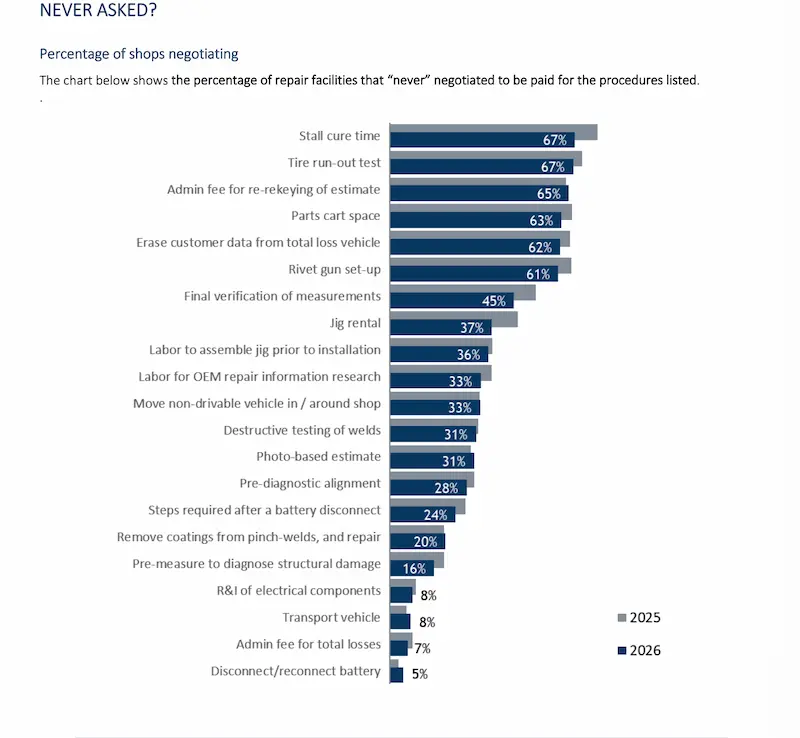
The survey's "Never Asked?" chart shows how wide that gap can be. Among the procedures shops are least likely to negotiate for:
- Stall cure time and tire run-out test: roughly two-thirds of shops have never asked to be paid.
- Admin fee for re-rekeying of estimate, parts cart space, erase customer data from total loss vehicle, and rivet gun set-up: a little more than half have never asked.
- Final verification of measurements: a little under half have never asked.
Those are not procedures insurers are refusing, according to the data. They are procedures most shops never put in front of an insurer. When shops do negotiate for them, they are paid a meaningful share of the time.
More shops are getting paid than a decade ago
In his letter introducing the report, Anderson said the survey series is meant to show shops that, despite what they may be told, they are not "the only one" performing and charging for the nearly 100 not-included procedures the series covers over the course of a year.
Some operations saw payment-frequency changes this cycle, both up and down, but Anderson cautioned that many fall within the survey's margin of error, a minimum of plus or minus 4.5% on questions involving all respondents, and should not be read as meaningful change. The longer trend, he said, has been an increasing number of shops negotiating for these not-included procedures and being paid for them.
The ranking chart, from best-paid to rarely billed
The report's overall ranking chart maps every surveyed procedure by how regularly shops bill and are paid, from the operations paid most consistently down to the structural and frame steps performed often but billed rarely.
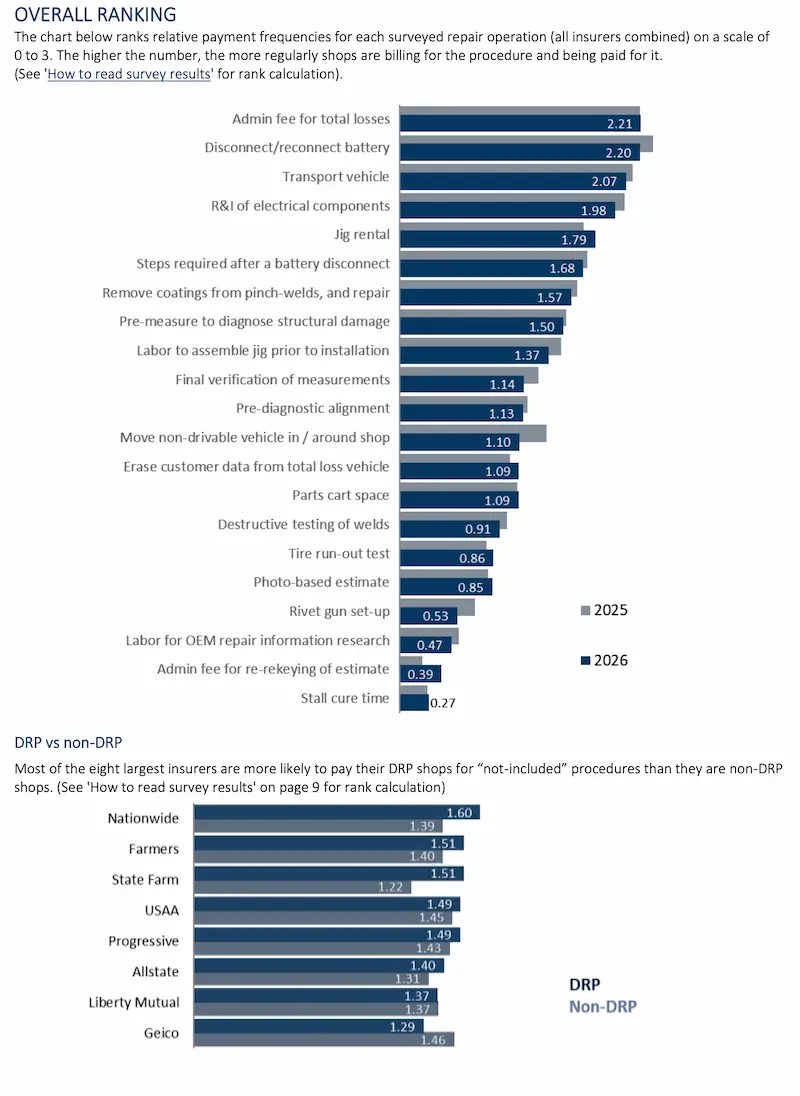
Administrative fee for total losses, disconnect and reconnect battery, transport vehicle, and R&I of electrical components rank at the top. Procedures such as stall cure time, admin fee for re-keying an estimate, and labor for OEM repair information research fall near the bottom.
The ranking also points to a recurring pattern: most of the eight largest insurers are more likely to pay their direct repair program (DRP) shops for not-included procedures than non-DRP shops. Just over half of respondents, 55%, said they do not participate in a DRP with any of the eight insurers.
The full Frame & Mechanical Operations Reportis available to download now.The latest "Who Pays for What?" survey, focused on not-included body labor procedures, is now open through July. Shops can click here to complete the survey.