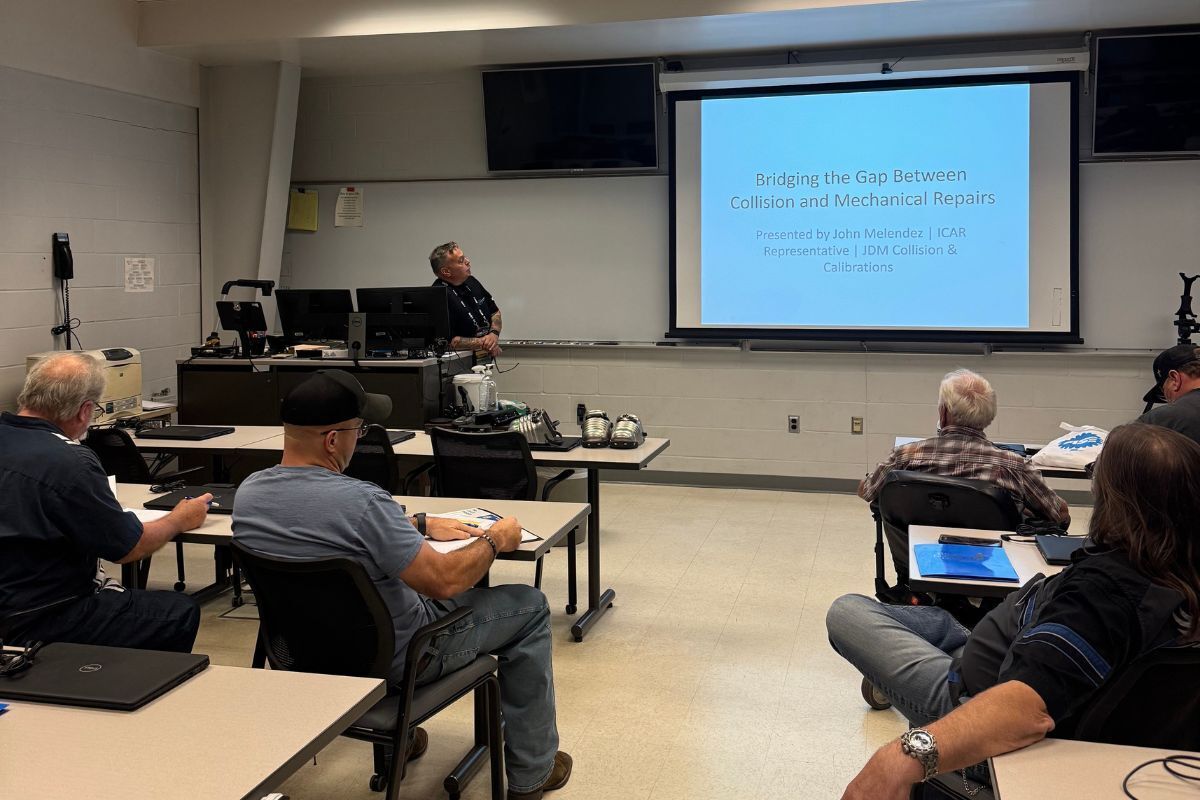
A renewed sense of collaboration took center stage at the recent Illinois College Automotive Instructors Association (ICAIA) conference, held at Illinois Central College in East Peoria, IL.
The featured presentation, “From Nuts & Bolts to Advanced Repairs: Preparing Students for Modern Vehicles,” delivered by industry professional John Melendez of JDM Collision & Calibration, emphasized the urgent need for mechanical and collision repair instructors to work together to better prepare the next generation of technicians.
In an era where modern vehicles integrate complex electronic, structural and calibration systems, the line between mechanical and collision repair has virtually disappeared. Melendez’s session demonstrated how proper, safe repairs require shared understanding and collaboration between both disciplines — from diagnosis to final calibration.
The presentation included a real-world example of a Chevrolet C8 Corvette currently undergoing repair, which will be documented step-by-step on LinkedIn as the work progresses. The case underscores how ongoing collaboration between mechanical and collision professionals is essential for safe, OEM-compliant repairs, while providing a live learning opportunity for instructors and students.
Attendees responded enthusiastically, engaging in discussions about curriculum alignment, cross-discipline learning, and integrating mechanical and collision instruction at the educational level.
“Students entering the trade must see both worlds as one system working together,” Melendez noted. “When educators bridge that gap, they help the entire industry move forward toward safer, higher-quality repairs.”
The ICAIA conference highlighted a long-overdue shift in industry thinking: mechanical and collision education must collaborate to produce safer, more competent technicians. The session made clear that the benefits extend beyond the classroom — impacting repair quality, shop efficiency and motorist safety alike.