



When collision repair shop leaders talk about growth, the conversation often centers on hiring challenges, cycle time, customer satisfaction, and profitability. But beneath all those outcomes is something less flashy and far more foundational: standard operating procedures (SOPs).
SOPs are often misunderstood as “extra paperwork” or something only large MSOs need. In reality, well-built SOPs are not about bureaucracy. They are about clarity, consistency, and creating a business that doesn’t depend on one person holding everything together.
 Mark Claypool is co-founder of SOP MD, along with Dean Hancock.Mark Claypool, co-founder of SOP MD, describes SOPs simply as a shop’s best practices — the agreed-upon “best way” to complete key processes efficiently, effectively, and consistently over time. The purpose is not documentation for documentation’s sake. The purpose is to help shops work smarter, not harder, while reducing avoidable mistakes and daily friction.
“If SOPs live only in your head,” Claypool says, “you don’t really own a business. The business owns you.”
SOPs are about ownership, not control
One of the biggest misconceptions about standard operating procedures is that they are about micromanagement. In practice, they do the opposite. SOPs allow leaders to step back from constant oversight and let the business run on clearly defined systems.
Claypool has seen firsthand what happens when SOPs aren’t documented. In some cases, a shop owner becomes unexpectedly unavailable due to illness, injury, or worse. In others, a key employee leaves, taking years of undocumented knowledge with them. Claypool refers to this as the “hit-by-a-bus” scenario: when processes exist only in people’s heads, they disappear the moment those people do.
That risk doesn’t just affect ownership — it affects teams and families as well. Without clear processes, even capable staff can feel overwhelmed trying to keep operations moving. SOPs create continuity, protecting the business from disruption and uncertainty.
SOPs aren’t just for “big shops”
Another common belief is that SOPs are only necessary for large operations or multi-location businesses. Claypool disagrees. The deciding factor isn’t size; it’s mindset.
SOPs benefit:
- Owners who want the business to run without their constant presence
- Managers responsible for training, consistency, and accountability
- Shops adding new services, roles, or locations
- Operations onboarding new hires or apprentices
- Businesses preparing for transition, succession, or acquisition
“There’s no magic number of years in business,” Claypool says. “The real question is whether you want to own a business or work for the worst boss on the planet, which is often yourself.”
Protecting your best people
Standard operating procedures also address a quieter problem many shop owners don’t immediately see: the productivity drain on top performers.
According to SOP MD, high-performing employees can spend 20 percent or more of their time answering questions, helping others or tracking down information needed to complete a job. While that collaboration is valuable, it often pulls skilled team members away from the work that drives throughput and profitability.
When SOPs are clearly documented and easy to access, team members can find answers on their own. That reduces interruptions, protects productivity, and allows top performers to focus on what they do best.
Why SOPs fail (and how to make them stick)
Many shops technically “have SOPs,” but still struggle with inconsistency. Claypool says the reason is simple: having SOPs is not the same as using SOPs.
Procedures don’t work if they live only in someone’s head — or in a three-ring binder sitting on a shelf. To be effective, SOPs must be accessible, current, and integrated into daily workflow. Otherwise, teams revert to old habits, especially under pressure.
Claypool emphasizes four keys to successful SOP implementation: Develop. Train. Test. Audit.
First, teams should be involved in developing SOPs and agreeing that “this is how we do it here.” Next, staff (new and existing) must be trained on those procedures. Testing ensures understanding before assuming execution. Finally, leaders must audit and verify that procedures are actually being followed.
Without accountability, even well-written SOPs will be ignored. Claypool notes that it takes time, often more than two months, for new habits to form. Leaders must stay consistent long enough for the new process to become the norm.
SOPs support growth and consistency
Beyond daily operations, standard operating procedures play a critical role in long-term strategy. Shops that systematize their operations are better positioned to scale, whether that means adding locations, expanding services, or preparing for acquisition.
Claypool points to the franchise prototype popularized by Ray Kroc and later described by Michael Gerber in “The E-Myth Revisited.” The idea is simple: a business should operate consistently regardless of who is on-site. That consistency builds brand trust with customers, insurers, and partners alike.
In practical terms, SOPs support:
- Increased efficiency and reduced wasted steps
- Shorter cycle times and fewer comebacks
- Stronger workforce development and training
- Higher customer satisfaction
- Improved profitability
Shops that rely on undocumented knowledge may function day to day, but they are far more vulnerable to disruption. Shops that rely on systems are better equipped to adapt and grow.
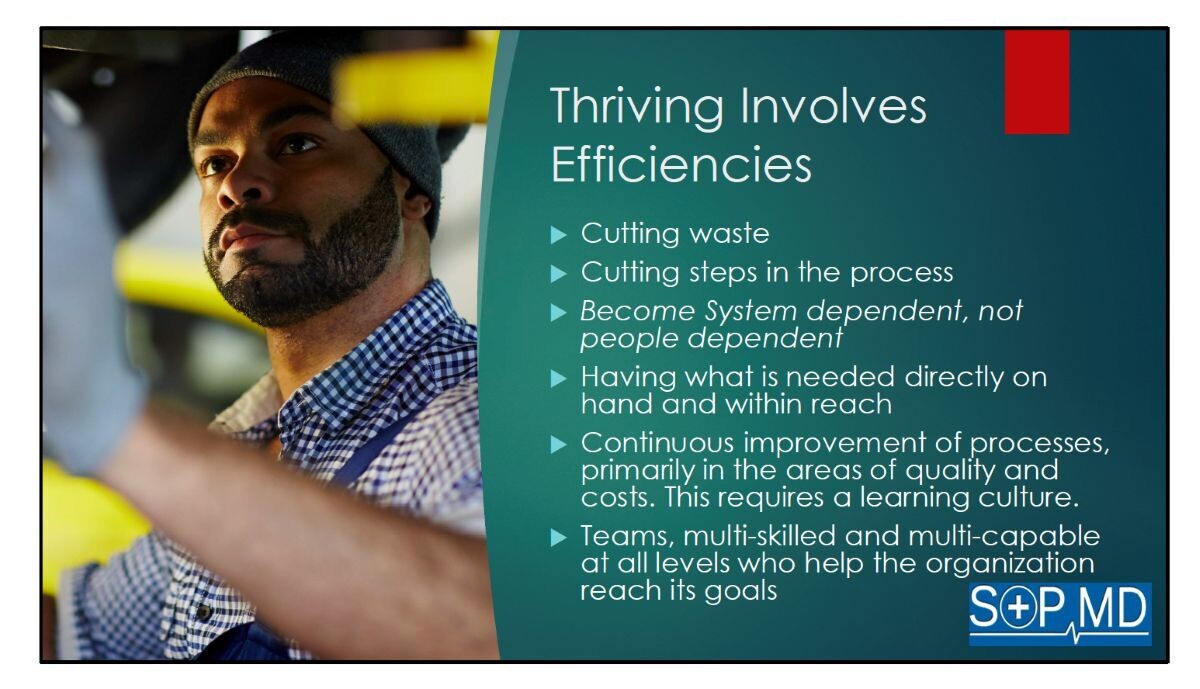 If your facility wants to create a culture of thriving rather than surviving, SOPs are a systems-based approach to running your shop more efficiently and continuously improving your processes.
SOPs complement — not replace — shop management software
Shop management systems are powerful tools, but they assume users know how to operate them effectively. SOPs fill that gap by documenting how a specific shop uses its software in real-world conditions.
Rather than replacing technology, SOPs maximize its value, guiding team members through step-by-step workflows and ensuring consistency across roles and shifts. SOPs also cover processes that exist outside of software, such as payment handling, internal communication, and customer interactions.
Who SOPs are really for
At their core, SOPs are not about rigidity. They are about freedom: Freedom for leaders to step away without chaos, and freedom for teams to execute confidently without guesswork.
SOPs are for shop owners and managers who want:
- Consistency in how work gets done
- Scalability without losing control
- Stability during change or transition
As Claypool puts it, “If the business only runs because you’re there every day, then it doesn’t really belong to you.” In an industry facing increasing complexity and pressure, SOPs are no longer optional. They are a foundational tool for shops that want to be systems focused.








Leona Scott