


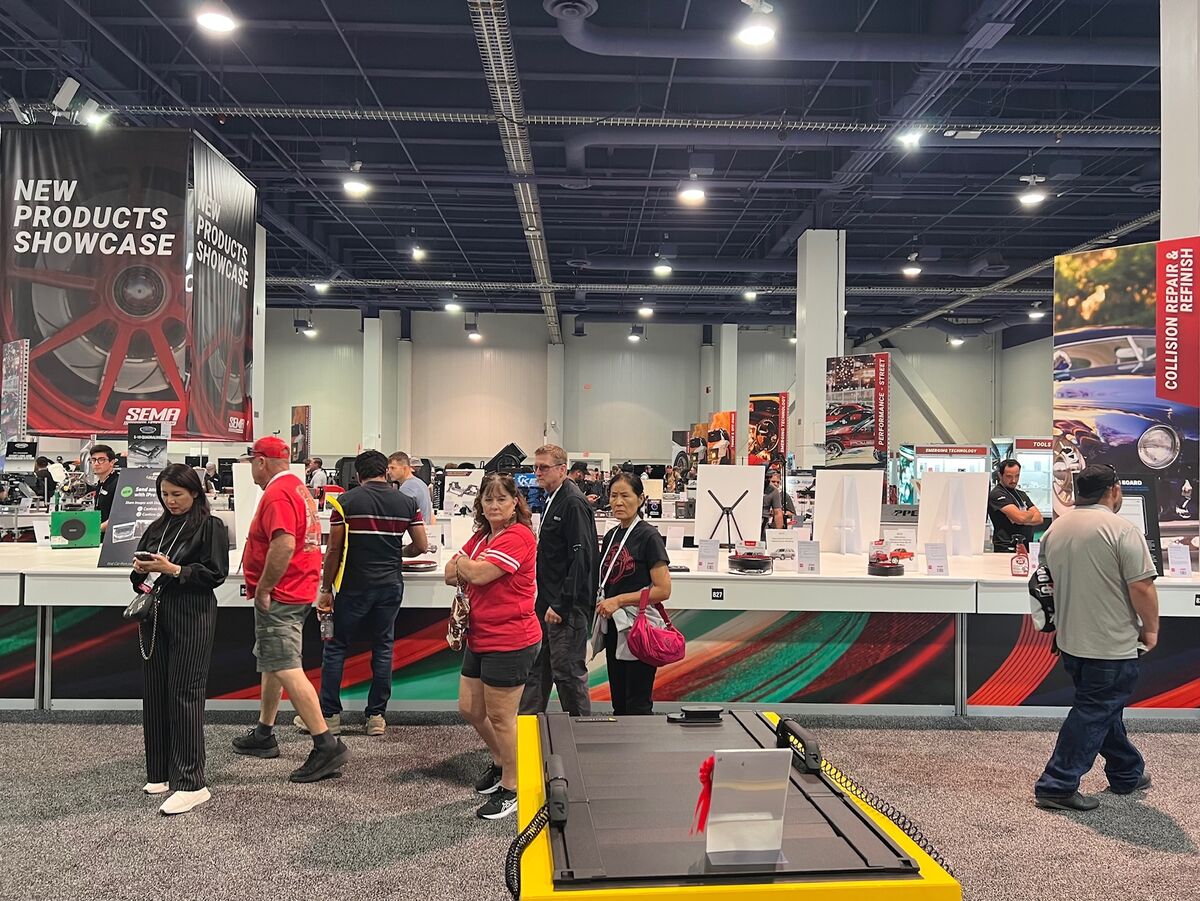
The 2025 SEMA Show hosted the first-ever Media’s Choice Awards, giving journalists the chance to highlight the entries in the New Products Showcase their audience would find most appealing.
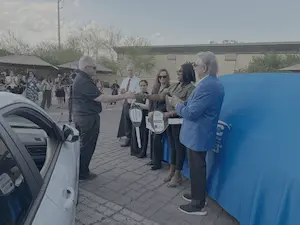
The manufacturers of the winning products accepted their awards at a reception held Nov. 5 outside the showcase.
Autobody News enlisted three collision repair experts to make its picks: Darren DuVall, CEO of Driving Force Collision, a Northeast-based MSO; Toby Chess, experienced technician and 20-year I-CAR instructor; and John Melendez, owner of JDM Collision in the Chicagoland area.
The chosen products represented a mix of solving both relatively new and longtime problems for collision repairers.
Revv Integrations Ecosystem
DuVall chose Revv’s Integrations Ecosystem, which also won the New Product Award in the Collision Repair and Refinish category.
The Integrations Ecosystem connects shops and insurers by syncing calibration data directly into the tools they already use, cutting down on manual work and keeping everyone aligned throughout the repair and claims process.
The product was one of three launched by Revv on Nov. 4 to add to its end-to-end repair platform, along with Claims Builder and Advanced Billing System.
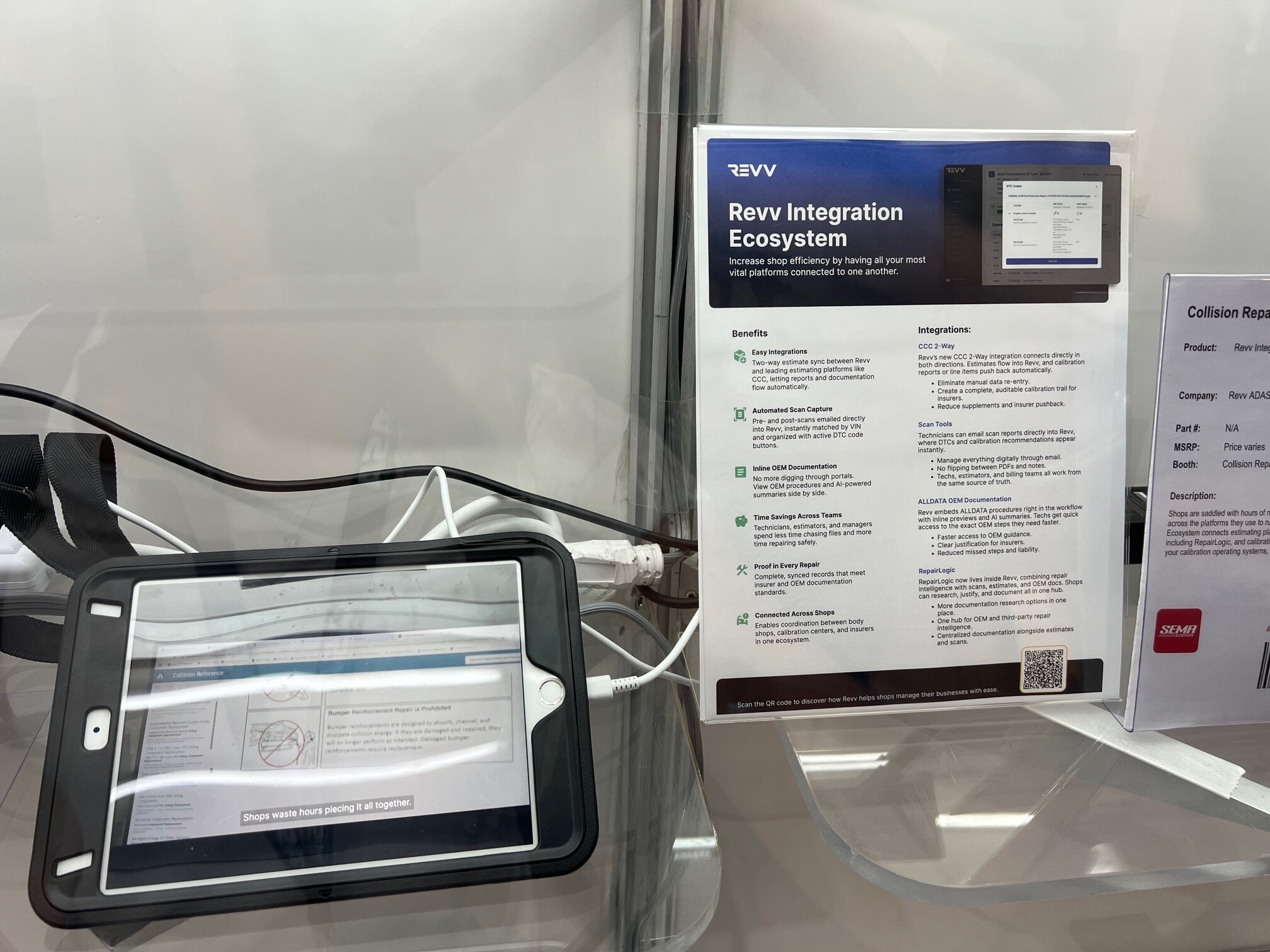
DuVall said his MSO — which will soon have seven locations — will use Integrations Ecosystem to make sure it is capturing everything that needs to be done to complete a safe and proper repair.
“It speeds up the process by having everything at your fingertips in one place, so you’re not having to data mine to get documentation or position statements from the OEs, and to make sure that we capture things that we may not have known as well,” DuVall said.
That ultimately helps Driving Force Collision “get paid for what we’re doing to repair vehicles correctly,” DuVall added.
Kristin Briggs and Nathan Parikh, product managers with Revv, accepted the award.
“It’s great to hear that our customers love and care about what we do,” Briggs said. “We win when our customers win.”
Revv invented Integrations Ecosystem to fix one of the most common issues its customers said they were dealing with: a disconnect between all the different tools they use in the repair process.
“We wanted to do our best to address that pain point and try to bring things together as much as possible,” Parikh said.
Killer Tools Spot Weld Pro
Chess chose Killer Tools’ Spot Weld Pro, a patented surface prep tool with a 0.6-horsepower pneumatic motor and dual cleaning heads that strip paint from both inner and outer flanges quickly — boosting productivity, ensuring clean, accurate welds, and removing material only where spot welds are needed.

“You need a clean surface where the electrodes come into contact,” Chess explained. “Any dirt or paint will cause sparks on your weld and create a poor weld.”
Chess teaches welding students to grind the front and back of the surface, but it’s often hard to see the back to ensure the spot they are grinding lines up with the spot on the front.
“What this tool does is two operations in one,” Chess said. In addition to grinding both spots at once, “it’s going to line up perfectly on both sides.”
Chess said he needs to test the tool himself before fully endorsing it, but he’d never seen anything like it. “That’s why I’m so excited about it,” he said.
The tool was invented by Dave Kilburn, a 25-year technician who now works at Honda World Westminster in California. He has invented several products for Killer Tools to solve problems in the body shop.
Kilburn said it’s not recommended to strip all of the electrocoating, or ecoat, from a panel, because that could lead to rust. His tool makes sure the ecoat is only stripped where needed.
“This is the future,” he said.
Tim Gerhards, vice president and national sales manager for Killer Tools, said in accepting the award that Kilburn had been working with Killer Tools to develop the Spot Weld Pro for three years.
“I was a technician; I tried to solve the same problem,” Gerhards said. “This was brought to us and it was obvious from the get-go that it was something that was going to work, and it was needed.”
I-CAR Mixed Attachment Methods
Melendez chose I-CAR’s Mixed Attachment Methods, a new course for structural technicians working on modern vehicles.
The course is designed to reinforce proficiency in the joining techniques most frequently referenced in OEM collision repair procedures: rivet bonding, MAG welding, MIG brazing, steel sectioning and spot welding.

These skills are currently part of I-CAR's ProLevel 2 and ProLevel 3 training requirements. This new course consolidates them into a single exercise to confirm a technician's ability to apply various joining techniques. The prop used closely resembles what technicians may encounter on a vehicle.
Melendez said the course covers “one of the most important parts of a structural repair that a tech is going to have to perform…on a daily basis.”
“I feel the work and R&D that went into this product shows that our technicians who are trained in this tomorrow are going to be well-rounded, and we’re reassuring that we’re having a proper, safe repair,” Melendez said.
T.J. O’Rourke, subject matter expert, and Jamie Jacobs, supervisor of instructional design with I-CAR, accepted the award.
“The industry was asking for a little bit more of a challenging test for their technicians,” Jacobs said of I-CAR’s motivation to develop it.
“We’re trying to make sure that when removing panels, [techs] aren’t damaging underlying materials that are high strength steel or ultra high strength steel,” O’Rourke said. “When that is compromised, it has to be replaced. If you cut too deep, or drill too deep, you can damage the vehicle and end up having to purchase it, because it might almost become a total loss.”
The course includes a 24-gauge steel that mimics some of the lighter materials being used in vehicle production.
“We haven’t done that in the past,” O’Rourke said. “I think that’s going to help test these technicians to make sure that they’re familiar with the materials.”
Honorable Mention: KECO Kwik-Stick
 The KECO Kwik-Stick, left.
Chess wanted to highlight a second product after his Media’s Choice Award pick: KECO Body Repair Products’ battery-powered Kwik-Stick.
The Kwik-Stick delivers leverage and pulling power for glue tab repairs. Powered by a Milwaukee battery, it provides quiet, user-friendly operation while giving technicians the strength to tackle large dents and collision damage across panels, rockers, doors, seams and body lines.
It creates a vacuum seal to the floor to provide a strong leverage point, while the small base makes it easy to maneuver around the shop floor.
Technicians apply a glue tab to the dent, then attach the adapter on the Kwik-Stick and pull.
“This is a great entry-level price for someone who wants to get started in glue pull repair,” Chess said.






Abby Andrews