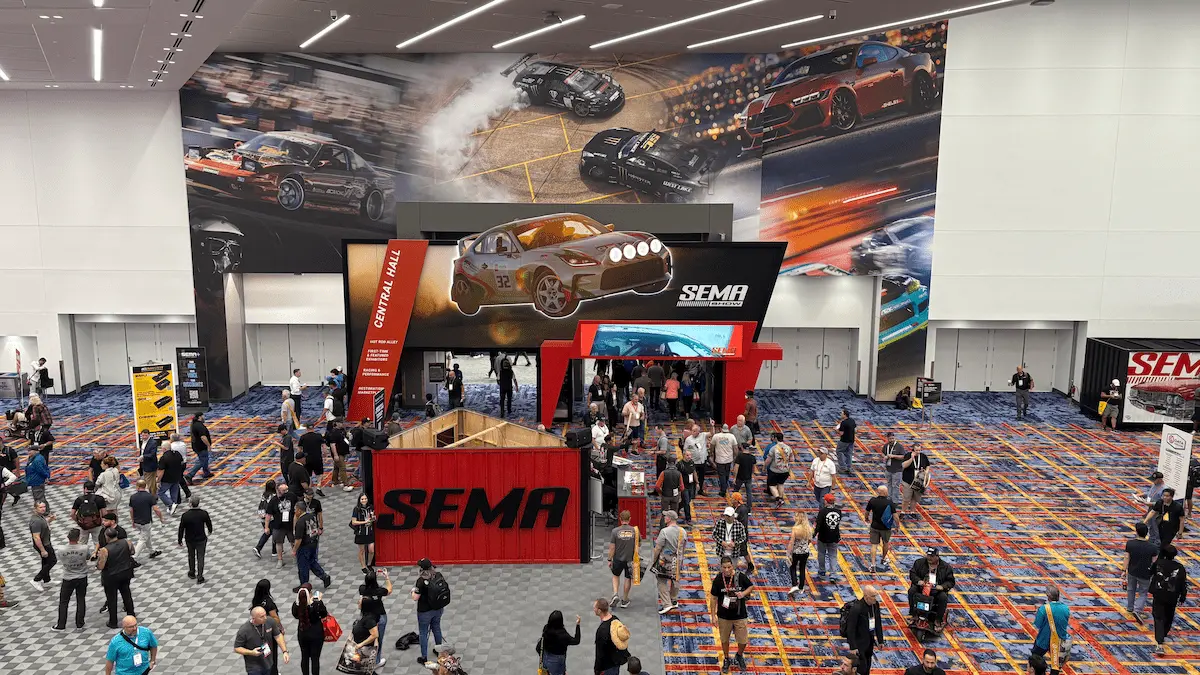
The collision education at this year's SEMA Show, Nov. 3 to 6 in Las Vegas, arrives as shops say their biggest worry is fewer cars coming through the door. In Autobody News's 2026 Industry Insights Survey, nearly eight in 10 shop owners, managers, and technicians said they are concerned about declining claim volume, and more than half called it their single biggest concern.
What respondents plan to do about it lines up closely with the week's schedule. Adding new revenue streams and improving cycle time and throughput tied as the most common goals for the next 12 months. Asked which metric matters most to their business, nearly a third named gross profit per repair, well ahead of total repair volume.
When asked what topics areas or features they are you most interested in, one respondent commented “ADAS, insurance updates in the industry, new tools coming out to help the repair go through more efficiency” while others said “the hard-to-find facts on certain vehicle collision repairs” and “keeping up with new technologies and service trends throughout the industry in general.”
Most of these sessions are part of the Society of Collision Repair Specialists' (SCRS) Repairer Driven Education series and OEM Collision Repair Technology Summit. The rest are I-CAR courses and show-floor stops.
New revenue from mechanical and glass work
Adding new revenue streams tied for respondents' top goal, named by about three in 10. One session looks at mechanical work many shops already perform but don't fully capture, and two more look at bringing mechanical and glass work in-house.
Capturing Mechanical Labor: Being Intentional About the Opportunity
Tuesday, Nov. 3, noon to 1:30 p.m. | Room S231
Mike Anderson of Collision Advice opens the mechanical labor conversation Tuesday. He'll present industry data on how often operations such as pre-measurements, diagnostics, component removal, inspections, and alignments are left off the repair plan or misclassified. For shops looking for new revenue, his session starts with work many of them already perform.
Bringing Mechanical Repairs In-house
Tuesday, Nov. 3, 2:30 to 4 p.m. | Room S231
The panel that follows in the same room picks up from there. Steve Dawson of Hunter Engineering leads a discussion with shop leaders who added mechanical capability: Chris Dacus of Dacus Auto Body and Collision Repair, Dan Stander of Fix Auto Highlands Ranch, Gerry McNee of Ultimate Collision Repair, and Todd Hesford of Mission Viejo Auto Collision. They'll cover why they did it, what it cost, and how it affected cycle time and profitability.
The Profit & Control Playbook: Bringing Auto Glass In-House
Wednesday, Nov. 4, noon to 1:30 p.m. | Room S230
On Wednesday, the focus shifts to auto glass. As glass work becomes tied to ADAS calibration and OEM procedures, Shauna Davis, Jason Horne, and Jorge Sandoval of Kaizen Glass Solutions argue that shops subletting it give up both revenue and control of the repair. They'll share examples from shops that have made the move, along with how to judge whether in-house glass makes sense and what implementation involves. The session is offered in English and Spanish.
Profit per repair starts with the plan
With claim volume their top concern, respondents named gross profit per repair as the metric that matters most. Three sessions make the case that much of that margin is decided in the repair plan: in the research done up front, the operations that make it onto the estimate, and the budget a shop sets its targets by.
Repair Planning That Pays: Protecting Revenue Through Research
Tuesday, Nov. 3, 9:30 to 11 a.m. | Room S230
Isaac Aronson of OEC draws on patterns from thousands of repair plans to show where upfront research breaks down. That includes the OEM procedures, conditional operations, and calibration requirements that need attention before a repair begins. Gaps there tend to surface later as supplements and delays, which bears on the cycle time goals shops named as well.
Stop Guessing, Start Earning: Building Bulletproof Repair Plans
Wednesday, Nov. 4, 9:30 to 11 a.m. | Room S229
On Wednesday morning, Danny Gredinberg, administrator of the Database Enhancement Gateway, and Andrew Batenhorst, bodyshop manager at Pacific Collision Center, lead an interactive workshop on the repair plan itself. Their premise is that many plans lean too heavily on estimating software defaults, which leads to missed operations, thin documentation, and lost income. Attendees will work through commonly overlooked operations and build a complete repair plan as a group, then review real-world examples of where plans typically fall short.
Financial Success Starts with a Plan: Turning Numbers into Action
Wednesday, Nov. 4, noon to 1:30 p.m. | Room S231
Later Wednesday, Tracy Dombrowski of Collision Advice and Maria Quintero of Body Builders Automotive walk owners through building a working budget, calculating breakeven and target net profit, and setting technician production goals from those numbers. The session also covers spotting gross profit as it starts to drift off target. It runs at the same time as the auto glass session, so shops sending more than one person may want to split up.
Documentation that holds up to review
When asked what content would help them most, respondents ranked help navigating insurer requirements first, including billing, supplements, and reimbursements.
“There are many challenges facing our rapidly changing business, said one survey respondent. Calibrations is a very confusing part of the business. We have 12 DRPs and everyone of them want something different. Manufacturers are changing the statements and insurance companies are pushing back on these changes.”
Three sessions start with what a shop controls: the documentation behind the repair.
Repair Transparency: The Key to Defensible Repairs and Better Outcomes
Tuesday, Nov. 3, 2:30 to 4 p.m. | Room S229
A DCR Systems panel follows a real claim file from intake through final billing, stopping at the points where documentation gaps weaken a repair. Arynne Kelly, David Martin, and Michael Giarrizzo Jr. of DCR are joined by two shop leaders, Barry Dorn of Dorn's Body & Paint and Kris Burton of Rosslyn Auto Body. Attendees will work through a live claims package to see how clearer documentation strengthens a repair's defensibility, conversations with insurers, and customer confidence.
The 3 Daily Mistakes Repair Shops Make That Empower Insurers
Wednesday, Nov. 4, 9:30 to 11 a.m. | Room S230
Attorney Sean Preston of Coverall Law and Tim Ronak of AkzoNobel focus on the shop's own operations rather than the insurer's. Their session looks at how everyday habits affect payment, the strength of a shop's documentation, and its position in a negotiation.
They organize 30 specific steps around protection, payment, and process. Real scenarios and audience discussion are part of the format, with the goal of changes attendees can make the next business day.
Defensible ADAS Calibration: Documentation, Measurements, and Risk Mitigation
Thursday, Nov. 5, noon | FutureTech Studio, Booth #24401
For calibration work, Pam Oakes of Driven Evidence covers how vehicle geometry, calibration data, and documented procedures work together to back up an ADAS repair if its performance is questioned later.
Keeping up with OEM and ADAS requirements
Respondents said OEM repair updates are some of the hardest information to find. On Thursday, the SCRS OEM Collision Repair Technology Summit brings NHTSA's deputy administrator and engineers from GM, Ford, and Rivian to the same room.
OEM Collision Repair Technology Summit
Thursday, Nov. 5, 12:30 to 4:30 p.m. | Room S233
NHTSA Deputy Administrator Lee White opens at 12:30 p.m. with current vehicle and roadway safety priorities. A conversation with SCRS Executive Director Aaron Schulenburg follows, on where repair fits within those goals.
At 2 p.m., Michael Carpenter and Jameson Collins of GM explain how automakers define what a safety system should do and measure whether it works in the real world. Jake Rodenroth moderates.
The final session, at 3:30 p.m., gets into the repair itself. ADAS and service engineers from GM, Ford, and Rivian (Steven Vance, Chad Zagorski, Brian Perkins, and Ryan Davenport) discuss how repair variables can change what a vehicle's sensors perceive. Among them are sensor position, structural dimensions, ride height, and replacement glass. Danny Gredinberg of the Database Enhancement Gateway moderates.
ADAS Showcase
Tuesday through Friday, programming 9:30 a.m. to 1:15 p.m. | Booth #31200, South Hall Upper | Full schedule
Those conversations continue on the show floor at the ADAS Showcase, which has two calibration bays and a different OEM leading sessions each day. GM opens Tuesday with "Small Changes, Big Consequences" at 10:15 a.m. and "Would You Calibrate It?" at 11:30 a.m. Rivian follows Wednesday with "Calibration Failed. Now What?" On Thursday, Ford's sessions include "Successful Calibration ≠ Complete Repair."
On Friday, GM's Michael Carpenter and Jameson Collins take on what "restored" means for active safety systems. Toyota follows at 11:30 a.m. with a hands-on demonstration alongside the SCRS ADAS Council. Each discussion is followed by open time for questions.
I-CAR courses
Tuesday through Thursday, multiple times daily | Rooms S224 and S225 | About $46 to $95
I-CAR's courses offer hands-on training on many of the same topics, running several times a day Tuesday through Thursday. Diagnostics and ADAS calibration courses cover pre-repair, in-process, and post-repair scans, along with the shop and vehicle conditions a calibration depends on.
There's also blueprinting, which I-CAR says can improve repair planning and decrease cycle time. The lineup includes glue pull repair, a newer technique for most shops, and GMA/MIG welding at basic and advanced levels. Attendees who complete both courses in a bundle and pass the post-course test earn two I-CAR course credits toward annual training. I-CAR welding experts also run live demonstrations near Booth #33139.
Planning for fewer crashes
Declining claim volume topped the survey's concerns, and one 10-minute talk on Wednesday takes it on directly.
IDEAS Collide Showcase
Wednesday, Nov. 4, 2:30 to 4 p.m. | Room S229
Justin Allen of Hunter Engineering asks, "What Will You Do When the Cars Stop Crashing?" at the IDEAS Collide Showcase, a series of short presentations. He'll look at what advancing ADAS could mean for a shop's business model over the long term.
In the same block, Joel Adcock of Revv makes the case that a clean diagnostic scan doesn't by itself prove a safe repair, and that running a scan is not the same as documenting it.
A few things to note before you head to Vegas
Individual Repairer Driven Education sessions cost $125. The SCRS Full Series Pass, at $425, covers one session per time slot, the IDEAS Collide Showcase, all three OEM Summit sessions, and the SCRS Sky Villa Afterparty. Room assignments can change, so check SEMA's education schedule for the latest.