


Mike Anderson of Collision Advice led sessions focused on automaker safety inspections during the Society of Collision Repair Specialists (SCRS) OEM Collision Repair Technology Summit this month at the SEMA Show in Las Vegas, calling such inspections “the single big friction point in our industry.”
“We all struggle with pushback from payers, right?” Michael Bradshaw of K&M Collision in Hickory, NC, said in opening the first session. “We didn’t develop the safety inspections. We didn’t create the rules. We just want to repair the vehicles properly. And so it can be really disheartening when you’re just trying to do the right thing, and you’re getting friction, and you’re getting questioned, and you’re getting told what you’re doing is wrong, even though in your heart of hearts, you know it’s right.”
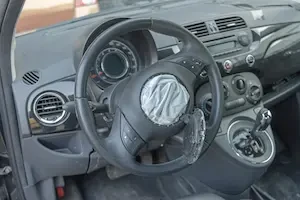
Anderson pointed out that many automakers call for the steering column to be removed and measured after a collision, given that they are designed to collapse as needed to protect the driver. A “Who Pays for What?” survey earlier this year, however, found that only 41% of shops said they are paid for this work when it is called for and performed — and nearly one-third of shops acknowledged never having sought to be paid for this procedure.
“What’s most concerning to me is not the reimbursement piece, but the fact that more than 30% of the people have never asked to be paid for it,” Anderson said. “If they’ve never asked, it leads me to believe that they’re probably not doing it.”
 One of the three sessions during SEMA focused on OEM safety inspections, led by Mike Anderson (left), including panelists (from right) Tyler Smith of Rick’s Paint & Body in Georgia, and Tyler Foote and Gerry Rosenbarker, both from the Mohawk Auto Group in New York.He said shops regularly measuring steering columns have made some startling discoveries. He cited an example of a shop in Colorado that regularly measures Subaru steering columns post-collision, as called for by the automaker. He said the shop contacted him the first time they found a Subaru steering column that was actually longer than the specifications in a vehicle that had been hit in the rear.
“The third-party payer said, ‘Well, there’s no way that’s from the accident. We’re not paying for it,’” Anderson said.
He said he asked I-CAR for some assistance.
“We got some steering columns, and we did some investigating and checking on that, some research on it, and then got back to the OEM and said, ‘This is what we’re seeing. This is what we found. Could it possibly be longer,’” Bud Center, director of technical products and curriculum for I-CAR, said during the SEMA session. “Their almost immediate response was, ‘Well, of course it could.’ So then we were able to go back to the shop, give them that feedback from the automaker so that they could go back to the third-party payer and say, ‘Here it is from the vehicle maker.’”
“In this case, the driver was a very large individual,” Anderson said. “So as he shifted forward during the crash, the steering column collapsed as designed, shearing off the interior pins that allow that to happen. But as he then moved back in the seat, holding on to the steering wheel, the column could get longer because the pins were sheared, and it had the ability to extend. It absolutely was from the accident. Everybody thinks they only have to [measure steering columns] if it’s a front collision. I can tell you we probably see as many, if not more, collapsed [or extended] steering columns from rear-end collisions as we do front-end collisions.”
 Andrew Batenhorst said he used props, such as a BMW steering gear, to explain to customers or adjusters why a particular part may need to be replaced after a collision.Some automakers also recommend inspections of steering gears after a collision. During one of the OEM Collision Repair Technology Summit sessions, Andrew Batenhorst of Pacific BMW Collision Center in Glendale, CA, showed a 2020 BMW X7 steering gear he has on a mobile rack in his shop to explain to customers or adjusters why a steering gear may need to be replaced. (He said in most cases BMW has a core charge on such parts and wants them returned whole, but this particular part didn’t have a core charge.)
“The way the steering gear is made, there are two different electric motors that are belt-driven inside the casing, and they have very, very precisely machined teeth on the gears,” Batenhorst said. “These steering gears are not designed to take a shock load laterally without that chipping the teeth off. And when the teeth get chipped, you end up getting a very notching feeling in the steering gear, and the motors can’t operate correctly. The problem is that none of that is visible from the outside. We’ve been replacing steering gears on BMWs for a very long time, and this had always been a sticking point for us.”
Attached to the cart holding the steering gear are BMW’s guidelines regarding replacement of the steering gear. Batenhorst said he likes such props because they help those who are visual learners.
“I also have a diorama inside the shop of a quarter panel that’s mocked up with all the rivet placement and gluing positions and section joints,” he said. “I have a bumper that’s been taken apart. We’ve probably got five or six different props all scattered throughout the lobby with signage on there that explains in layman’s terms what exactly the customer is looking at. So while they’re waiting for us to check in their car, they can walk around and look at them. This [steering gear] in particular sits right outside my office. You wouldn’t believe how many times customers or others walk up to me and say, ‘What is this? Why do you have this?’ And it usually stimulates a great conversation.”



John Yoswick