

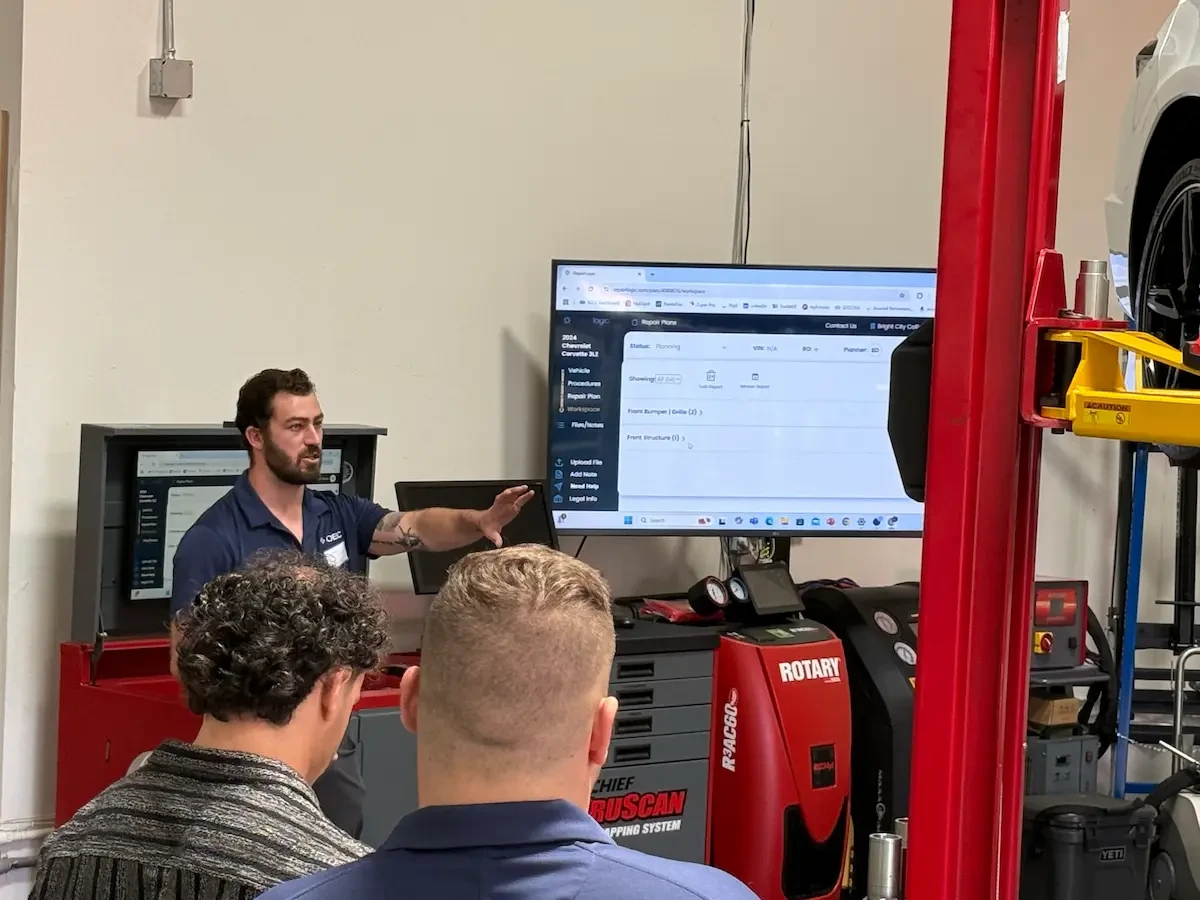
OEC's new integration between its RepairLogic repair research and planning platform and CCC ONE, which OEC describes as the industry's most widely used estimating platform, is designed to close a long-standing gap: shops that know OEM repair research should be done, but do not always have time to dig through the procedures or complete research thoroughly. A beta participant says that gap is closing at his shops.
"It's super important for me to have our guys know where they go directly for the repair procedures," said Brian Davis, regional director at Davis Paint and Collision, in a recent OEC webinar explaining the integration alongside OEC staff. Davis Paint and Collision, a certified multi-brand MSO, took part in OEC's early adopter program ahead of the integration's general availability launch on June 1.
Davis told Autobody News the company operates three locations handling roughly 250 repair orders a month, with more than 15 estimators and technicians actively using the integration day to day.
One click instead of two systems
Before the integration, Davis said, CCC and RepairLogic did not map cleanly to each other, meaning estimators lost time reconciling where the same information lived in each platform. A feature of the new integration, called Estimate Navigator, changes that by linking the two directly: clicking a MOTOR Group within a CCC ONE estimate now automatically navigates RepairLogic to the matching procedure category, according to OEC.
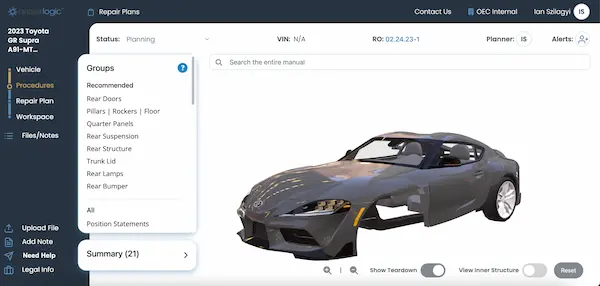
RepairLogic's Procedures view, showing a 3D vehicle model with a teardown overlay estimators can navigate directly from a CCC ONE estimate through the new Estimate Navigator integration.
"We can actually click in one area and then have it on the other screen and actually start building a repair plan at the same time and going three to four to five levels deep within RepairLogic and really helping us make that repair plan a comprehensive repair plan," Davis said.
He described how the click-through works in practice: "As the estimators are going into that section...since it goes directly to, let's say, a rear body panel, they're not funneling around with a whole different section of stuff. It goes directly to the rear body panel, and you can start immediately going R&I...The documentation is there, and you just gotta click it…and add it to your repair plan."
Once procedures have been added, RepairLogic automatically uploads the full repair plan, a single-use parts report, and a calibrations report back to the CCC Workfile as a single, always-current source, according to OEC. Jeremy Dibble, RepairLogic's product manager, described building "a single page PDF with the full repair plan, the calibration guide report, and single use parts report" during the webinar, so the documentation no longer has to be reprinted or resent each time it changes.
Estimators and technicians working from the same document
Davis said the clearest day-to-day change has been communication between estimators and technicians.
"The communication between the front end and the back end...the techs and the estimators...that communication really got way better," Davis said. "They were able to understand each other in a different sense and understand that it's not one opinion. It's now they're both looking at the same documents, and they can read it and understand it together and have good conversation."
Asked later in the webinar how that specifically changed his shops' process, Davis described estimators previously spending long stretches researching alone, then having to double back with technicians to confirm what they meant. "Now with them having the same device, they can look at it together in real time..." he said.
Calibration operations that were going unbilled
Digging further into RepairLogic through the integration has also surfaced calibration and relearn operations Davis said his shops were not previously catching through CCC ONE alone.
"Once you actually have that and you dig it in a little bit further into RepairLogic, you normally find...two to three operations that you should [be] charging for that you can document appropriately and really easy. You just didn't know it, because the systems weren't integrating very well," Davis said.
The financial impact has been direct, he said: "Doing the math on it, for us, getting two extra calibrations a month cover[s] the cost for RepairLogic for us, which is a huge ROI, immediate ROI that any owner or general manager director could actually see in that sense."
Time savings and early data
According to OEC's June 1 announcement, early adopters in the integration's beta program independently reported saving 10 to 15 minutes per repair order by eliminating manual steps between the two systems..
According to data OEC shared with Autobody News, the integration has improved the number of repair plans by 48% and increased the number of procedures by 20% in an evaluation of 305 shops after going live, compared to each shop's own pre-integration baseline. More than 40% of the shops had never added procedures before and now are benefiting from having documented proof of research and the ability to share information seamlessly using the automatic CCC syncing. OEC said the improvements held across typical shops during the 12 weeks of post-release data, not just high-volume outliers, or early or late adopters of the integration.
Davis told Autobody News the integration's reporting has also become a management tool, making it visible which estimators are and are not using the full workflow. He described making full use of the system non-negotiable for his teams.
"It's a requirement. Either you follow the process or you cannot be on the team," Davis said. "We all row the same way."
Asked what he would tell another MSO regional director considering the integration, Davis kept it simple: "Try [it]."








Lisa McArdle