
I recently conducted an estimator class to raise funds to purchase new equipment for a local high school collision program. As part of the registration, I sent attendees — estimators, owners, and managers — some questions to gauge their technical knowledge.
Not one person could answer all the questions. The average score was one or two correct answers.
That brings us to an important word in collision repair: justify. It means to prove or show what is right. It comes from one place — knowledge, pure and simple.
Below are some of the questions from the questionnaire. See how many you can answer:
- How does a receiver/drier work?
- What does 2K mean?
- What is electrodeposition primer?
- What is the difference between epoxy primer and DTM primer?
- Are you using the term “replace corrosion protection” as single line entry?
- What is galvanization?
- What are the three major steel classifications on today’s vehicles?
- What numbers on an alignment sheet tell that a sub frame has shifted?
You will be able to answer some of these questions after reading this article on the corrosion protection process, and primers, and the second article on seam sealers, adhesives, and other corrosion protection items. A third article will deal with alignment fundamentals, and fourth on air conditioning.
How is gross profit calculated?
Gross profit equals sales minus costs related to the sale (in the case of a body shop, labor, parts, materials and sublet). If you divide that number by sales, it equals gross profit percent.
Let’s see how this works with a simple example:
- Total repair sale: $1,000
- Total cost (labor and materials): $600
$1,000 - $600 = $400 gross profit
$400 divided by $1,000 = 40% gross profit
Now let’s say the repair involved removing and reinstalling a fender liner (.3 hours at $50 an hour) and replacing five broken clips at $2 each. Those items were performed but not billed.
That’s $25 left in the repair order.
- Revised sale: $1,025
- Costs remain $600
$1,025 - $600 = $425 gross profit
$425 divided by $1,025 = 41.5% gross profit
$25.00 may not seem like a big deal. But let’s say you average 40 cars per month — that profit is $1,000 per month, or an additional $12,000 per year. Now that $25.00 is a very large deal.
“Replace corrosion protection” is not a line item
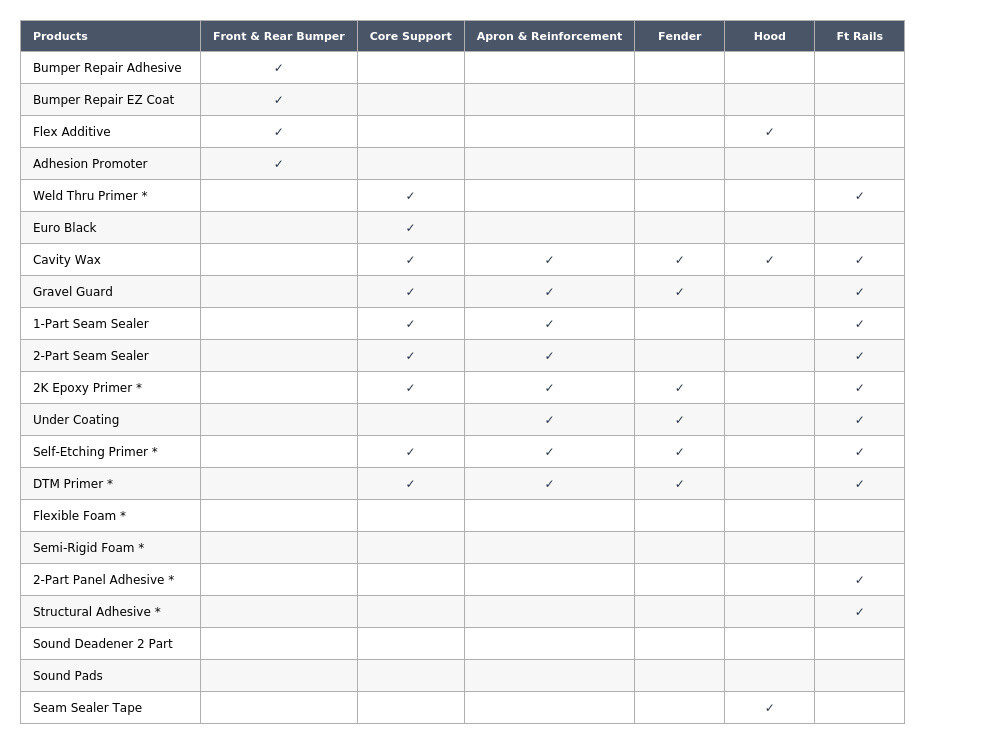
The term “replace corrosion protection” is a process involving several different products. Some repair/replacement operations require one or two items, and some require over a dozen. It is extremely important that you list each item on your repair order.
Furthermore, it is important to know how the various products work, where they are used, and the OEM requirements necessary for their vehicles.
To illustrate this, I created a spreadsheet showing common vehicle areas and the corrosion protection products typically required for each (sample shown here).
Understanding factory corrosion protection layers
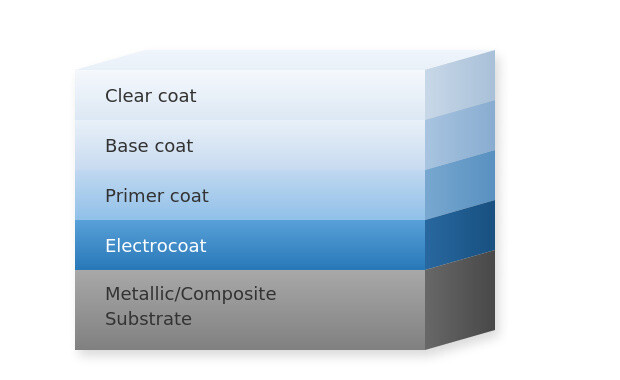 Let’s look at the layers of materials on a new vehicle.
The base metal supplied for steel manufacturing industry will have a protective coating of zinc applied. The process is called galvanization, and it is used for its strength, ductility, and corrosion protection. The zinc coating protects the base metal by acting as a barrier between bare metal and the elements that cause corrosion.
Next is the application of electrodeposition primer, or E-Coat.
Most modern vehicles receive an electrophoretic coating layer underneath the primer that provides excellent corrosion protection.
In the automotive e-coat process (electrodeposition), the car body is dipped into a tank of primer and it is negatively charged. The paint solids (polymer, extenders, and pigments) are positively charged due to application of a direct current. The paint solids are attracted to the car body (negatively charged) and are deposited until the coating electrically insulates the body completely.
Primers used in collision repair
Epoxy primer
Epoxy primer is a 2K primer that is the closest primer in characteristics to the OE-applied E-Coat. 2K materials means you need two items mixed together to produce a third by cross linking.
What is the difference between a cross linking and a catalyst? A catalyst speeds up the drying process, while cross-linking involves forming bonds between the catalyst and primer to form a different type of material. In other words, catalysts facilitate reactions by providing an alternative reaction pathway with lower activation energy, while cross-linking changes the physical properties of a polymer.
Epoxy primer is recommended by OEMs because they create a protective barrier against moisture and chemicals, making them ideal for use on metal surfaces that are susceptible to rust and corrosion.
Primers can be applied using a foam or standard brush, a small roller or dauber, or sprayed on. Using methods other than spraying may help reduce environmental concerns of overspray in the shop. Always check with the paint manufacturer on its recommendations. In addition, refer to the Paint Repair - Metal Surface Treatment section of the body repair basics manual.
In the past, epoxy primer was applied by the paint department, and the vehicle needed to be moved to the paint department for application. But this process takes extra time and increases the cycle time on the vehicle, so many repair shops have skipped this step. A number of years ago, I suggested mixing up a small amount of this primer and applying using a foam brush or dauber.
2K Aerosol Epoxy Options
Spray Max was introduced in 1998, and it is a true 2K product. The can has two chambers (one with primer and the other with the catalyst). To activate the material, you would press down on the bottom of the can and a spike would be driven into the catalyst chamber and the two products would mix. It was good for about two days, so it became a single-vehicle use.
CAR-Rep is a new epoxy technology spray can developed in Europe. The catalyst in the can is non-activated and, when the product comes in contact with moisture in the air, the chemical reaction occurs and the crosslinking process begins. It takes about an hour before body filler can be applied or 45 minutes until the application of seam sealer. The can has an unlimited self-life.
There are three types of this product: Epoxy Primer Sealer, Epoxy Primer Filler Seam Sealer and Epoxy E-Coat (five colors). It should be noted that nearly all OEMs require a barrier coat before applying seam sealer.
Weld-Through Primers
Weld-through primers (WTP) are applied to both mating surfaces of two pieces of steel (no weld-through primer when welding aluminum) or more panels that will be welded. The major element used in this primer is zinc.
When the weld is performed, the zinc liquefies and flows into the weld pool, protecting the weld from corrosion. Some product manufacturers use zinc only, while some use copper infused with zinc. Another company has a self-etch WTP, and I have been told it works really well.
I would recommend spraying the WTP into the cap of the primer and applying it with a dauber or acid brush for a cleaner application. Overspray needs to be removed because paint does not like to adhere to it. I-CAR recommends that the WTP be removed for the plug weld site before welding to prevent contamination in the weld site.
Many OEMs state their corrosion protection requirements in their workshop manuals and position statements. For example, the Honda Body Repair News document, “Corrosion Protection for Honda Vehicle Repair” DOC ID 14288, states the following:
WELD-THROUGH PRIMER
Only zinc-rich weld-through primer should be used on Honda vehicles and should only be applied to the mating surfaces of panels where squeeze-type resistance spot welding will be used as the attachment method. Refer to the body repair news, “Body Repair Manual Welding & Sectioning Guideline Revisions” for further information.
Repairs can locate corrosion protection requirements by researching the OEM service manual, typically under the corrosion protection section or a position statement article when available.
Self-Etching and DTM Primers
Self-etching primer contains phosphoric acid and zinc and is intended for bare steel and aluminum surfaces (E-coat has been removed for repair purposes). The acid etches the surface and deposits the zinc, giving itself a slightly rough surface to grab onto. This gives the primer a chance to bite and promote maximum adhesion, without having to sand the surface to roughen it beforehand.
Do not apply seam sealer, adhesives or plastic filler over self-etch primer, unless a sealer is applied first, because the acid will attack them (seam sealer, adhesives and plastic body filler). Apply to areas of bare metal only.
Direct-To-Metal (DTM) primers are formulated to match OEM coatings for rails, trunks ,and engine compartments. These primers are a form of self-etch primers and should not be used in certain OEM recommended procedures.. It contains an acid and should be totally cured prior to applying paint, seam sealers, or other corrosion protection products.
It should be noted that DTM primers are not E-Coat primer (the label reads EzCoat), but a self-etch primer.
Flexible primer/filler for all common types of plastic automotive components. Excellent for filling pinholes and scratches and priming flexible/rigid plastic parts.
A self-etching weld-through primer combines acid etching for bare metal adhesion with weldable properties, preventing corrosion, while offering protection and topcoat adhesion for automotive vehicles. Apply to clean metal — usually two thin coats with flash time between each coat. Allow it to cure as recommended by the manufacturer, and then proceed to weld, but be aware porosity can occur if it is applied too thick.
Why this matters for gross profit
Now that you understand corrosion protection is a process and not a line item, let’s see what happens to your gross profit.
If you add just the two properly documented line items — 2K epoxy primer and weld-through primer — with a combined sale of $50 per repair:
- At 40% gross profit, that’s $20 per job.
- At 30 vehicles per month, that’s $600 per month or $7,200 per year!
That extra $7,200 can go a long way.
Like I stated earlier, with the rest of the corrosion protection items necessary for collision repairs, along with A/C and alignment facts, you will have the knowledge to justify a number of items that will go directly to gross profit dollars.
Stay tuned.