


This article is part three of three in a series on CES, which took place in January.
At CES 2026, the conversation around electric vehicles extended far beyond range estimates and charging times. Automakers, startups, and technology providers showcased a broader vision for how vehicles will be built, powered, connected, and ultimately repaired in the years ahead.
Part three of this three-part CES series looks at what’s coming next on public roads: the rise of lightweight electric platforms, university-driven autonomy projects, and vehicle-to-everything (V2X) systems that tie cars directly into traffic infrastructure.
Longbow introduces the Featherweight Electric Vehicle (FEV)
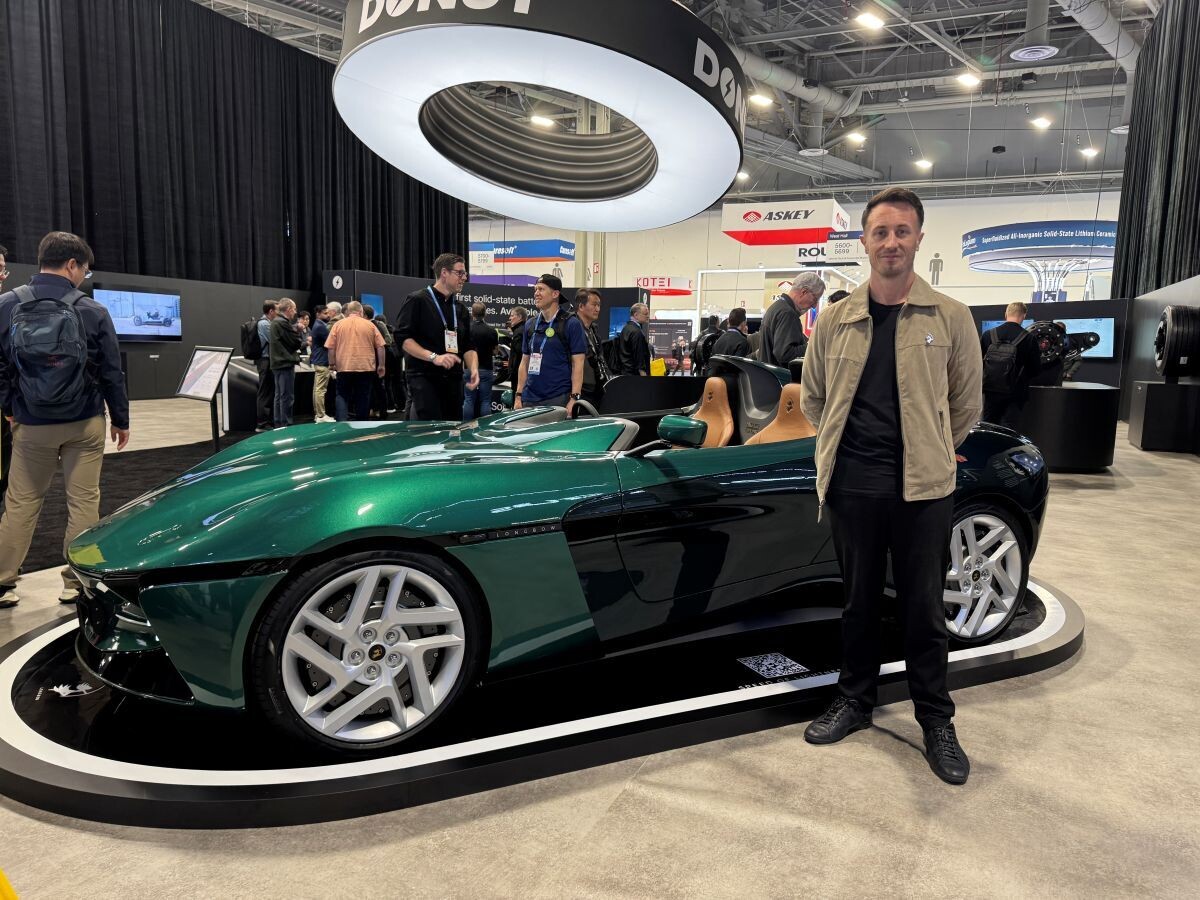
One of the unique vehicles on display at CES was the Longbow Speedster, an electric sports car that co-founder and CEO Mark Tapscott said has been designed and engineered with a focus on beauty, connection, and lightness. The company launched in March 2025, and the first Speedsters will be delivered later in 2026. They will be designed, engineered, and hand-built in the UK.
“At Longbow, we are blending new materials and technology, but accessibility is core to our brand,” said Tapscott. “It is critical to us that our vehicles must be able to be serviced by the market.”
He recognizes the importance of repairability. “Part of the solution to allow repairability is in how we select tried and tested components from a mature supply chain, and part of it is down to innovative design and manufacturing processes,” he explained.
Tapscott mentioned how cars have become heavier, larger, more complex, and more expensive. “EVs are heavy and the driving experience is often lackluster,” he said. In response, Longbow created a new vehicle category, the Featherweight Electric Vehicle (FEV).
“Light weighting improves everything — efficiency, performance, range, braking, ride, tire life, sustainability, the amount of material used and (we believe) joy,” shared Tapscott, who helped launch Tesla, Hyundai, Lucid Motors, and BYD over his career.
He said that performance EVs can easily weigh more than two tons. However, the Speedster will be 1,973 pounds.
“It represents the modern continuation of lightweight and engaging British sports cars like the Lotus Elise or Jaguar E-Type — a driver’s car for the electric age,” said Tapscott.
During CES, the company demonstrated what’s possible with the Longbow FEV platform when taken to the extreme, using in-wheel motors in a special 2,000-pound Speedster to achieve a 1:1 power-to-weight ratio.
Over the past decade, Tapscott said there has been a momentous shift within the automotive industry.
“Electrification has shaken up the sector in ways that few of us could have foreseen, and the technology has already come a long way,” he acknowledged. “When you consider that the automotive combustion engine has more than a century of optimization behind it, EVs are just getting started in many ways, but already there is a well-established supply chain that means it is easier than ever to enter the industry."
The company has experienced this firsthand. “By combining new and innovative technologies with tried and tested components, we have been able to make a lighter, more exciting sports car without compromising range, performance or cost,” said Tapscott.
The Italian Trade Agency showcases self-driving Fiat 500e vehicle
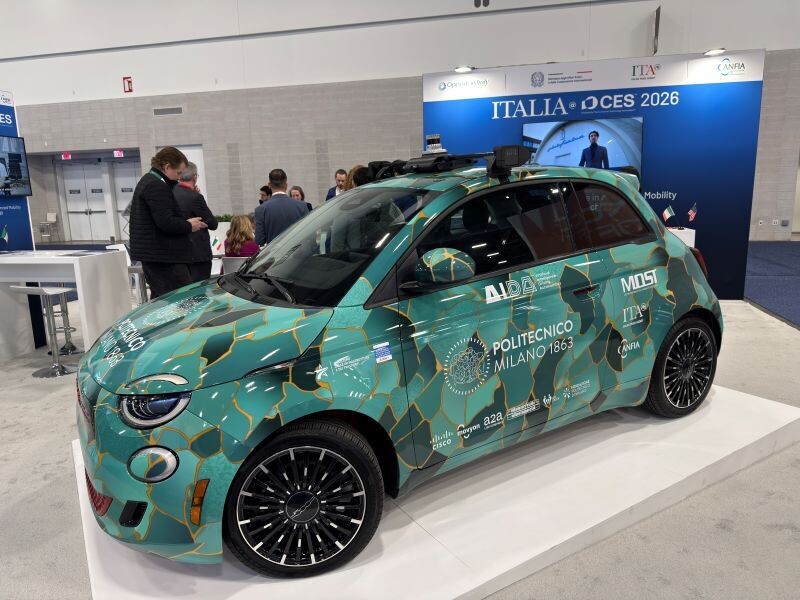 The Italian Trade Agency (ITA) presented a self-driving Fiat 500e, designed by students on the Artificial Intelligence Driving Autonomous (AIDA) team at the University of Milan, Politecnico di Milano.The Italian Trade Agency (ITA) presented a self-driving Fiat 500e, designed by students on the Artificial Intelligence Driving Autonomous (AIDA) team at the University of Milan, Politecnico di Milano.
The project was created to help design autonomous vehicles in Europe and showcase Italian engineering.
In addition, the ITA brought over 50 Italian startup companies to CES. These included businesses working on vehicle technology and safer mobility, from AI-powered safety systems and fleet solutions to next-generation sensing and onboard intelligence.
For example, Oraigo, a neurotechnology company tackling driver drowsiness, showcased Aigo, a wearable electroencephalogram (EEG) device with a mobile app and a fleet web platform that combines AI and brain-activity signals to detect early signs of fatigue and alert drivers in real time. The company said this will help prevent accidents while supporting companies regarding safety, risk reduction, and fleet efficiency.
Miovision demonstrates V2X Solutions
 The Miovision team showcased V2X Solutions and how the company’s technology is addressing traffic management and road safety across North America and Europe.Miovision showcased its comprehensive V2X Solutions, demonstrating how the company’s technology is addressing traffic management and road safety across North America and Europe.
A highlight of its exhibit was the demonstration of HARMAN Ready Aware, a vehicle-to-network solution delivering contextual in-vehicle digital alerts on road and traffic conditions, including time-to-green notifications and red-light assist features.
“V2X is more than a communication technology,” explained Miovision CEO Kurtis McBride. “It is the entire framework, including distinct use cases supported by vehicle, traffic signal, communication tech, plus corresponding business models.”
He shared that V2X technology is transforming modern vehicles by connecting them to traffic signal control systems at 84,000 intersections and 68 countries, delivering critical real-time information to enhance safety and efficiency. The company’s Personal Signal Assistant already powers premium automotive features in vehicles from Audi, Lamborghini, Bentley, and Porsche, helping drivers make safer, more informed decisions at intersections through cloud-connected infrastructure intelligence.
McBride advised collision repairers to prepare for more vehicles equipped with cloud-connected features that tap into infrastructure intelligence at scale, delivering contextual alerts that help drivers anticipate what's ahead without requiring direct vehicle-to-infrastructure connections.
“As we continue scaling our AI-powered intelligent mobility platform with focused investment in predictive analytics and deeper safety insights, we'll see expanded collaboration between transportation agencies, public safety organizations, and automakers to create smarter, safer streets for all road users,” he added.
The future of vehicles
From featherweight EV platforms to student-built autonomous prototypes and infrastructure-connected vehicles, CES made one thing clear: the next generation of cars will be lighter, smarter, and more deeply integrated with the world around them.




Stacey Phillips Ronak