


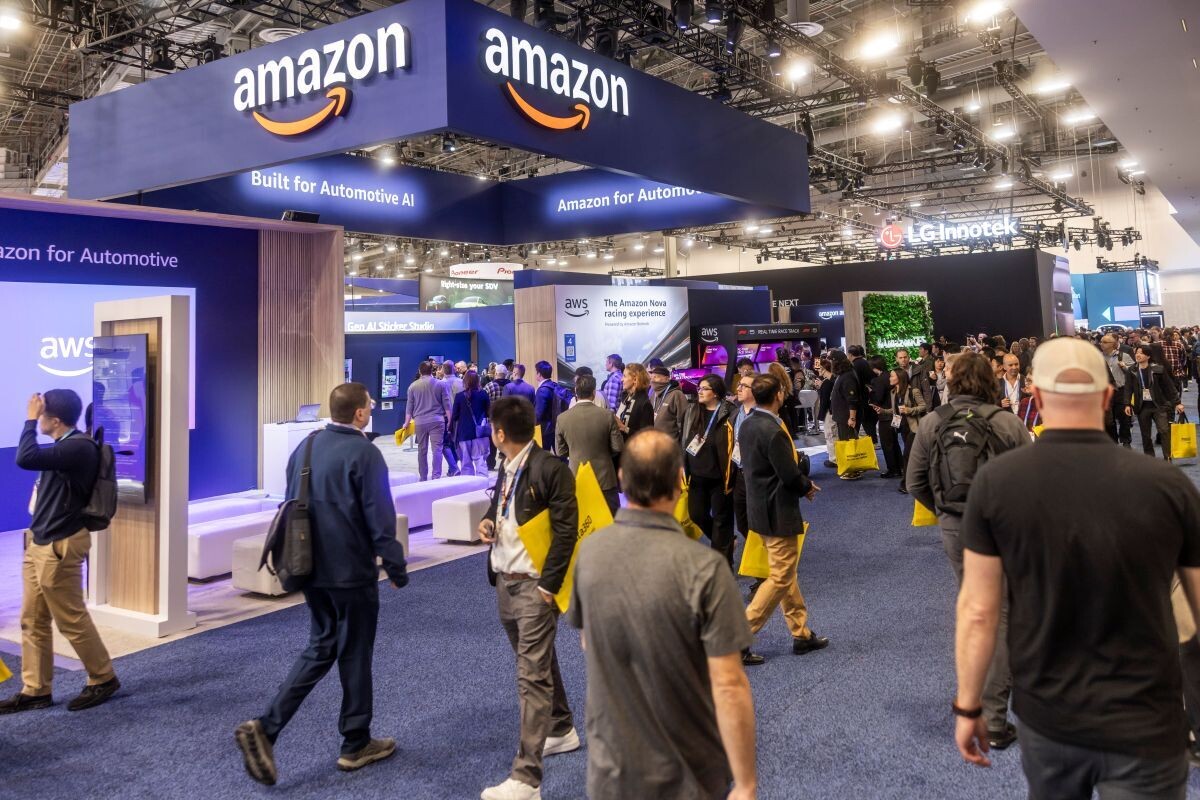
This article is part two of three in a series on CES, which took place in January.
During the four days that CES took over Las Vegas, approximately 148,000 attendees had the chance to see the future of vehicles and what collision repair shops can expect in the years ahead. From advanced driver-assistance systems (ADAS) and hands-free driving technology to AI-powered in-cabin monitoring, 4D imaging radar, and software-defined vehicle platforms, automakers and tech companies are layering vehicles with sensors, cameras, and intelligent processing.
S&P global mobility analysts recap CES 2026 automotive insights
Following this year’s event, S&P Global Mobility senior analysts held an AutoTechInsight webinar to provide a recap of CES 2026 and highlight key automotive trends.
Brock Walquist, a senior analyst on the in-vehicle autonomy team at S&P Mobility, noted several announcements made during CES. These included:
- Sony Mobility’s AFEELA Intelligent Drive and the introduction of an SUV prototype with expected production in 2028
- Ford’s plans to debut the next-gen L2+ BlueCruise system in 2027
- L3 eyes-off driving in 2028;
- A pitch by Tensor for a personally owned Level 4 autonomous vehicle.
Connected and autonomous vehicles take center stage
A variety of connected and autonomous vehicles were on display, such as the new Mercedes-Benz CLA with MB DRIVE driver assistance and automated driving technologies, and the BMW iX3 with Panoramic iDrive and an AI-powered Intelligent Personal Assistant with Alexa+ technology.
Walquist mentioned that Geely was front and center, showcasing impressive vehicles with sensor configurations and lidar. Although he said it is unlikely that Geely cars will be sold in the U.S. market, they signal the next generation of automated driving systems and architectures.
Phil Amsrud, S&P Global’s senior principal analyst for the automotive semiconductor research area, with a special focus on ADAS and autonomous vehicle technology, pointed out the growing alignment between autonomous vehicles and robotics.
“Both will leverage physical AI and as such, the lessons learned from autonomous vehicles is directly applicable to robotics,” said Amsrud.
Amazon Web Services enters the AI and self-driving vehicle space
AUMOVIO and Amazon Web Services (AWS) announced an agreement during CES to help accelerate the development of safer, smarter self-driving vehicles.
The collaboration integrates agentic and generative AI capabilities into AUMOVIO’s autonomous development and validation workflows, which the companies said will speed up the time it takes manufacturers to develop, test, and ready autonomous vehicles for real-world deployment. The solutions will be used for the first time to deploy Aurora’s autonomous trucks at scale.
Company representatives shared that developing self-driving vehicles requires processing massive amounts of information, including millions of road scenarios, driver behaviors, and safety situations. The collaboration will help create scalable solutions that rapidly process this information.
"At AWS, we believe the future of autonomous mobility isn't just about technology — it's about enabling our partners to deliver on the promise of safer, more efficient transportation at scale,” said Ozgur Tohumcu, general manager of Automotive and Manufacturing at AWS.
Amazon recently announced the next evolution of Alexa Custom Assistant for vehicles, offering in-vehicle conversational AI, with technology built on top of the Alexa+ architecture. BMW Group will be the first to utilize this technology.
“AI is supercharging automakers' evolution to software-defined vehicles, transforming cars from static hardware into intelligent platforms on wheels," said Tohumcu. "Manufacturers can now develop and validate at the speed of software — tasks that once required years and significant resources can be accomplished with AI in a fraction of the time."
Ambarella says autonomous vehicles will be plentiful on the streets
Ted Chua, director of product marketing and radar technology at Ambarella, shared that collision repairers can expect to see a lot more autonomous vehicles on the streets in the future.
“These vehicles will be equipped with high-performance 4D imaging radar, cameras, and lidar, giving the smart vehicle the ‘eyes’ and ‘ears’ to drive autonomously,” he said. They will not only be passenger cars, but also autonomous street sweepers, cargo/goods delivery vehicles, buses, and more.
“Eventually, all these vehicles will be unmanned, zigzagging along the streets harmoniously and safely without a single human operator,” said Chua.
Ambarella supplies low-power, high-fidelity camera plus AI SoCs (System-on-a-Chip) that enable ADAS and autonomous systems to see the road and make decisions in real time. The company’s camera SoCs are also used for in-cabin monitoring for driver and occupant safety. An SoC is an integrated circuit that consolidates most or all of a computer system’s core components into a single chip.
“Our low-power SoCs combine high-resolution video compression with advanced image and radar processing and powerful neural network acceleration, so customers can build systems that see, fuse sensor data, and plan intelligently,” Chua explained.
During CES, Ambarella demonstrated its latest low-power, high-performance edge AI CV7 SoC, running next-gen video security and automotive workloads with cameras that Chua said deliver standout image quality and run powerful AI right on the device.
The company also walked attendees through automotive demonstrations that fuse vision and radar to enable safer, more automated driving experiences.
“At CES 2026, we showed how far we’ve pushed intelligence at the edge — in cameras and cars, not in the cloud,” said Chua, who noted how Ambarella’s technology shows up in various edge AI and human vision systems — from video security and ADAS to electronic mirrors, telematics, in cabin monitoring, autonomous vehicles, edge infrastructure, drones, and other robotics.
“We give automakers and Tier 1s a full stack platform with flexible sensor fusion, so they can bring in radar, lidar, and other inputs as their designs require,” said Chua.
The company also offers its own Oculii 4D imaging radar, which can detect objects out to roughly 350 meters.
“Imagine a car has super sharp ‘invisible eyes’ that work even when normal cameras can’t see very well, like at night, in heavy rain, or in fog,” said Chua. “Ambarella’s Oculii 4D radar is like that: it sends out radio waves, listens for the echoes, and uses AI to build a detailed 3D picture of what’s around the car, including how far away things are and how fast they’re moving.”
When that radar is fused with the company’s camera/AI SoC, Chua said the system can understand what’s happening on the road — even in situations where the camera alone can’t see clearly. When the radar is combined with regular cameras, he said the car can understand the road much better and make smarter decisions about speeding up, slowing down, or stopping to avoid an accident.
During CES, guests were invited to drive around in an SUV equipped with the company’s Oculii 4D imaging radar.
Looking ahead
As vehicles grow smarter and more autonomous, collision repair shops will face new challenges and opportunities to work with advanced sensors, AI systems, and software-defined platforms. Staying ahead means understanding the technology behind the car.





Stacey Phillips Ronak