



As the search for skilled talent continues among independent body shops and MSOs, collision repair programs nationwide are stepping up to the challenge by training the next generation of technicians.
Larry Ramos, professor of automotive collision and department coordinator at Cypress College in Cypress, CA, emphasizes the importance of industry involvement to ensure collision programs are successful in helping to train and place students.
Over the years, he has found many older technicians are intimidated working with students and entry-level technicians who they feel may take their jobs.
“That's unfortunate because we're all aging out,” noted Ramos, who has worked at the college for more than 20 years, helping to prepare students to work as collision repair technicians, frame and structural alignment technicians, and automotive refinishers.
Ramos was always passionate about working on cars. From the age of 17, he painted neighbors’ vehicles in his parents’ garage and later for the city and police department.
When Ramos graduated from high school, he recalls being called a “huge disappointment” by his career counselor who encouraged him to take a job at the Orange County Fire Academy.
“He said, ‘You’re a bright young man… You could make captain by the time you're in your 30s, and probably battalion chief by the time you're in your 40s,” Ramos said. “I don't know if that was true or not, but I told him that I appreciated the opportunity but I really want to learn how to repair cars.”
Ramos ultimately joined the auto body program at Cypress College in the late 1970s and his mentor, Jack Dainko, took him under his wing. He worked in the industry until 2007, when he became an adjunct professor and then a full-time professor.
Although the industry has changed since Ramos first joined the program, he said technicians still have a common trait: being problem solvers.
“We need to figure things out,” he said. “It’s really up to us to make a decision as to how we're going to approach the job.”
Ramos and his team of instructors work to instill that in the young people they teach every day.
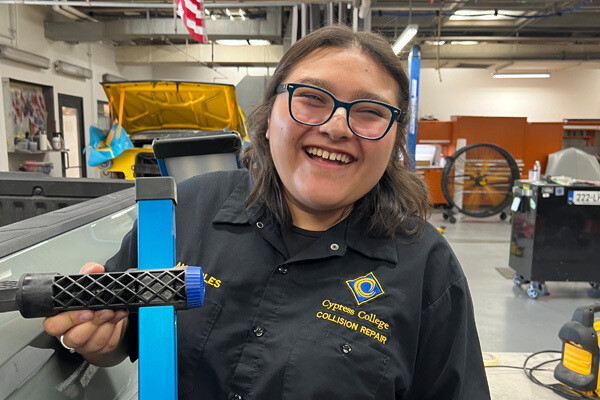 Every semester, approximately 200 students attend the program at Cypress College. The North Orange County Community College District includes two colleges: Cypress and Fullerton. Ramos said the automotive technology department is one of the largest and most notable in the nation.
After the pandemic, the college faced some challenges and many classes were held virtually.
“I was speaking to black screens because by California law, we're not allowed to force students to have their cameras on,” he explained. “It was a tough road to recover from.” However, he said classes are now at maximum capacity with a waitlist.
“We're very impacted and cannot get people out quickly enough,” he shared.
Every semester, approximately 200 students attend the program — the only National Automotive Technicians Education Foundation (NATEF) public collision repair program in California, Ramos said. The training offered is both theoretical and practical and the college offers an associate in science degree, several certificate options and is I-CAR/NATEF/IDA certified.
He emphasized how hard they work to maintain their certification and support students in furthering their education by taking I-CAR classes and maintaining ASE certifications by the National Institute for Automotive Service Excellence.
“They’re only going to be more valuable to the shop that they’re working for,” he said. “It also gives the shop more credibility.”
He noted how intelligent many of his students are.
“I’m humbled and proud to teach sharp people because they are going to be successful in anything they put their mind to,” he said. “I feel privileged that they came to my department to learn my craft.”
Ramos said students often suffer from the “looking at their shoes syndrome.” To help build their confidence, he encourages them to speak up.
He advises students to be pleasant workers whom someone wants to hire and always leave on good terms. “If you have to come back and work for that person for whatever reason, you will have a door open for you,” he said.
Ramos also counsels them to learn from their mistakes and grow as employees.
“I strive to work better every single day,” he said. “Even at 65, I learn every day from my students. It's awesome.”
Many graduates earn a good wage, whether they join a dealership, independent shop or MSO.
Ramos has found it isn’t uncommon for them to move from job to job. “It’s a natural progression,” he explained. “I don't expect them to stay in one location for a long time. That's my generation. The young people are more mobile.”
He is a firm believer there’s room for every level of student.
“I don't want to say I coddle my students, but I need them to be successful,” he said. “This isn't an English class. We're here to make you into good, qualified technicians.”
He often points from his podium through the glass windows in his lab and tells students, “I'm not so concerned about what you're doing here as I am what you do out there. Let's shine out there on the shop floor. Let's get you in the trenches and get you productive. Let's get you working.”
Why Industry Involvement is Critical
For the collision program to be successful, Ramos and his team rely on industry involvement.
“I can't stress that enough,” he said. “If we thought for a minute that we didn't have industry support and shop owners and managers actively seeking out students, it would make our jobs much more difficult.”
Over the years, Toby Chess has supported Ramos and his team’s efforts at the school.
“Toby was teaching our estimating class years ago, and he and I clicked,” recalled Ramos.
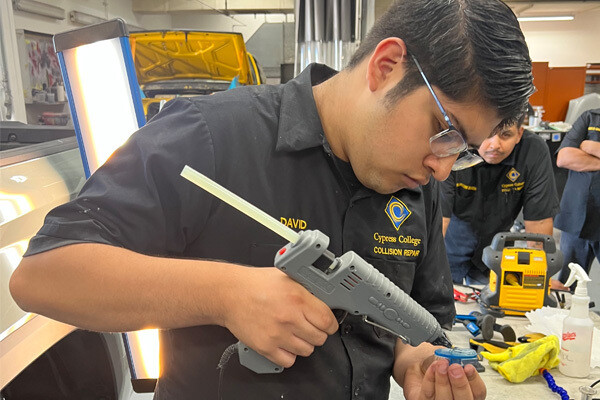 Larry Ramos advises students to be pleasant workers whom someone wants to hire and always leave on good terms.
Chess regularly reaches out to shops in the Los Angeles and Orange County, CA, areas to support college programs like the one at Cypress College and demonstrate new repair techniques.
This year, more than 42 body shops donated $15,000 to purchase equipment from KECO, Dent Fix Equipment and Astro Tools for the program.
Chess is now focused on asking shops to donate funds and equipment for the Norwalk High School program in the state. A frame machine, measuring system and I-CAR curriculum has already been provided through his efforts and the industry. “It is a great start,” said Chess. “It’s all about supporting the school programs and showing students how to use the equipment.”
Chess also acts as a liaison between the department and potential employers.
“That's huge for us because our placement rate is quite high and we provide technicians to all major MSOs as well as independents,” said Ramos.
Several months ago, Chess told Kye Yeung, president of European Motor Car Works, about an “exceptional” student at Cypress College seeking employment. Although Yeung wasn’t looking to hire a new team member at his Costa Mesa, CA, facility, he set up an interview with Edgar Mendoza after Chess’s recommendation.
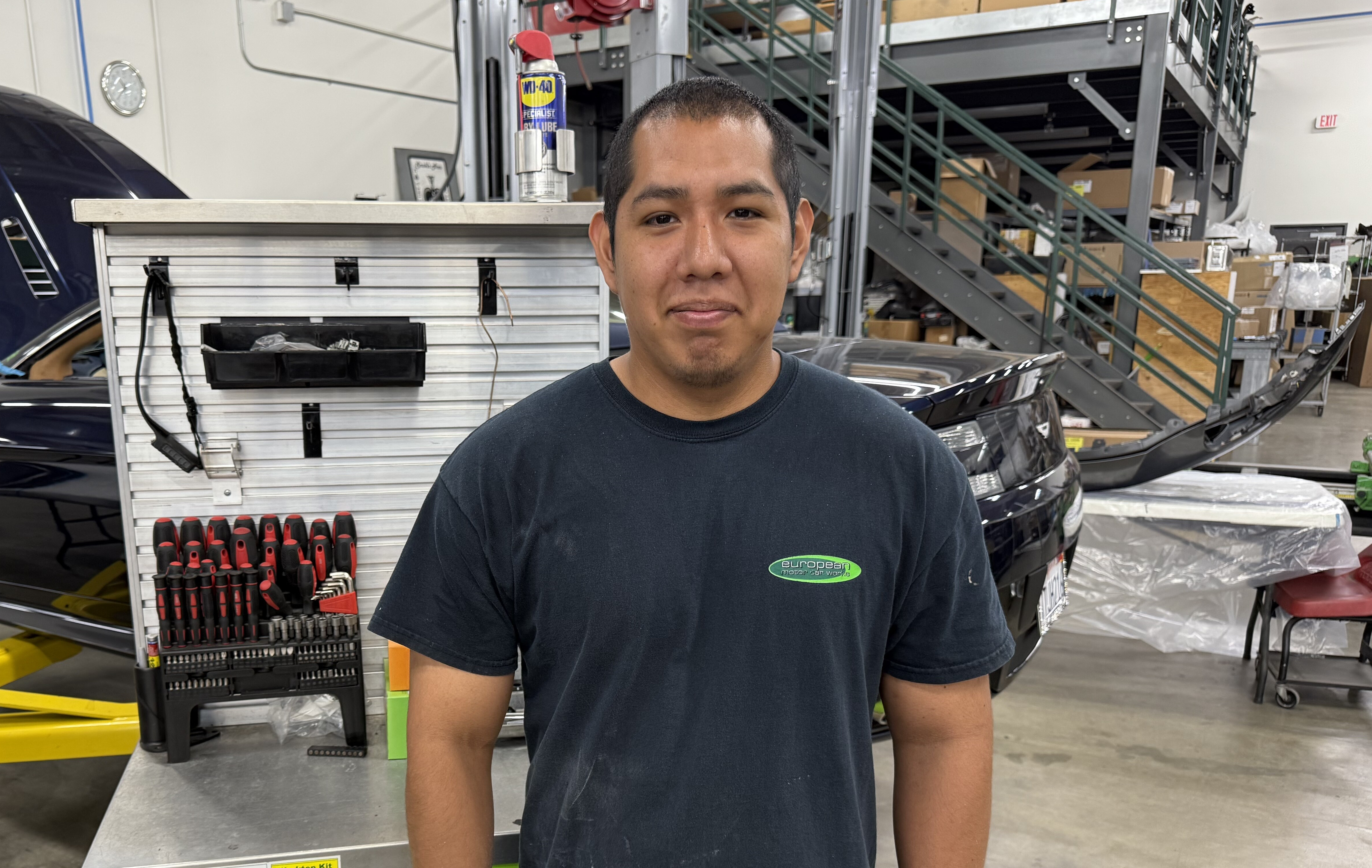 Kye Yeung, president of European Motor Car Works, recently hired Edgar Mendoza, pictured here, a student at Cypress College.
“You don't get those bright stars all the time,” Yeung noted. “If you have a gentleman or a lady who comes in with a good attitude and does the interview without any reservations and handles themselves very kindly, you want to give them an opportunity because those are far and few between.”
After Mendoza told Yeung he wanted to be a painter someday, Yeung said he might want to consider working as a technician to gain an understanding of how vehicles are constructed.
Mendoza agreed. The shop assembled a toolbox for him with new tools suited for an entry-level technician.
“The other technicians had the same type of toolbox, so he didn't feel any inferiority,” said Yeung.
Every night, Mendoza was expected to put his tools back in their designated places.
“That's how we would judge whether or not he was capable of working on the cars we repair,” Yeung explained. “If he couldn't put tools back in the right spot, how would we be guaranteed that he put the right bolt or nut back on the vehicle when he assembled it?”
Yeung said this test is an example of what they look for when creating the perfect technician.
“We were pleasantly surprised that his hand-eye coordination was way ahead of most young people who come in and start in that field,” Yeung said. “It looked like he had some obvious experience.”
Yeung attributes that to the basics Mendoza learned at Cypress College. Since joining the shop four months ago, Yeung said Mendoza is becoming a good, well-rounded technician.
“He has done a really fine job understanding the dynamics of how our shop works and what his responsibilities are,” he added.
Recently, there was an opportunity for Mendoza to move to the paint department.
Yeung encourages recruits to never shy away from opportunities. “When it's slow, you won't get sent home because you have other talents,” he said.
If asked to take on a position where they might feel uncomfortable, he recommends trying it anyway and learning a new skill.
“It might not be what you like to do, but always take advantage of those opportunities,” Yeung advised.
Yeung is very passionate about the value that community colleges bring to help replenish the workforce, especially since he attended an auto body program at a community college and has run his business for more than 50 years.
“They have affordable tuition, and it gives students an opportunity to go out in the workforce and learn a skill,” noted Yeung. “I've had guys who have worked for me for years retire or pass away, unfortunately, and to replace them is not an easy task.”
The goal is to find interested students with a great attitude.
“It's very hard to teach attitude,” said Yeung. “We can teach almost everything else, but if they have a good attitude, then the learning comes so much easier.”


Stacey Phillips Ronak