


Every year, the SEMA Show is the best chance to outfit or update a collision repair shop, and 2025 will be no different. From Nov. 4-7, the Collision Repair and Refinish Hall, located in the South Hall of the Las Vegas Convention Center, will be filled to the brim with vendors selling everything a shop could need.
Autobody News spoke to shop owners and vendors about how attendees can navigate the show and make the best use of their week.
Why Shop Owners Go to SEMA
Cory Lanier of Auto Body Masters Inc., a family-owned shop in Carrollton, GA, attended the SEMA Show for the first time in 2024, and is making the trip again this year, along with the shop’s painter.
Lanier said he goes to SEMA to see emerging trends and new products for himself.
“It's easy to see something in a magazine or on an equipment list and say, ‘I need that,’ but once you get right there in front of it, you can put your hands on it, it makes it a whole lot easier to make a decision,” Lanier said.
“There were a lot of things [in 2024] that I thought I wanted, but then when I saw them, I was like, ‘Well, maybe I don't need that,’” he added.
Most of the purchases he made as a result of the 2024 SEMA Show were software add-ons for solutions from CCC and ALLDATA that Lanier’s shop was already using. This year, Lanier is diving into ADAS as the shop considers bringing those services in-house.
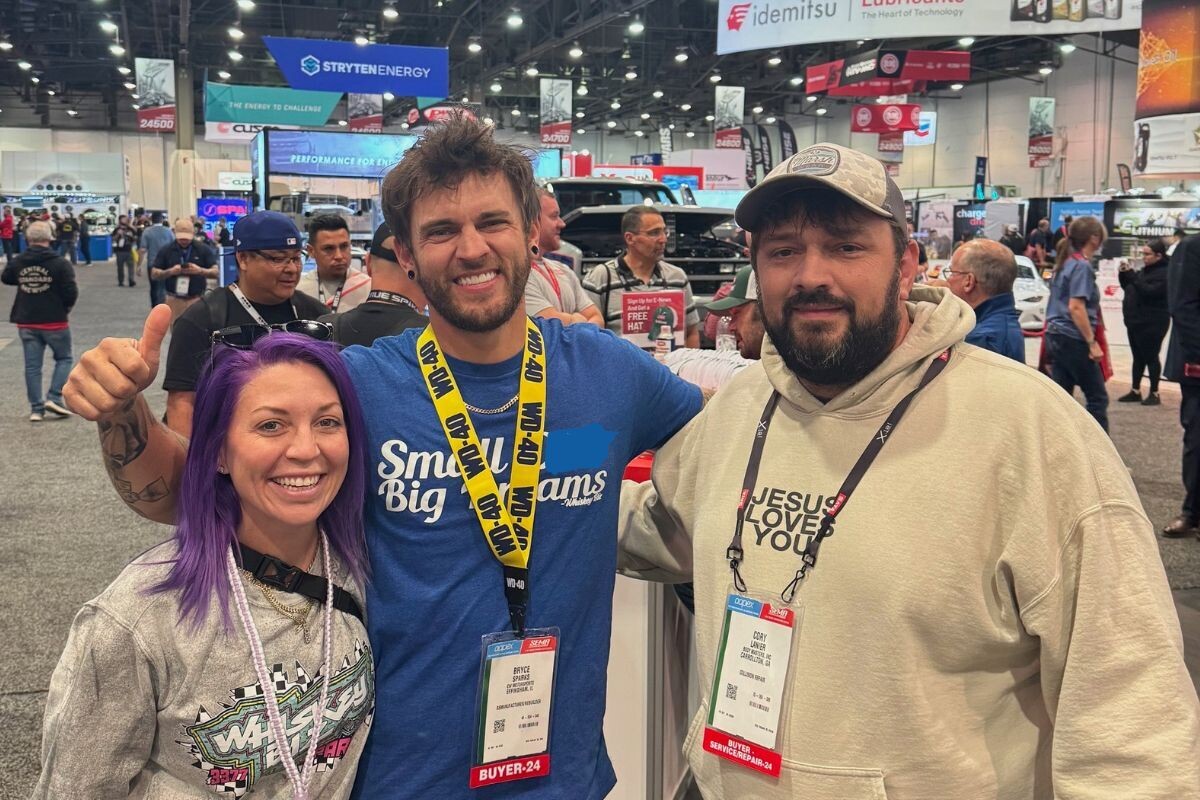 Cory Lanier, right, with influencer Bryce Sparks, center, and Paige Sparks, left.
For a single independent shop like his, large investments like ADAS equipment need to be carefully considered, he said.
“We're not like a lot of bigger shops where…they can throw money into something and then if it didn't work, move on,” he added. “If we throw money into something, there's not a whole lot of adapting there. We gotta make it work at that point.”
Lanier said he has held off on buying ADAS equipment for a few reasons.
“A lot of times when you jump too early on stuff like that, there's so many changes early on,” he said. “You invest a ton in equipment, and within six months you're outdated again. You almost have to time pulling the trigger on stuff like that perfectly.”
Waiting to make those investments also gives other companies time to develop their own versions, which might work better or cost less as competition increases, Lanier said.
Darren DuVall is the CEO of Driving Force Collision, a growing MSO based in the Northeast with six — soon to be seven — locations, and a former senior vice president with Crash Champions. He has been to the SEMA Show several times.
DuVall said the shops Driving Force targets for acquisitions are already up to date on tools and equipment, so most of his SEMA experience this year will be spent meeting with paint and parts vendors.
He is also planning on attending the MSO Symposium, held the day before the show opens on Nov. 3, as well as other events, “to get industry updates, knowledge, networking,” he said.
“The collision industry is such a relationship business,” DuVall said. “There's a lot of people that I do business with that the only time of the year that I see them in person is the SEMA Show.”
Advice for Shop Owners Going to SEMA
Both Lanier and DuVall said attendees need to map out a plan.
“You need a plan in place, because it is overwhelming,” Lanier said.
DuVall recommended attendees research the show floor to see where the vendor booths they want to visit are located.
Lanier said he felt like that was where he messed up last year.
 Attendees look at equipment on display at Pro Spot's booth at the 2024 SEMA Show.
“Last year, I just started at the beginning and I worked my way through,” he said. “This year, I want to start with the places that I know I need to see, and then flow out into the places that are secondary, that I just want to see. So go take care of the needs first, and then handle the wants later.”
“Just know that there's a good chance you won't be able to do everything you want to, so I would prioritize what's most meaningful that you want to accomplish while you're there,” DuVall said.
Lanier agreed: “It's bigger than you can even explain to somebody,” he said. “I felt like I had a good plan [in 2024], but it's really easy to what we call ‘squirrel out’ — you see something halfway across the room and you're like, ‘I wanna go.’”
For vendor visits, early is better: “Being on the floor early probably gets you…more face time with the people working the booth without the crowd,” DuVall said.
“Make sure you go to bed early and wear very comfortable shoes,” he said. “Don't let the nightlife get too much of a hold of you. Charge your phone, carry business cards or digital business cards for networking, drink plenty of water and take your vitamins.”
Do Your Homework
Representatives of several companies that will be exhibiting at the SEMA Show spoke about the information shop owners should bring about their businesses to help vendors make the best recommendations.
Andy Noyes, senior vice president of sales and strategic accounts for asTech, said when speaking with shop owners, he wants to know the size of their business in terms of monthly sales and vehicle throughput, if the shop is focused on DRPs or OEM certifications, and what processes and tools they are currently using.
That helps Noyes figure out where asTech can help: “What are the gaps?” he said.
Pete Liebetreu, vice president of marketing for Hunter Engineering, said he wants to know how many services — like alignments, tire and wheel services and ADAS calibrations — a shop is currently outsourcing, and which ones they might be interested in bringing in-house.
 asTech's booth at a previous SEMA Show.
“What we have found is that auto body shops who are getting really, really focused on quick turnaround times are insourcing more and more of those services that they might have otherwise sent out,” Liebetreu said.
It would also be helpful to know why the shop is currently outsourcing that service, whether it’s because they don’t have the space or if because they don’t feel comfortable doing it themselves.
The shop owner should also bring an idea of what it’s costing them in time and additional charges to outsource services, and whether they’re passing along those fees to customers.
He recommended shop owners interested in Hunter’s equipment visit hunter.com/roi before the show and use the tools there to get an idea of return on investment.
“Have a good idea whether it's a profitable service for you or not,” he said. “In most cases it is, but it's good to know what the payoff is. For most businesses, basically if it's under a year, you should be doing it. If it's a year or two, then it's a little bit more of a decision-making process.”
Jordan Smith, strategy manager for Pro Spot, said when speaking to vendors, attendees should “know your business:” typical WIP, top line revenue, bay capacity, etc.
They should also have facility-specific information, like what kind of power is running to the building, or if there are areas where the Wi-Fi is stronger for interconnected devices.
Shop owners should keep their facility’s footprint in mind when considering equipment purchases, said John Shewbridge, collision and undercarriage training specialist with Snap-on.
“Everybody wants that ‘Swiss Army knife,’ a machine that will pull frames, do ADAS calibrations and perform an alignment,” Shewbridge said. “All manufacturers have their own take on that, but if you look at the mammoth size of some of this equipment, the thing is footprint and portability.” For instance, if that piece of equipment is locked in place in an alignment bay, it may not have the space needed for many ADAS calibrations.
Buy Based on Goals — Not Fear
Shewbridge said he has been to SEMA as a technician, a shop owner, an insurance company representative and now representing an equipment manufacturer. In his current role, he sees that “a lot of folks buy on impulse and emotions.”
He recommended shop owners go to the show with their mid- or long-term business goal in mind, which could be moving from DRPs to OEM certifications or eventually selling to an MSO.
“There are folks that are going [to SEMA] investing in any equipment just to get curb appeal for getting ready to sell out to an MSO,” he said. “If you do the cheap out, the auditors from the MSO know what to look for, so you may be spending thousands of dollars only to gain hundreds back.”
There are a lot of good deals to be found at SEMA, he said, but the product has to match the business goals. “Push out the emotions,” he said.
 Hunter Engineering's booth at the 2024 SEMA Show.
Shop owners who don’t want to invest in a needed piece of equipment because of the current slowdown in work are missing the big picture. “Right now will be the time to get going,” Shewbridge said.
He said he had recently spoken to two OEMs that will probably need double their number of certified shops when work picks up again.
“I've been in this industry for 45 years plus,” Shewbridge said. “It gets slow, but it never stays slow.”
“The bottom line is that people going to SEMA this year should be looking at the equipment that is going to be a best fit for their shop in the next three to five years, not necessarily the current business climate, because in your current business climate, you're buying on emotion and fear,” he said.
Smith advised attendees avoid impulse buys. There may be a few deals only available during the show, he said, but most are available for another month or two after it.
“Negotiate now and plan to buy later,” he said. “For the most part, it's really a great time to shop and understand what all of your options are.”
Consider Training and Support, Not Just Price
Shop owners also need to look at the training and support offered by the manufacturer when choosing equipment, Shewbridge said.
“Am I gonna get my dollar’s worth out of this product before I have to call for service, and when I call service, how many folks do you have available to keep me up and running?” Shewbridge said.
A small distributor may only have one or two service technicians to cover three or four states, he said. Larger distributors usually have a bigger team who can service the equipment the same day it breaks.
Smith also said shop owners should look for vendors with strong distribution and service coverage.
“When your booth goes down, when your welder goes down, whatever it is, it can be stressful, so it's always great to know what that's like before you make a purchase commitment,” he said.
Attending the SEMA Show is a chance to meet the people you would be partnering with if you buy a company’s product.
“We may not have the exact rep [at the show], but we'll have probably the regional manager that would be in that [shop’s] area,” Liebetreu said.
The Value of In-Person Shopping
Shopping for equipment in person gives attendees the chance to see the quality — or lack thereof — for themselves.
“I look at a lot of equipment and there's times where I go, ‘Dang, that thing looks pretty good on the website,’ but look at it here — rough welds, horrible texture, horrible paint,” Shewbridge said. “It would be like buying a used car off the internet. You have to lift up the hood, take it for a test drive.
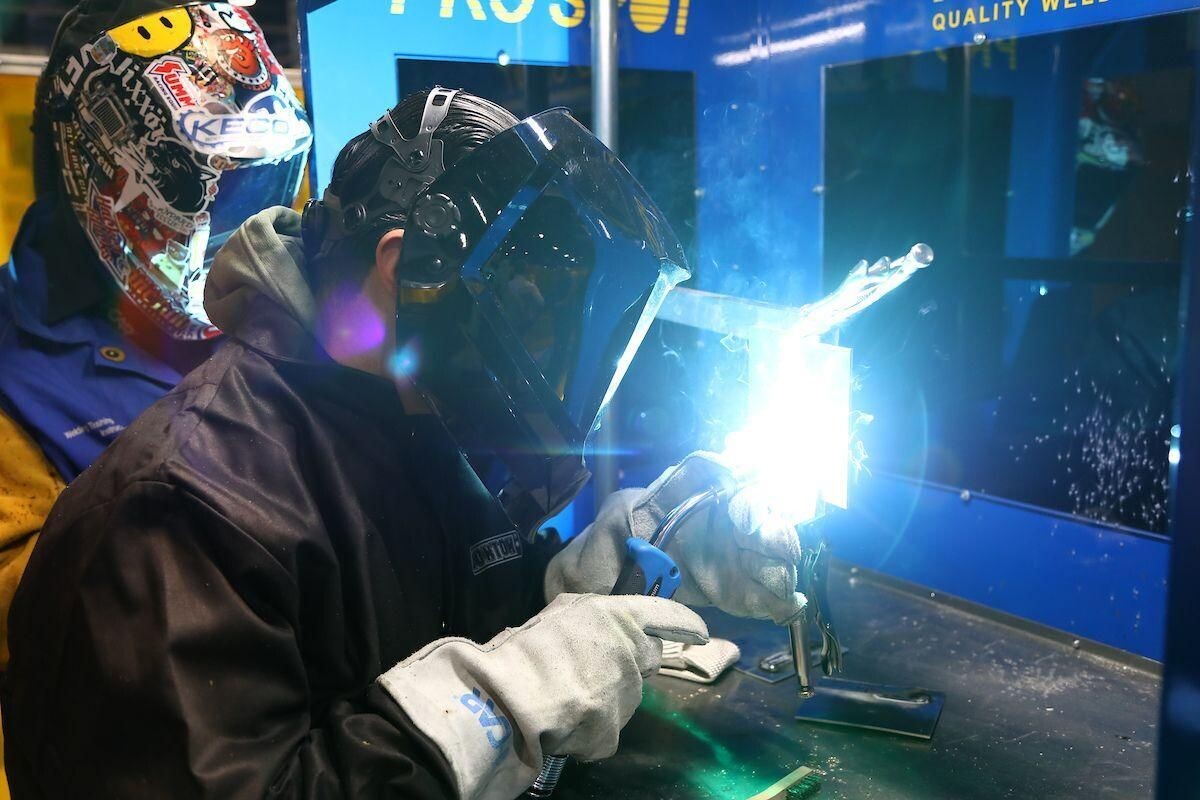 A welding demo at the Pro Spot booth.
“If I'm updating a shop, buying welders, frame straightening equipment, updating paint booths, you're looking at about a half-million worth of investment,” Shewbridge added. “That's worth getting on an airplane, flying out to Vegas and focusing at least a day or two on equipment, and then go out, have a good time for a day or two, think it over, and come back and sign the papers on the last day.
“I personally make clear decisions when I'm when I'm putting my hands on it,” he said. “I'm a little old school.”
“They are expensive pieces of equipment, and you want to make the best investment,” Liebetreu said. “It's probably not the kind of investment you want to do simply over the phone or, God forbid, do an internet purchase. Definitely get your hands on it while you're at SEMA.”
Liebetreu recommended attendees make appointments to meet the vendors they absolutely want to talk to, if possible. Those who want to make an appointment with Hunter can reach out to their regional manager to do so, which they can also find on hunter.com.
Smith said going to a show like SEMA to meet manufacturers and have a personal conversation is huge.
“We're still so much a relational industry,” he said. “The face to face interaction — whether it's with the customers bringing their vehicles into the shop or it's your distributor, your manufacturer.”
The SEMA Show is one of the only times everyone in the industry is in the same place.
“It's a great opportunity to, in a relatively short period of time, see everything or at least see a lot of everything that's out there and really be able to create that good comparison,” Smith said.
Attendees shouldn’t be shy, he advised.
“A lot of these booths, they've got the welcoming committee right there at the edge, wanting to welcome you into the booth,” he said. “They're not going to be shy. You shouldn't either. Just go in, make a personal connection, and start asking those questions that you came prepared with.”
Liebetreu said sometimes shop owners come to Hunter’s booth at SEMA with questions about best practices, which can be answered by some of the technical employees who will be at the show.
“We'll be happy to assist in any way we can,” he said. “It's not just about selling equipment. We will be happy to speak with anyone about just helping them through their business needs.”
Have a Plan, But Allow Yourself to Be a Little Amazed
Jennifer Hawxhurst, vice president of sales for asTech, said attendees should go in with a game plan.
 There is a lot to see and do beyond the Collision Repair and Refinish Hall at SEMA. Take some time to look around.
“Really be specific about why you're there and what you’re looking for to improve the way you operate your business and improve the way you help your customers,” she said. “You can take the driver's seat, pun totally intended.”
Liebetreu recommended attendees don’t pack their agenda too tight: “Maybe one or two appointments in the morning, one or two in the afternoon, look at your [show floor] map ahead of time and get it geographically worked out. That's what we tend to find our most successful customers have done, and then just enjoy the show.”
Smith said attendees should “also plan some time just to allow yourself to be amazed a little bit.”
“There's so much to see you while you're there, especially if it's your first time,” he said. “Set some time aside to really soak in everything that SEMA has to offer, whether it's the cars on display or the vendor booths.”
asTech, Booth 32195 in South Upper Hall, will be displaying new products including its Generation 3 pass-through device and Connected Calibrations.
Snap-on® Total Shop Solutions, Booth 32017 in South Upper Hall, will be displaying equipment from several brands, including Car-O-Liner, John Bean and Hofmann.
Hunter Engineering, Booth 42017 at the front of South Lower Hall, will feature 18 new innovations and 13 updated products, including ADAS, wheel alignment and inspection equipment, as well as wheel alignment lifts, tire changers and balancers.
Pro Spot, Booth 23049 in South Upper Hall, will display welding, dent pulling and riveting equipment, as well as some robotics and automation offering a look at what the industry could look like a few years from now.


Abby Andrews