The collision repair industry has long known that hail work is feast or famine. When storms hit, shops in the damage corridor face an overwhelming surge of vehicles and an equally overwhelming challenge: documenting damage quickly, accurately, and in a way that satisfies increasingly remote insurance adjusters.
Mobile Environmental Solutions (MES) has developed a tool that addresses this challenge head-on: a portable, inflatable hail damage estimation tunnel that transforms how shops identify, document, and get paid for hail damage repairs.
The problem with traditional hail estimation
Anyone who has tried to complete a thorough hail damage estimate under normal lighting understands the difficulty. The industry's traditional approach involves a light board (typically two to three feet long and about 18 inches wide) that an estimator moves panel by panel across the vehicle to reveal dents through reflected light lines.
The process is time-consuming and inconsistent. Miss the right angle on a quarter panel, and you miss dents. Miss dents, and you leave money on the table or face a supplement battle with the insurer later.
"The naked eye wouldn't pick this up," said Tom Williams, president of Mobile Environmental Solutions. "This is where the tunnel saves time and money."
How the tunnel changes the equation
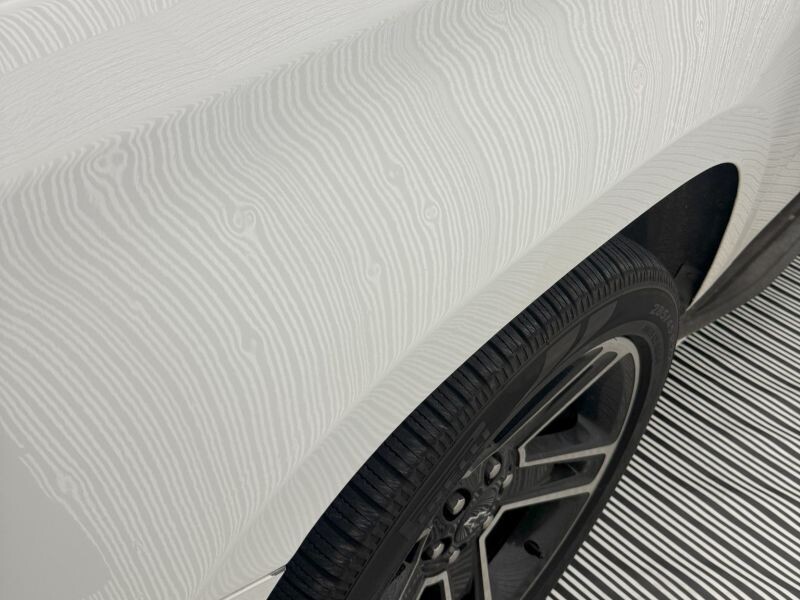 The MES Hail Damage Tunnel projects uniform light lines across the entire vehicle simultaneously, eliminating the need to reposition equipment panel by panel. The result: estimators can identify damage that would otherwise go undetected, and they can document it in a fraction of the time.
Williams reports that shops using the tunnel save between 40 minutes and an hour and 15 minutes per vehicle compared to traditional methods. For a shop processing hail-damaged vehicles at volume, that efficiency compounds quickly.
"Instead of making 10 appointments a day, they could probably do 20," Williams explained. "They could probably double their workload."
The tunnel accommodates full-size cars, trucks, SUVs, and vans, and can be set up indoors or outdoors. When used outside, the translucent material allows natural sunlight to create the same line-reflection effect, eliminating the need for powered lighting entirely.
Setup takes less than 10 minutes — what MES calls "bag to booth" — making it practical for shops to deploy the tunnel only when needed rather than dedicating valuable floor space.
Leveling the playing field with insurers
In the post-COVID claims environment, insurance companies increasingly rely on photos and video rather than sending adjusters to physically inspect vehicles. This shift has created both opportunity and friction for repair facilities.
The MES tunnel addresses this directly by producing documentation that leaves little room for dispute. The specialized lighting reveals damage so clearly that both parties, shop and insurer, can agree on what they're seeing.
"The tunnel makes it an even playing field," Williams said. "The insurance company can't come around and say, 'Well, you got 10 dents' when I've got a picture that shows 50. And the PDR company can't say they have 125 dents when they only have 50. The pictures don't lie."
This matters because of how PDR work is typically compensated: technicians are paid based on dent count and size, grouped into ranges. Accurate documentation directly impacts revenue and reduces back-and-forth that delays claim resolution.
A new revenue stream for body shops
For collision facilities in hail-prone regions like Texas, Oklahoma, Colorado, Kansas, and Missouri, the tunnel represents an opportunity to capture work that might otherwise go to standalone PDR shops or traveling catastrophe teams.
"I put this right next to the ADAS stuff," Williams said, comparing the tunnel to shops' investments in calibration equipment. "The body shops that are investing in ADAS equipment and bringing that in-house, to me, this is right there. It's a revenue stream."
The economics are compelling. With the tunnel priced at $7,995 (or approximately $15,000 with integrated LED lighting), and average PDR repair bills running around $5,700, Williams estimates the equipment pays for itself within two jobs.
For shops without dedicated PDR technicians, the tunnel also enables them to write more accurate estimates before subcontracting the repair work, capturing a percentage of invoices that would otherwise go entirely to outside PDR specialists.
"A lot of shops sub it out to PDR guys," Williams explained. "They'll take usually 30 to 40 percent of the invoice. But they need to be able to write accurate estimates first."
Turning parking lots into profit centers
One of the tunnel's key advantages is its portability. Because the inflatable structure requires no permanent installation, shops can deploy it in parking lots or other outdoor spaces—effectively expanding their capacity without building additional bays.
"If you put it outdoors, that allows them to extend their parking lot to generate revenue where normally it wouldn't," Williams said. "There's not a shop you go to that has plenty of room. None of them have enough room."
The flexibility also appeals to the catastrophe teams and mobile PDR technicians who travel to storm-affected areas. These operators can set up in dealership lots, grocery store parking areas, or temporary rental spaces, wherever the work takes them.
American-made, field-proven
MES manufactures its tunnels in Texas, with multiple patents protecting the design. The commercial-grade vinyl passes NFPA 701 fire safety standards, and the system includes UL-approved air movers, a repair patch kit, storage bag, and a one-year manufacturer warranty.
The current generation represents years of refinement. Williams noted that MES previously covered hail estimation technology with Autobody News nearly a decade ago, but the product wasn't yet fully dialed in.
"It took too long to set up with the lights. The pattern wasn't as dialed in as it is now," he said. "Now the tunnel is dialed in, the lights are bright enough, and the market has changed with insurance companies wanting data sent to them versus sending an adjuster out. It all came together."
The response at SEMA 2025 validated the evolution. "The tunnel just did extremely well," Williams said. "When people could walk up and see the damage on a white car — which is extremely hard to see normally — they were blown away."