

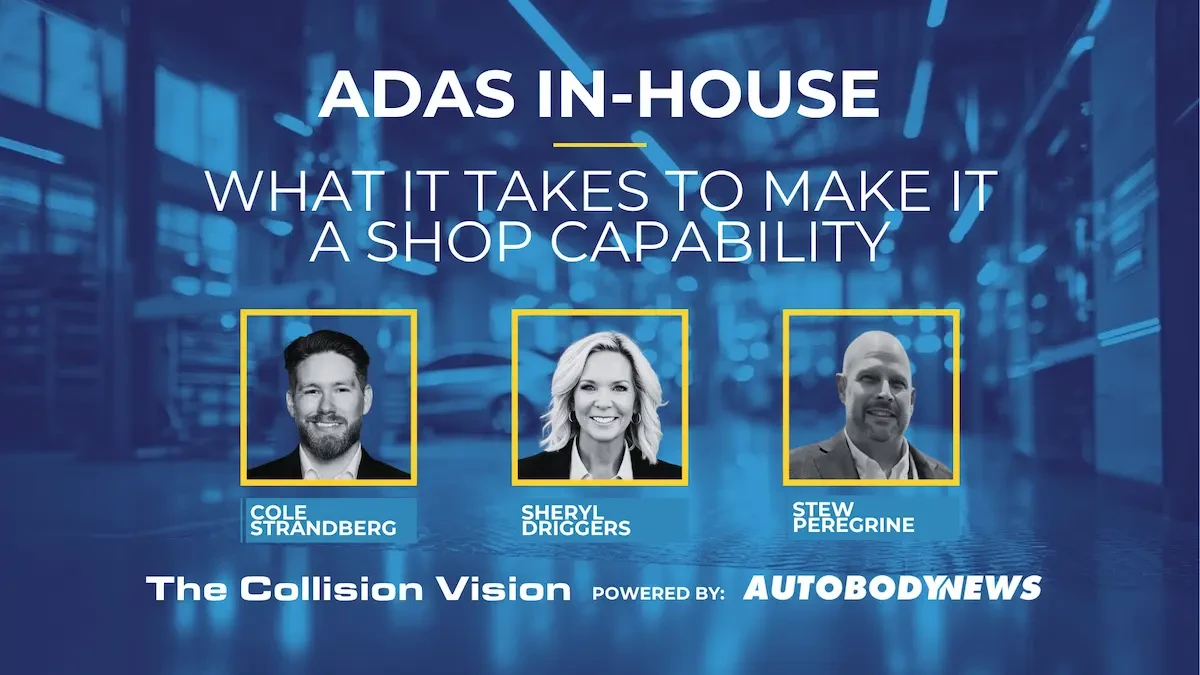
What separates a shop that does 10 calibrations a month from one doing more than 10 a day? That's one of the central questions from this roundtable episode of The Collision Vision, which follows up on host Cole Strandberg's earlier conversation with Mike Ambrosino of ADS Calibration.
The takeaway from that episode, reinforced throughout this one, is that ADAS is no longer a department, a piece of equipment, or a line item to sublet and forget. It is a foundational part of the repair process, and shops that treat it as anything less are taking on risk they may not fully understand.
Strandberg is joined by regular panelist Sheryl Driggers, an industry consultant who speaks with multiple shops daily, and Stew Peregrine, senior executive at Autel who leads the ADAS team. Their conversation covers sublet liability, workflow discipline, documentation, the difference between a green checkmark and a safe repair, and what it takes to build a process that actually scales.
ADAS Is Already in Your Shop
Peregrine opens with a reframe that sets the tone for the entire conversation. Shops in the collision space are already in the ADAS business, whether they know it or not.
"Anytime you disturb cameras and radar mounting locations, there's always something that you need to be doing to the vehicle," he said. "So the question is no longer whether ADAS really matters. The question is whether the shop has enough control over the process to perform, document, and really defend the repair correctly."
Driggers echoed that framing. The shift she identified in Ambrosino's episode was that ADAS is no longer discussed as a standalone department or a piece of equipment — it's woven into the entire repair conversation. "It's not something that we're just thinking about at the end, what calibrations need to happen. It's part of the conversation from the very beginning. The repair consultation, blueprinting, our part selection. It has to be part of the process and not just an afterthought."
Key Takeaway: If you are removing bumpers, replacing windshields, or performing suspension work, you are already in the ADAS business. The question is whether your process reflects that or whether you're discovering calibration needs at the end of the repair when they should have been planned for at the start.
Subletting Doesn't Transfer Liability
One of the most consistent misconceptions Driggers hears from shops is that subletting calibration work eliminates their liability. It does not.
"One of the biggest things is when shops sublet it and they think, 'OK, I'm no longer liable because someone else did it.' And that's just not the case," she said. "The shop is the one that's delivering the vehicle, the shop is the one that is liable, and the shop is the one who should be considered when somebody gets back in that vehicle if that vehicle is going to operate the way it was designed."
Peregrine added that the risks compound quickly when the shop is not in control of the process. "The repair order still belongs to that shop. Poor oversight on their part or weak documentation on their part can become a real serious long-term exposure problem for them."
He identified the downstream effects: lost calibration revenue, supplement friction, rental expense, rework, and a liability exposure that doesn't go away just because the work was performed offsite.
Key Takeaway: If you are subletting calibration work, you are still responsible for the outcome. Vet your vendor's equipment, space, and documentation practices. Visibility and accountability don't end at the point of handoff.
Workflow Determines Whether the Equipment Pays Off
Peregrine is direct that the equipment matters less than the process built around it. "Workflow determines whether the equipment produces a safe and profitable outcome."
He identified the intake and blueprinting stages as the most common failure points. Shops often struggle to accurately identify what's required, pull the right OEM procedures, and plan for calibration before the vehicle enters final assembly. Some tools miss procedures. Some shops rely on build sheet data that isn't complete.\A best-in-class workflow, he said, begins with identifying ADAS systems at intake, pulling OEM procedures, planning for pre- and post-scans, and assigning work to trained technicians. It ends with a complete repair that includes not only scan and calibration results but supporting measurements, including physical angle verification and wheel alignment, that too many shops are skipping.
Key Takeaway: Evaluate your intake and blueprinting process before you evaluate your equipment. If calibrations are being identified at the end of the repair, the workflow is broken. Build the process around ADAS, then fill it with the right tools.
A Complete ADAS Record Is a Risk Management Document, Not Just a Payment File
Peregrine was emphatic on this point: documentation is not about getting paid. It is about being able to defend the repair.
"Documentation is not just a payment issue. It's a risk management issue."
He outlined what a complete and defensible ADAS record should include: pre- and post-scans, date and timestamps, VIN, odometer reading, technician identification, OEM procedures used, the type of calibration performed, proof the procedure was completed correctly, setup conditions, target distances, bay and floor suitability, DTCs before and after repair, road test notes, dynamic calibration records, wheel alignment, and thrust angle status.
Physical angle verification, he said, is one of the most consistently missed items in the industry. "It shouldn't be optional. It should be done each and every time, and there should be specs from the OEMs. If there's not specs from the OEMs, then those need to be produced."
Driggers added that many shops still think of documentation primarily as a reimbursement tool. "It's much bigger than that. We have a liability issue. ... We should be building files that will one day be in a court of law."
Key Takeaway: Audit your current ADAS documentation against this list. Pre- and post-scans are the floor, not the ceiling. If your records cannot stand up to scrutiny in a liability situation, they are not complete enough.
A Green Checkmark Is Not the Same Thing as a Safe Repair
Peregrine is not dismissing the value of a successful calibration confirmation — he is making a more specific argument about what it does and does not tell you.
"A tool can confirm that routine was completed, but it can't erase the poor setup, and it can't uncover the hidden structural problems that you have to uncover as you're going through the process."
The concern is systemic: calibrating one system correctly does not guarantee the calibration will stay aligned with other vehicle systems over time, particularly if physical angles were not verified before the calibration was performed. "Everything starts with physical angles. The vehicle was in a collision. It's a custom repair. Everything has to be square before we move forward with any repair plan."
He called on OEMs to make physical angle specs available to every shop, not just when a calibration fails. "Nobody should have to measure a new vehicle and get physical angles on any part of that vehicle. It should be readily available to every shop in America."
Key Takeaway: Train technicians to understand what a successful calibration confirmation tells them — and what it doesn't. Confirm physical angles and wheel alignment before every calibration, regardless of whether OEM service information explicitly requires it.
You Cannot Dabble in ADAS
Driggers did not mince words on this one. Shops that dabble in ADAS, such as doing some calibrations in-house without the right space, equipment, training, or process, are not in a middle ground. They are in a liability gap.
"You can't dabble because you're not an expert if you dabble into something. It's either you are going to bring it in-house and you're going to have the right space, the right lighting, the right floor conditions, you're going to have people who are properly trained, or you're going to find a sublet vendor who has all of that. There's not a dabble."
Peregrine reinforced the point from the equipment side. A green checkmark in a poorly set up environment is worse than it looks. "A tool can confirm that routine was completed, but it can't erase the poor setup."
Key Takeaway: Assess where your shop actually stands. Are you set up to perform calibrations correctly (right space, right lighting, right floor, trained technicians, documented process) or are you somewhere in between? In between is not a safe place to be.
ROI Comes from the Operating Model, Not the Equipment Purchase
Peregrine described what he sees in the shops generating the strongest return on their ADAS investment: they are not just buying equipment. They are building a repeatable operating model around it.
"They dedicate the space. They schedule the work around that. They assign ownership. You’ve got to have ownership throughout these stages and train the right people. You got to track how often the calibrations are identified, completed, documented, billed. You do not know if you're winning or losing or if you're doing it correctly unless you have the proper KPIs in place."
Two metrics he pointed to specifically: calibrations identified versus calibrations completed and documented per repair order. That gap, if it exists, is where shops are leaving money and liability on the table.
Driggers connected ROI to culture. "I believe it is in creating a culture of continuous learning. ... When we get to the point where we think we have figured everything out — we haven't."
Key Takeaway: Start tracking calibration identification rate and calibration completion rate as separate KPIs. If you are not measuring the gap between what should be calibrated and what is actually being calibrated and documented, you do not have a complete picture of your ADAS operation.
For Shops Still Subletting Everything, Start Here
For operators who are subletting 100% of calibration work and are evaluating whether to bring it in-house, Peregrine offered a straightforward starting point: car count and spend.
"If your car count is excessively high and you are letting that go out the door, the revenue opportunity is probably very great for you. And more than likely ... adding a very profitable revenue stream, especially at a little bit higher labor rate than normal paint and body repair, could be super beneficial to your shop."
He recommends starting with forward-facing calibrations, front of the vehicle, before building out to full around-the-car capability. "Learn to walk before you run. You have to build a muscle. You have to build a process." He also recommends visiting shops that are doing it well before making the investment. "That will tell you real quick what you have to start first."
Key Takeaway: Pull your sublet spend data now. If your car count is high and your sublet calibration spend reflects that, the ROI case may already be made. Start the process with a site visit to a shop that has built a functional in-house ADAS operation, and start on the front of the car.
Culture Is What Makes the Process Stick
Driggers returned at several points to the culture piece as the connective tissue that holds all of this together. Equipment and process are necessary, but they require people who are invested in doing the work correctly.
"We have a culture of continuous learning, and that's something that is created. It's something that starts with a leader. This is who we are. This is what we do. We create regular lunch and learns, regular technician roundtables. We're bringing in the right vendors to do training with our team. And we are doing this on a consistent basis. It's not one and done."
She also noted the hiring dimension. Building the right ADAS culture means recruiting people who already have the mindset to match. "We're hiring people who have that desire to learn and grow and to always have that mindset of curiosity."
Key Takeaway: Evaluate whether your shop has a defined learning culture around ADAS, or whether training happens reactively. If it's the latter, start scheduling regular touchpoints like vendor training, technician roundtables, site visits to high-performing shops, and make them recurring, not one-time events.
Shops That Don't Adapt Are Running Out of Time
Both panelists were direct about what happens to shops that continue to avoid the ADAS conversation. Peregrine pointed to longer cycle times, weaker margins, and growing liability exposure as the compounding effects of inaction. Driggers went further.
"I don't think that they will be in business more than a couple more years because we can't put our head in the sand. There's too much liability. These systems have to operate the way that they were designed if that vehicle is in another accident."
The inverse, Peregrine said, is also true. Shops that build a fast, repeatable, defensible ADAS process stand to improve safety, speed, and profitability simultaneously. "The winning shops will be the ones that do not separate diagnostic work, alignment work, calibration work, their documentation, and their delivery quality in the different conversations, but they manage them all in one repair outcome."
Key Takeaway: The window is still open to build this process deliberately, before a liability event forces the conversation. Use it. The competitive advantage for shops that build strong ADAS operations now is only going to grow as the rest of the industry catches up.
Where It All Comes Together
The through-line of this conversation is straightforward: ADAS is no longer coming; it is here, and it is already part of every repair that touches a camera, radar, or sensor mounting location. The shops building discipline around it now, with the right process, the right documentation, and the right culture of continuous learning, are the ones that will control cycle time, capture calibration revenue, and defend their work when it matters.




Lisa McArdle