If there is an easy place for a collision shop to start recovering money on not-included frame and mechanical work, it may be the procedures other shops are already paid for most consistently.
The 2026 "Who Pays for What?" survey, conducted by Mike Anderson of Collision Advice with CRASH Network, ranks about 20 such operations by how often eight large national auto insurers pay for them, and a handful sit clearly at the top.
Four procedures paid 70% of the time or more
Among shops that negotiate for the procedure, the survey found the largest percentage of the shops saidinsurers paid for these four operations "always" or "most of the time." Those procedures anchor the top of the report's overall ranking chart. They are high-frequency, well-documented operations, which makes them a practical place for a shop to start.
|
Procedure |
Paid "always" or "most of the time" |
|
Disconnect and reconnect battery |
80% |
|
Administrative fee for total losses |
75% |
|
R&I of electrical components |
70% |
|
Transport vehicle to sublet service provider |
70% |
Payment for electrical R&I is falling, not rising
R&I of electrical components stands out in the data, Anderson said, not for ranking well, but because its payment rate has slipped. In his notes accompanying that section, he wrote that this is one procedure that should show 100% of shops being paid when it is necessary and performed, and said he was at a loss to explain why the rate has gone down rather than up.
His theory is that newer or less-trained estimators on both sides are the cause: shops that cannot clearly explain and justify the need, and insurer personnel who have not been properly trained.
The need itself is not in dispute, Anderson said. Welding systems typically run 110 to 220 volts and produce high levels of electromagnetic noise, and any conductor of electricity near the weld, such as an electrical component, can act as an antenna, picking up the charge and destroying the electronics. OEMs vary on how far components must be moved:
- Some specify 12 inches.
- Toyota and Lexus call for 18 inches.
- Land Rover and Jaguar call for 20 inches.
Documenting that requirement from the OEM repair procedure, he said, is what changes the conversation with an insurer.
Total-loss admin fees: from 46% paid to 74%
The administrative fee for total losses shows the opposite trajectory. More than 23% of all claims in 2025 resulted in a total loss, according to the report, and the share of shops paid for the admin fee all or most of the time has risen from 46% in 2015 to 74% or more over the past three years.
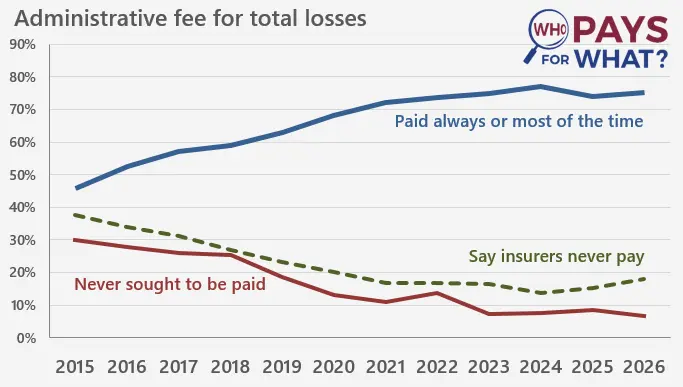
Anderson attributed the increase to a process that has grown more complex, involving more tear-down, more OEM research, and loading or unloading the vehicle to and from a tow truck.
More shops are itemizing these charges, such as estimate or repair-plan fee, storage, parts cart storage, disassembly, and OEM research, rather than billing a single flat fee, Anderson said.
He cautioned that some insurers are resisting itemized and storage billing, in some cases using collection agencies to recoup amounts already paid, and recommended shops have an attorney review their authorization forms.
A memory saver won't cut it, and it's "D&R," not "R&I"
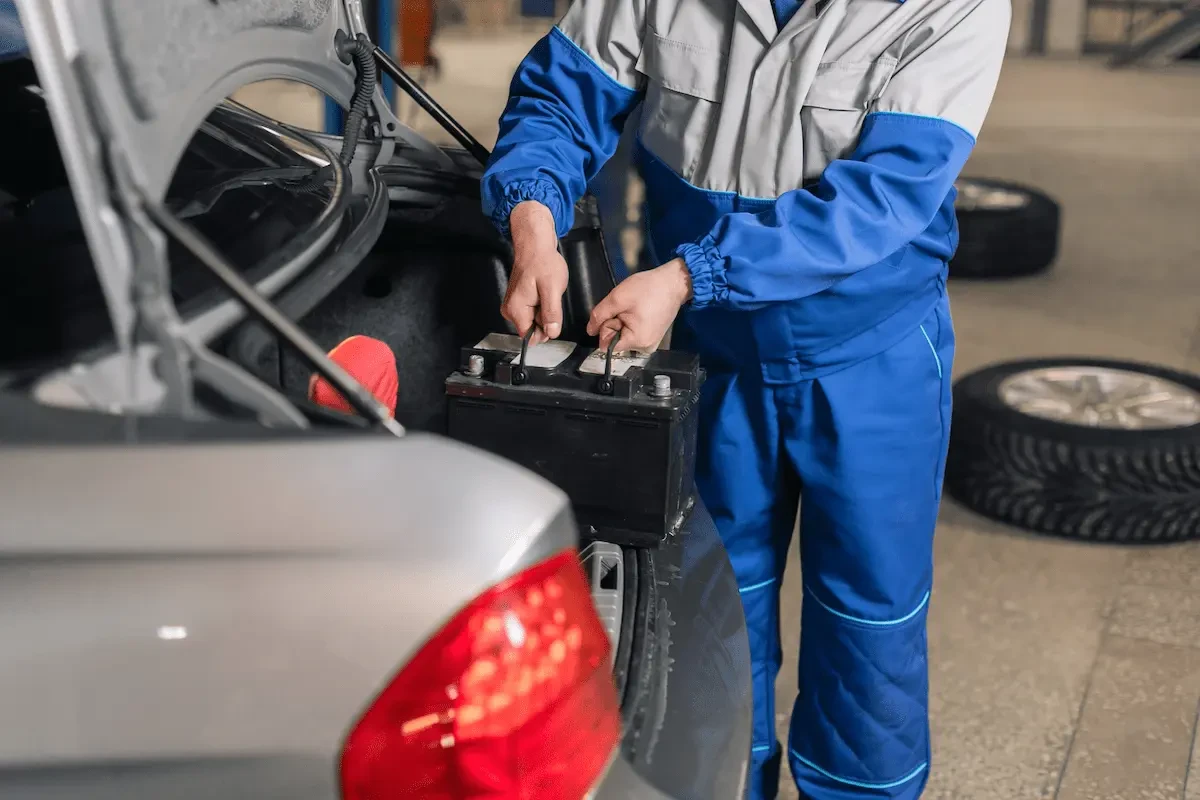
On the top-ranked procedure, disconnect and reconnect battery, Anderson emphasized both the requirement and the terminology. Every vehicle manufacturer requires disconnecting the battery for welding, he said, and a memory saver is not a sufficient substitute; the battery cable still must be disconnected, following the OEM's vehicle-specific steps.
He also noted a point of language: when a shop is only disconnecting one cable, the correct term is "D&R battery," for disconnect and reconnect, not "R&I battery."
DRP shops are paid more often, but most shops aren't in one
DRP status continues to affect payment across these procedures. Most of the eight largest insurers are more likely to pay their direct repair program shops for not-included procedures than non-DRP shops, the report notes, and 55% of respondents do not participate in a DRP with any of the eight insurers.
For shops looking to act on the data, Anderson's guidance in the report is to start with the procedures most frequently paid and prepare estimators to negotiate for them, perhaps choosing two or three to focus on each quarter. He suggests four questions when negotiating any not-included item:
- Is it required to return the vehicle to pre-accident condition, and how is that documented?
- Is it included in any other labor operation?
- Are there pre-determined times?
- What is it worth, based on the shop's own labor and materials?
The full Frame & Mechanical Operations Report is available to download now.