

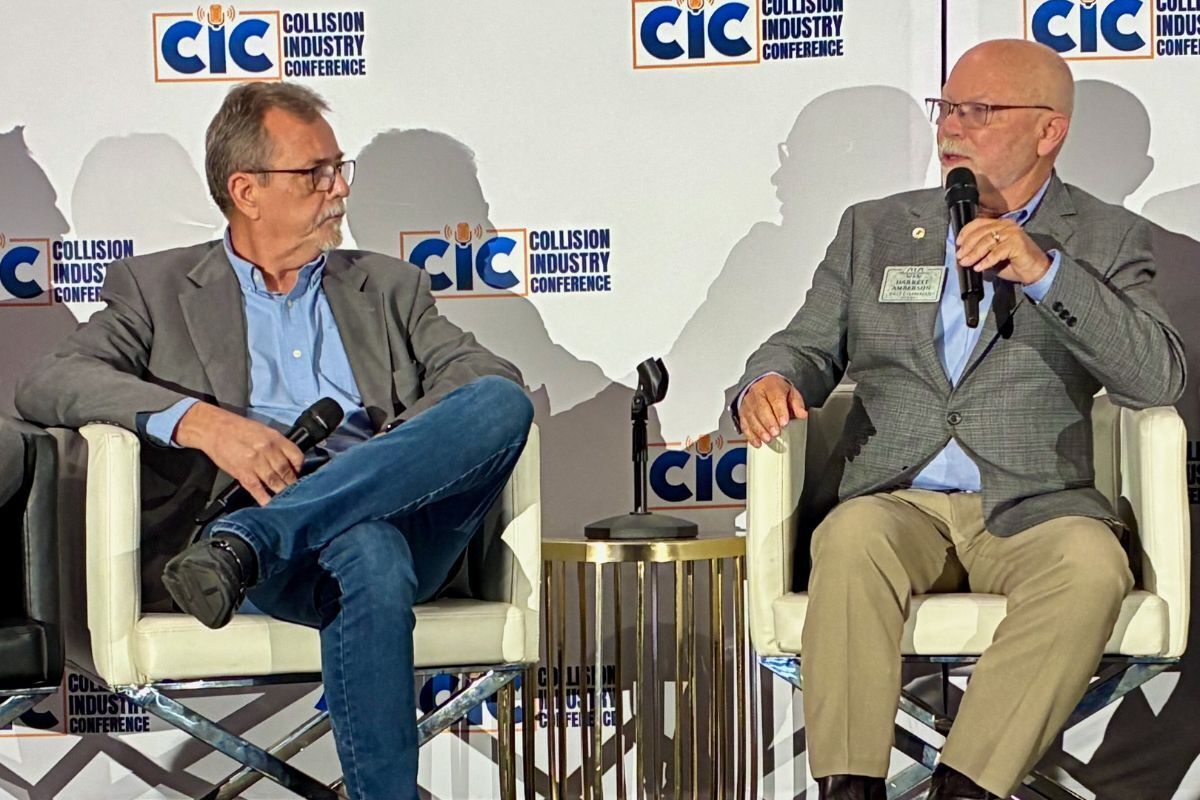
A poll of the audience at this summer’s Collision Industry Conference (CIC) found that 86% believe that newer vehicle technology — whether materials used in vehicle construction, or electronic systems like ADAS — will contribute to a higher percentage of claims resulting in total losses because of the added costs.
But Chuck Olsen of AirPro Diagnostics, a co-chair of CIC’s Emerging Technologies Committee, offered a counter-perspective.
“I sort of look at it a little bit differently,” Olsen said. “I have a lot of confidence in the automakers and technology, and I think if this technology is successful, fewer vehicles should be totaled. If the systems are doing their job, if they’re calibrated properly when they’re fixed, if they’re maintained properly throughout their lifetime, total losses should decrease because the accidents won’t be as severe.”
Others have said the percentage of damaged vehicles that are totals is higher in part because ADAS is preventing more of the minor damage caused by low-speed crashes, like in parking lots. But Darrell Amberson of Quality Collision Group thinks the number of those claims is down not just because fewer of those minor accidents are happening, but also because more of that minor damage isn’t being turned in as a claim, or is not being repaired even if it is. He thinks that will rebound when consumers are less concerned about small claims adding to their premiums, and as the number of vehicles, and total vehicle miles traveled, continue to increase.
“Personally, I have a lot of faith in the motoring public to find new ways to crash their cars,” Amberson said.
Vehicle technology also could improve processes to help reduce some of the time and costs associated with total losses, Amberson and others believe. In fact, nearly two-thirds of CIC attendees polled at the meeting said having more upfront access to vehicle event data captured by the vehicle would improve the total loss decision process.
 Darrell Amberson thinks insurers should allow more time for automakers to make parts prices concessions to help shift some total loss vehicles into the repair column.
“I appreciate the data that we get, but better reporting on the [details of] the actual loss would be helpful,” Amberson said. “As a general rule, when an insurance company passes on information on the loss, it often is incomplete or not very good.”
Olsen agreed.
“Currently crash event recorder data isn’t something that we really have access to because there’s a lot of implications around whether it is going to be used properly,” Olsen said. “But I think that it can be sanitized. How fast was the vehicle going? What were the g-forces that happened when that vehicle crashed? If you have a previous databank of vehicles that have been estimated that were obvious total losses, and then you have a digital footprint of what [a current accident] looks like in the [event] data, those decisions could be made almost instantaneously.”
Amberson was asked during the discussion about automaker programs to help reduce total losses.
“So far, I think they’re more talk than reality, but I’d like to see them come to more reality,” Amberson said.
One of the challenges, he said, is by the time it’s determined a vehicle is a total loss, insurers want to act immediately to minimize their storage costs. That limits the time for an automaker to see if there are ways to keep a vehicle in the “repair column.” Amberson said a bit of a grace period by insurers could allow time to “find out what concessions [the automaker] is willing to make on parts.”
“Many of them are [willing to make such concessions] right now because they share our concerns over there being too many totals,” Amberson said. “We have to engineer that [process], between us as repairers, and insurers and OEMs, to make that all work. I think if we can save some cars [from totaling], it’s worth it.”







John Yoswick