

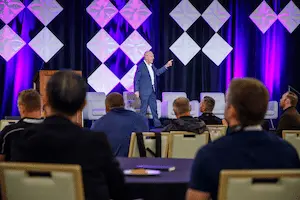
Hundreds of shop owners and other collision industry participants gathered in a packed meeting room in Palm Springs for the first Collision Industry Conference (CIC) of 2026. The agenda ranged from welding quality and shop liability to the proposed Repairify–Opus IVS combination. Discussions also touched on shifts in OEM certification programs and new technology moving into repair workflows.
Have the documentation to back your repairs
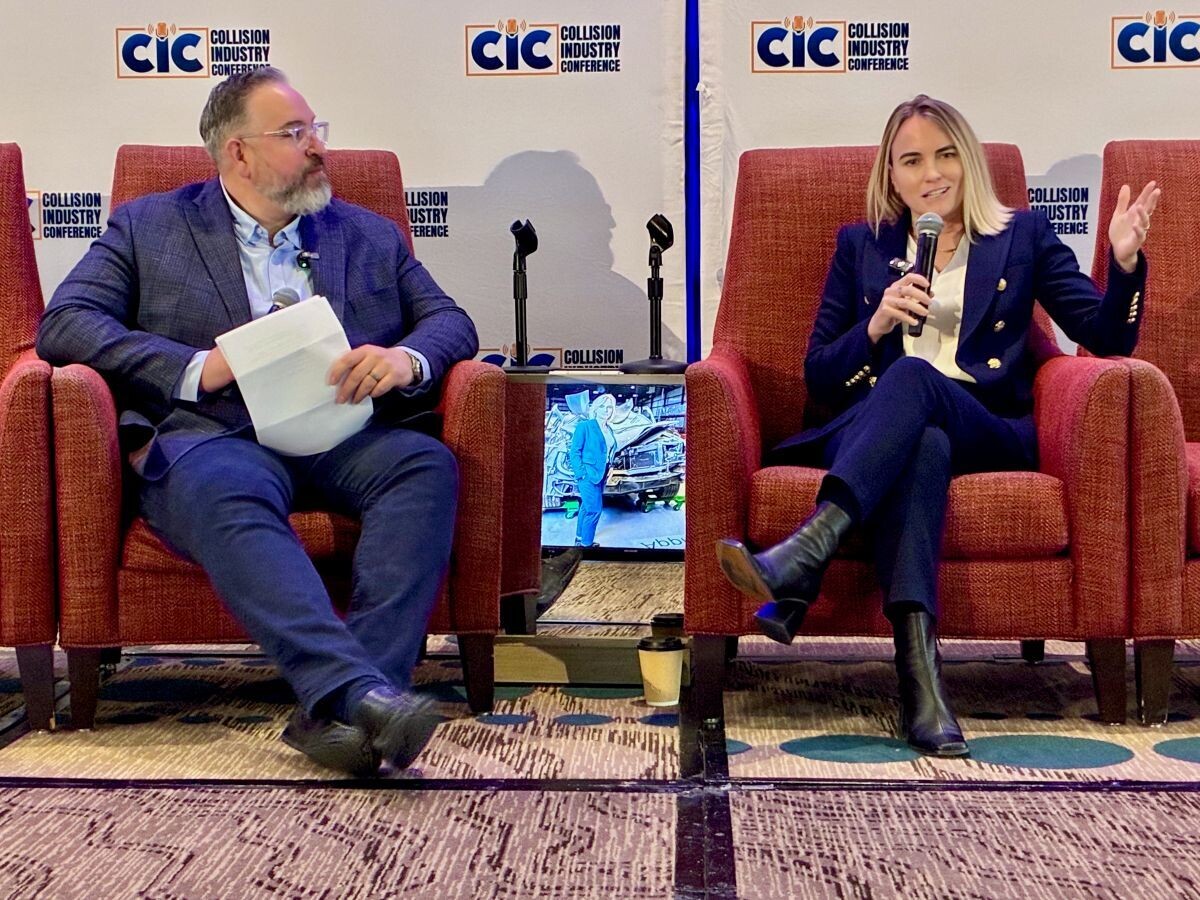
Georgia-based personal injury attorney Rebekah Cooper was interviewed on-stage during CIC, discussing how emerging vehicle technology, including ADAS, is reshaping liability. She some of her firm’s cases revolve around whether a safety system on a vehicle, such as an airbag, performed as it was intended if a driver or passenger has been injured in an accident. But it’s not always just a vehicle manufacturer that may be shown to bear responsibility for that, Cooper said, offering a caution for collision repairers.
“It can be a level deeper than just ‘There’s an airbag that didn’t go off,’” Cooper said. “It is: What kind of technology was on the vehicle, and how was it supposed to work, and if it didn’t work, where was that vehicle last serviced, and was that service [or repair] done how it was supposed to be done?”
She said an early step in most cases involves getting all the automaker information, including such things as repair procedures. She noted that a speaker from American Honda earlier in the meeting had discussed some of that company’s documentation on “no-repair zones” on bumpers, and when he asked how many people at the meeting had seen that information, few hands went up.
“There are times when we ask shops for those [types of documents], and Honda has them, but they don’t,” she said. “That has real consequences. I’m taking a deposition like this on Monday. We bring a representative in and we ask them, ‘Have you seen this before? Are you seeing it for the first time right now?’ And if the answer is yes, that’s a problem. Now they can say, ‘I’ve been a mechanic for 25 years. I know how to do this.’ And I can understand that. But ADAS wasn’t here 25 years ago, so you need to be looking at these now. Your industry knowledge or institutional knowledge isn’t going to cut it in that situation.”
Welding quality still an issue in the industry
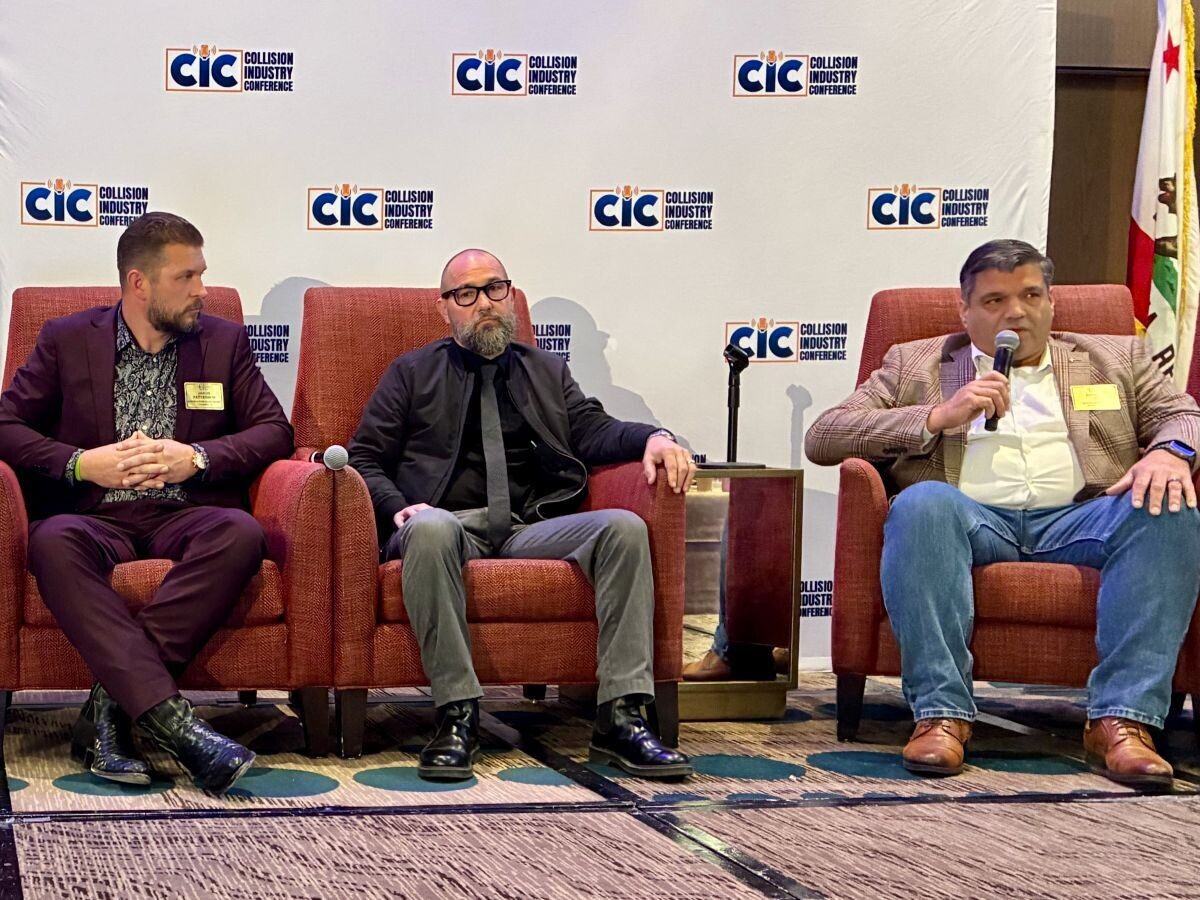 A panel discussion focused on causes – and solutions – for poor welding happening in the industry included (from left) Jason Patterson, Daniel Iannetta and Ben Cid.Repair quality was also the focus of a panel discussion during CIC focused on issues related to welding, in particular some of the causes behind — and solutions for — improper welding being done within the industry. Committee co-chair Kye Yeung showed photos of some of the poor welds he’s seen on previously repaired vehicles that have come into his Southern California shop. He said he believes one reason so many body techs are poor welders is that it’s not something they do frequently.
“I think in a lot of shops, technicians start out and develop a skillset where they can take cars apart, and then all of a sudden they’re putting vehicles together,” Yeung said. “Usually a tech is judged on panel alignment, gaps and lines, panel reformation, shaping filler work and sanding, getting it ready for the paint shop. And every once in a while, they might have to weld something. Well, it isn't really their forte. Welding is not something they do every day.”
Jason Patterson of Southern California Collision Equipment and Gab Collision Center said he conducts welding training and sees some of the poor welding being done in the industry. “In my opinion, probably 2 percent of the cars on the road that were repaired and welded at repair facilities are probably welded correctly,” Patterson said. “Some [welding-related] certifications can mean something, and some certifications don’t.”
Deal plans reignite pricing agreement concerns
One exchange during an “open mic” session at CIC focused on the announcement, made just two days before the meeting, that Repairify and Opus IVS intent to combine the two companies (still subject to regulatory approval). Aaron Schulenburg of the Society of Collision Repair Specialists (SCRS) noted that at CIC in July of 2024, Repairify faced criticism at the meeting over Geico’s announced “agreement with asTech to standardize pricing and reduce friction for diagnostic, programming and calibration operations.”
Since that time, State Farm has begun requiring its direct repair shops to use ADAS Map from Opus IVS.
“Both of these companies [Repairify and Opus] individually have entered into direct arrangements with insurance companies for mandated or required services,” Schulenburg said. “And I think we all need to stop and take a look at how the combination of those two companies now puts all those agreements in one company versus multiple companies, and the impact that has on the marketplace and on these [collision repair] businesses. I think it’s important to talk about these things, as sensitive as they are, because if we don’t talk about them, then we’re skirting around an issue that I think so many repair businesses are facing and are concerned about.”
Keith Crerar, who joined Repairify eight months ago as chief transformation officer, said that while “asTech was unfortunately tied to a pricing rollout, I don’t believe that was the intention. The intention was to make things smoother for shops, more transparent and helping make the reimbursements quicker. That was not the outcome.”
He said the company has “learned a hard lesson.”
“Collision centers are our core customers and we won’t forget that,” Crerar said. “And what that truly means is staying focused on shops and making things faster and easy for everybody. Our intention is not to be part of pricing.”
Schulenburg said he appreciated Crerar’s comments, but it also demonstrates the importance of the types of discussion he is calling for, “because…you guys are looking backwards and saying, ‘Not what we intended.’”
“You’ve fundamentally changed things, and I don’t know how you move backwards from that,” Schulenburg said. “I think that was the sentiment and the concern in the room [in July of 2024], and it remains the sentiment today. Because you’re not the only companies that are exploring those types of solutions and it is not easy to unwind. You opened a door that can’t be closed, or it’s difficult to close. And I think it’s important to have that dialogue and to figure that out and to talk about it in this room.”
“My commitment to you and everybody else in this room is that we will be very good listeners, we’ll be very collaborative, and we’ll do the right thing together,” Crerar said. “Because make no mistake, our North Star is the collision centers. That’s why we exist. So I can’t change the past, but I can promise you this: We’ll be good listeners and we’ll focus on doing things the right way moving forward.”
Brian Herron, CEO of Opus IVS, also addressed the issue during the CIC discussion, saying the technology the company offers “was not developed for insurance companies, but to help collision repairers get the information they need.”
“Now, what we have had happen over time is our customers have asked us to help get insurers to understand that these repairs need to be reimbursed,” Herron said. “It would be great if OEMs and cars reported on this technology straight from the vehicle, which we are actually lobbying for through SEMA. So in the future, perhaps the vehicles will tell us what they’re equipped with and the calibrations needed. But in the current state, we built this technology, and others did in the industry, to help repairers. And then we were asked to help educate insurance companies on why this was needed. So that's really the impetus for what we have gone through.”



John Yoswick