


Collision repairers working on light-duty cars and trucks can generally access automaker information and repair procedures. Their colleagues repairing medium- and heavy-duty trucks, buses, vans and emergency vehicles say the same is not true for them.
Without OEM procedures, those shops say they are left to rely on experience and best guesses, creating liability exposure and making it harder to get paid for proper repairs. The issue came up repeatedly at the ninth annual HD Repair Forum, held recently in Nashville.
Shops Left to Guess Without Manufacturer Guidance
"I've always thought the OEM manufacturers would step up," Mark Polzin, owner of Budget Truck and Auto in Janesville, Wis., said during the two-day event held in conjunction this year with the ATA Technology and Maintenance Council's annual meeting exhibition. "That's who we really need help from. We did not engineer the vehicle. So how do we repair it properly to make it safe to the customer and to the public?"
Polzin said he has heard for years that OEM procedures are only for dealers or proprietary, leaving shops and insurers without the documentation needed to justify proper repairs, and exposing shops to liability if a repair done without manufacturer guidance later results in a lawsuit.
Bernie Obry, general manager of Perfect Body, a bus repair shop in North Bergen, N.J., agreed, pointing to the 2017 multimillion-dollar lawsuits against the John Eagle Collision Center and an insurer based on a couple's life-altering injuries after an accident in an improperly repaired vehicle.
"There is going to be a time when the liability will shift to the manufacturer because we have documented over and over again that they are the hold-up. It's not the shop," Obry said. He argued that shops are assuming liability they should not bear, and that once a plaintiff's attorney targets a manufacturer for withholding repair information, the fallout could dwarf the John Eagle case. "It's absolutely criminal to withhold the information."
Estimators Writing Sheets in the Dark
Stephanie Schwartz, the second-generation owner of Truckstar Collision Center in Deerfield, Wis., said she recently met with an estimator who had been with her company for a year after working as a painter.
“He voiced his personal nervousness and concern about writing sheets that could [end up being] not be a proper repair,” Schwartz said.
The estimator told her that when he has repair questions, technicians sometimes say they don't know or tell him to Google it — and that with senior technicians retiring, fewer people are left with answers.
"It keeps you up at night. You just think about the potential to actually hurt somebody on the road by what we do,” she said. “And it breaks my heart to think we have an employee who cares so much and feels vulnerable because he does not have proper repair procedures. He's not sleeping at night. I told him: You got to do the best you can, research the best you can. It shouldn't be that way."
Public Fleet Repairs Rely on Experience Alone
Gigi Walker of Walker's Autobody and Fleet in Concord, Calif., said she often doesn't have access to repair information for the transit and school buses her shop repairs, and has to rely solely on the talent and experience the shop has gained over the years.
"There's hardly anything written on how to repair or replace a roof on a school bus," Walker said. "These buses are purchased with taxpayer dollars. The county and city governments need to mandate that those buses have repair manuals available when they purchase those buses with our tax dollars."
Industry Pushes OEMs for More Information Access
Several speakers at the event offered at least some response to concerns about these shops’ difficulty in getting OEM information.
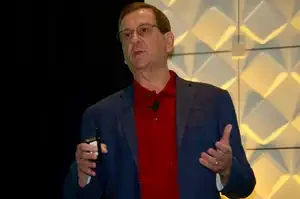 Bill Brower of Solera said his company meets with OEMs to get more collision repair parts and procedure information for medium- and heavy-duty vehicles into its estimating system. Phil David, president of Maxi Collision in Quebec, asked a speaker from the estimating firm Solera “how invested” that company is in pushing manufacturers to provide more repair information.
“That’s always been the fight for us,” David said. “We have [few] part numbers. Every truck is different because of the way they’re built. We’ve been trying to push manufacturers, through different organizations, to provide more information. So maybe your company or insurance companies can have more leverage on this, because right now this is what’s keeping us from being where [the passenger vehicle] repair industry is.”
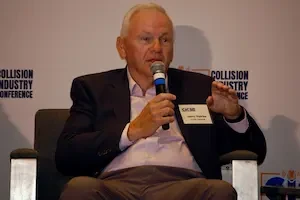
Bill Brower, senior vice president of Solera, acknowledged it had been an issue for a long time.
"We are talking with most all of the truck makers," he said, noting they have focused primarily on the manufacturers that produce both light-duty and medium- or heavy-duty vehicles. Brower said he doesn't fully understand the OEM hesitation around releasing information, but acknowledged concern exists on their side.
He said Solera has been actively meeting with manufacturers to find a path forward, noting that sharing information benefits OEMs too. Automated parts data means manufacturers are more likely to get the sale over an aftermarket alternative.
"I'd like to give you timelines on it, but I don't know. But we are having those conversations and really working hard to encourage the industry to think differently about sharing that information."
A representative of one truck manufacturer at the meeting also addressed the issue.
"I was a little bit surprised because last year I know one attendee stood up and mentioned that he was able to get procedures," Amy Lytle, aftermarket reliability engineer for Volvo Group, said. Lytle said she knows some shops are able to access the information, and urged anyone who cannot get procedures from their local dealership to try another — and to report back to her which dealerships are refusing to help.
"I need to know if there are dealerships not giving information on vehicles. That's crazy," she said, drawing applause from many of the 250 event attendees.


John Yoswick