



North Carolina Insurance Commissioner Mike Causey acknowledges that some of the issues related to shops and insurers are “as bad now as ever,” but encouraged collision repairers to keep educating their state’s insurance regulators while being aware of the limitations those regulators face.
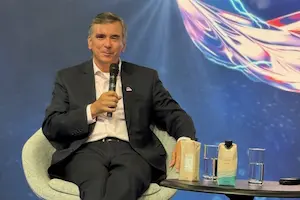
Causey, a former collision repair association lobbyist and insurance agency owner first elected as insurance commissioner in 2016, spoke at a Society of Collision Repair Specialists (SCRS) open board meeting in Concord, NC, just prior to the Collision Industry Conference (CIC) and the Southeast Collision Conference.
He said while his department can only accept complaints related to auto insurance from consumers, not shops, he also said he welcomed hearing from shops, saying if he’s only hearing from one shop but 10 others are facing the same issue, “we’re losing that ammunition.”
“If we’re hearing from every body shop in the state that this is the thing that’s happening, we can take that to the North Carolina Rate Bureau, to the legislators, to the insurance companies and say, ‘Look, we’ve got a problem that needs to be fixed,’” Causey said. “It gives us more leverage.”
Repairer concerned about centralized claims review
During a Q&A session, Michael Bradshaw of K&M Collision in Hickory, NC, the national board chairman of SCRS, told Causey a key concern he has is a “centralized claim review” process being used by State Farm. Bradshaw said his shop will reach an agreement about a vehicle with a State Farm appraiser at the shop.
“We have the conversations at the vehicle, they identify the operations on their estimate, then their estimate is fed to a central review team in Arizona where somebody that's never identified on the estimate, removes things,” Bradshaw said.
“I actually sent just very recently to…your office probably about 40 examples of this, where State Farm is taking $2,000 and $3,000 off of appraisals. And I will tell you, everybody in this room, regardless of what state they are in, is dealing with that,” he continued. “If there’s an operation that a licensed appraiser identifies as needing to be done for that vehicle, and then somebody thousands of miles away arbitrarily removes it without discussion, explanation or review, what do we do? How do we challenge that process?”
Bradshaw said he knows Causey “understands our issues as much as anyone,” but added, “The scary part for us is if the largest carrier starts to push the envelope, and they very much are in a way that I have never seen…”
“Others follow suit,” Causey said, finishing Bradshaw’s statement.
‘Steering’ tough to control
Causey acknowledged that steering of customers to preferred shops is one of the areas in which “insurance companies are experts at skirting state statutes.”
“They know what the law is, but they’ll go right up to it or figure out a way to go around it,” Causey said. “They’re really good at that. We catch them sometimes [when] we have auto glass shops and body shops that record conversations from the insurance folks to the customer. But it is a tough one. We’ve gone back to the companies and said, ‘Look, we believe this is steering.’ And they say, ‘Okay, we’ll just change our language.’ Well, how long are they going to change it for? Thirty days? And then they’re back to it? We don’t know.”
As one of only 11 voter-elected state insurance commissioners, Causey said that although he doesn’t advocate for that over governor-appointed commissioners, he does see a difference.
“So I don’t work for the governor. I work with the governor, but the governor’s not my boss,” Causey said. “If you look at the states that elect the insurance commissioner — [including] Georgia, Mississippi, Delaware and Kansas, California — they have much more stability in the insurance markets. And I believe it’s because if you look at the states where the people elect the insurance commissioner, I think the consumers are better served.”
Keeping regulators informed
Collision repairer representatives at the meeting pointed to several issues they wanted to make sure Causey was aware of.
“We here in North Carolina have the appraisal cost mechanism, and that does serve as a backstop” when there are differences between insurers and customers, Bradshaw said. “But unfortunately, and you may already be aware of this, State Farm has intentionally written the appraisal clause language out of policies in states where it’s not a regulatory requirement.”
Jill Tuggle, executive director of the Autobody Association of Texas, asked Causey how state departments of insurance personnel keep themselves educated on collision repair issues.
“We had an instance where we were talking to a former commissioner in Texas, and we made a comment about how the insurance companies deny certain operations in the claim,” Tuggle said. “And he made a comment, ‘Well, yeah, the client comes in and they want to get their windows tinted or want new wheels on their car, of course that’s not going to be approved.’ And it just showed how disconnected they were to the realities of what we’re talking about.”
“I think it is an opportunity for the association to provide that [education],” Causey said. “I can’t speak for other states, but here in North Carolina, I’ve talked with the current and past presidents of body shop associations. I used to host body shop meetings all over, and we’ve had working groups, roundtable discussions and that type of thing. So I think we’re pretty much in tune with what’s happening.”




John Yoswick