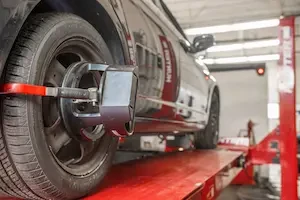
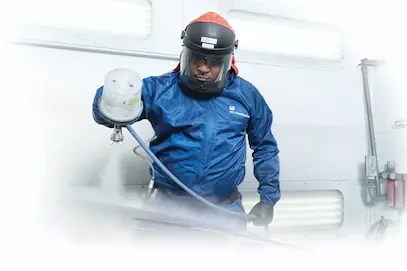
At two busy Hendrick Automotive Group collision centers in North Carolina, technicians are embracing glue pull repair (GPR) as a way to speed up repairs, protect OEM finishes, and improve outcomes for both shops and customers.
Hendrick Automotive Group
Charlotte and Concord, NC
704-412-2393 (Charlotte), 704-720-3900 (Concord)
hendrickcars.com
Facebook: @HendrickCars
Instagram: @hendrickcars
X: @HendrickCars
LinkedIn: @hendrick-automotive-group
YouTube: @Hendrickauto
Company At A Glance...
Type: Collision Repair
Facility Employees: 36 (Charlotte), 44 (Concord)
In Business Since: 2005 (Charlotte), 1995 (Concord)
Number of Locations: 21 nationwide
Production Space: 60,000 square feet (Charlotte), 50,000 square feet (Concord)
Sean Ellis, collision center director at Hendrick Collision Center of Concord, and Justin Bowers, collision center director at Hendrick Honda in Charlotte, have both adopted the KECO L2E Premium GPR Collision System from KECO Body Repair Products. Though they work at different facilities, the two managers share similar goals: faster, safer repairs and a more efficient workflow.
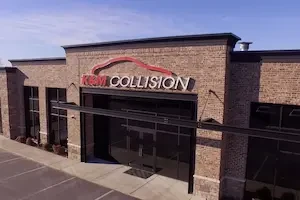
The Hendrick Automotive Group is the largest privately owned dealership group in the world, with more than 20 collision centers nationwide. The Concord shop has been in business for nearly 30 years and services around 300 vehicles each month. The Charlotte location, part of the Hendrick Honda dealership, currently services approximately 280 vehicles per month.
Both shops hold multiple OEM certifications, including Honda, Acura, GM, Subaru and others. Technicians at both facilities work on a wide range of vehicles, from high-volume models to luxury brands, which makes precision and adaptability essential. That diversity also demands tools and processes that support consistency across different materials and repair standards.
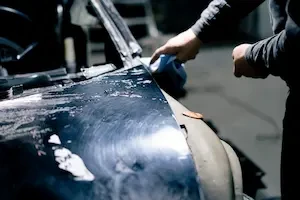
Before switching to KECO, both shops used stud-welding systems. While effective, those systems could be invasive. “We were using a tab welding system, but the corrosion it created meant more repair work,” Ellis said. “Glue is less intrusive. It allows us to avoid damaging the backside of panels.” Bowers agreed. “Glue pulling is so much more efficient and cleaner than stud welding,” he said. “You’re not moving components out of the way or risking damage to what’s behind the panel.”
 The KECO system helps Hendrick Collision Center of Concord and Hendrick Honda in Charlotte align with OEM standards.
That shift to a less invasive approach has had multiple benefits. “Cycle time has improved, definitely,” Ellis said. “We are able to move forward with repairs without waiting on parts or setting a car down for too long.”
Bowers noted that the system has been especially valuable for EV repairs, where safety and precision are critical. “With glue pull, we’ve saved several quarter panels already — especially on aluminum, which doesn’t have the memory of steel,” he said. “We don’t have to remove high-voltage EV components or cut into the vehicle. That makes the job not just faster, but significantly safer for our technicians.”
The KECO system also supports shops in staying compliant with OEM procedures. “The less intrusive the repair, the more it helps us maintain compliance,” Ellis said. “It saves time for both the estimator and technician.” One of the system’s key components is the K-Power Lateral Tension tool, which applies controlled force around a dent to release locked-in damage. Bowers recently used it to reverse severe roof damage from a fallen tree. “It brought the panel back to nearly perfect form with minimal additional work,” he said. “It was incredible.”
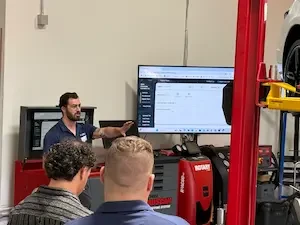
The reduced repair area also has the potential to lower material use, including filler, primer and paint. “It takes something you might have replaced before and gets it back to a place where you can repair it instead,” Bowers said. Both shops took advantage of KECO’s training and support. In each case, technicians attended in-person training in Oklahoma City after an initial on-site overview. “They came back from Oklahoma with huge smiles,” Bowers said. “They learned a lot and came back more confident.”
 Since switching to the KECO L2E GPR system, both shops have noticed increased safety and efficiency compared to stud-welding systems.
Ellis saw similar buy-in at his shop. “I need to buy more equipment because they’re fighting over it,” he joked. “They see how much cleaner and more controlled the repairs are. It’s something they feel confident in using — and when techs feel confident, you get better results.”
Technicians have also been able to reach out directly to KECO for ongoing support. “They have a direct helpline that you get to immediately,” Ellis said. “They’ve been very responsive — right on point.”
As GPR becomes more widely adopted, Bowers believes shops that fail to adapt risk falling behind. “This isn’t a trend. It’s the direction our industry is heading,” he said. “Shops still relying on older, invasive methods are missing opportunities to improve safety, speed and profitability. GPR is part of staying competitive.”
If he were opening his own shop, Bowers added, “the KECO system would be one of the first tools I’d buy. It’s low maintenance, there are no moving parts to service, and it’s just going to make you money.”
Ellis and Bowers also share a friendly professional rivalry. “We’re very much in a competition between each other to see whose shop performs better,” Ellis said. “I love the guy, but I race him to the buffet line.”
Whether it’s shop metrics or repair methods, both are committed to staying ahead of the curve, and GPR is playing a growing role in that strategy.
KECO Body Repair Products
Company Contact: Benjamin Staton
888-532-6822
www.kecotabs.com
Facebook: @KECOBodyRepairProducts
Instagram: @kecodentrepair
X: @kecotabs
LinkedIn: @keco-body-repair-products
YouTube: @KECOBodyRepairProducts
To read more auto body shop profiles from the October 2025 Shop and Product Showcase, click here.