

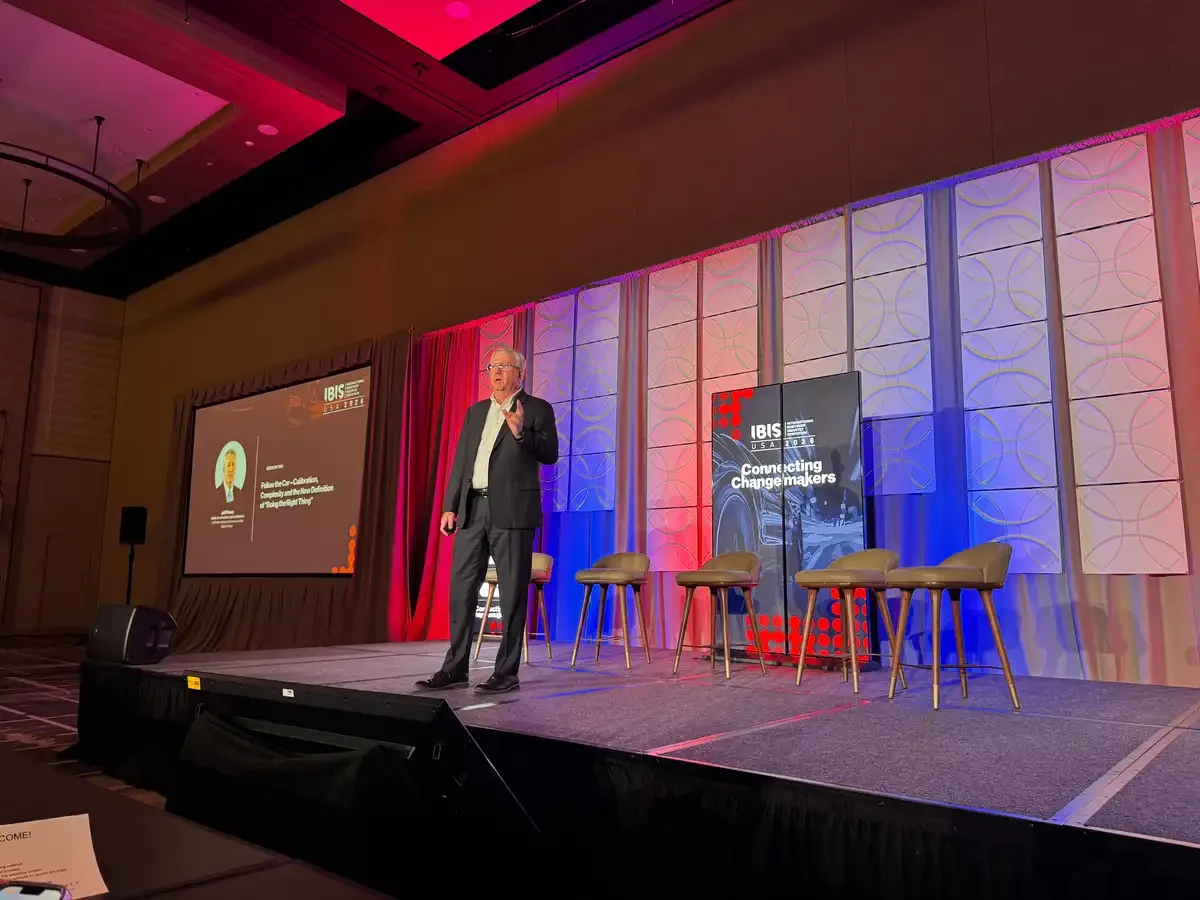
This article is part four in a series on IBIS 2026.
During the recent International Bodyshop Industry Symposium (IBIS) USA event, held in Scottsdale, Ariz., presenters discussed some of the challenges the collision industry is facing and how shops can take steps to become “changemakers,”
Suzie Scott, corporate head of sales for IBIS Worldwide, said the event’s theme, “Connecting Changemakers,” was particularly fitting. “The industry is evolving quickly and the people in this room are the ones shaping what comes next,” she noted during the event.
IBIS Conference Director Robert Snook said the new IBIS format helped make the event more strategic and foster deeper discussions, while also creating a more relaxed atmosphere.
“Creating the right environment in the right location, providing valuable content and insights through national, regional, and global perspectives and having fun and making new connections showed Connecting Changemakers in action,” he noted. “This is what we do at IBIS; we connect changemakers.”
A Shifting Mindset Toward Learning
When I-CAR Vice President of Industry Relations Jeff Peevy presented at IBIS USA, he asked attendees for their undivided attention to address a concern shaped by decades of observing how the collision repair industry evolves: the need for the pace of learning to change.
“We must learn faster,” he shared. “We must take the need to learn more seriously.”
Twenty years ago, Peevy recalls many technicians struggled to meet what were then limited training requirements, such as passing basic welding certification. Today, he said some foundational gaps remain even as modern vehicle repair complexity has increased significantly.
“Today, mixed attachment methods are upon us, adding more we need to understand,” he said. “Meanwhile, the industry is confronted with a ‘technical tsunami’ of new vehicle models that contain advanced driver-assistance systems (ADAS) and the need for calibration.”
Peevy noted that vehicle complexity will continue to grow, and the industry’s approach and mindset toward repairs needs to evolve in response.
The learning and unlearning challenge: One of Peevy’s core messages centered on learning velocity. Peevy said knowledge now has a shorter shelf life than ever, observing that what he learned in the last three to five years is often more relevant than what he learned over the past 40 years.
“Learning is really important, but more importantly, learning velocity — the speed at which we learn — is really important,” he said. “If we can't learn fast, technology will outpace us and our ability to perform proper repairs.”
Peevy explained that repairers can no longer approach vehicle repairs based on the mindset of last year’s model. “We need to unlearn things and do it quickly,” he said. “Our current model of achieving a complete, safe, and quality repair has to change.”
Peevy referenced the concept of “experience gravity,” which is the tendency to continue to go back to the ways we have always approached things. “We just can’t do it anymore.”
Peevy also emphasized the need for a broader mindset. Technical skills remain essential, but they must be paired with analytical reasoning and systems thinking. Modern vehicles also function as interconnected systems, requiring all repair professionals to frame problems holistically instead of defaulting to component replacement.
“Our current mindset is not going to get us where we need to go, and it's not going to even keep up with where we need to be,” he said. “Something has to change and it starts with awareness.”
Peevy said that call for awareness reflects why I‑CAR was founded — to bring the industry together around shared challenges that no single segment can solve alone.
“As a neutral organization working across OEMs, repairers, insurers, and other stakeholders, I‑CAR focuses on aligning the knowledge and skills the industry needs to keep pace with change, supporting a common understanding of what it takes to perform complete, safe, and quality repairs as vehicles — and the learning required to repair them — continue to evolve,” he shared.
Improving Processes to Create a Harmonized Ecosystem
Entegral Vice President of North American Sales Dan Friedman compared the current state of the industry to a flat tire disrupting a road trip.
 Entegral Vice President Dan Friedman “In the last five or six years, we've seen probably the biggest disruption most of us have seen in our lifetimes as a result of the pandemic,” noted Friedman. “Out of necessity, our response was very reactive.”
Following the pandemic, many in the industry returned to running their businesses the same as before.
“We must not underestimate the value of proactively improving our processes ahead of the next disruption, so we don't have to scramble in the moment,” he advised. “How do we prevent the next flat tire?”
Friedman stressed the importance of improving processes to create a harmonized ecosystem. “This is how we become changemakers,” he said.
Takeaways:
Deliver Excellent Customer Service: Friedman noted that customers rely on the industry to navigate the various elements of the repair process.
“In the eyes of the customer, getting their car back with a safe and proper repair is by far and away their top priority,” he said. “They don't care about our industry's internal processes. They just want and expect everything to work.”
Optimize value chain: When the value chain is fragmented, Friedman said it can complicate and delay a shop’s ability to conduct a safe and proper repair. An optimized value chain can help all collision industry partners deliver smoother processes and minimize disruptions.
To achieve that, Friedman recommended connecting all services with a smooth data flow that ideally reflects and leverages a single source of truth.
“A claims process where the disparate players are not singing from the same sheet of music, or where there isn't a single source of truth in terms of data, creates confusion for the customer,” he explained.
Collaboration: Friedman encouraged the industry to reduce customer friction, administrative burden, and costs while enabling more value. Collaboration, according to Friedman, occurs when providers and customers are connected and partners agree to leverage data for everyone’s benefit.
Be part of an open ecosystem: Friedman challenged the industry to look for opportunities to be a part of an open ecosystem, identify data that can be trusted as the single source of truth, and to stay aligned. “We all share the same customer and the same goals and expectations for the customer's experience,” he said.
Friedman has observed the benefits of carriers, shops, and technology companies committing to partnering in pursuit of a more harmonized ecosystem.
Organizations like IBIS that bring together industry players will play a critical role in that harmonization, according to Friedman.
He acknowledged that the industry is on the right track. “We'll need to continue to evolve our mindsets along with our processes if we want to unlock the full potential of this industry,” he said. “We can only do this if we work together.
Navigating the Shifting Landscape
The most important challenge the industry needs to address, according to Jake Rodenroth, chief revenue officer at Quality Collision Group (QCG) is the conflict among industry constituents.
“How we view one another as people is often referred to as a ‘war,’” he said. “I don't like it and I don't believe that any of you have signed up for such a war.”
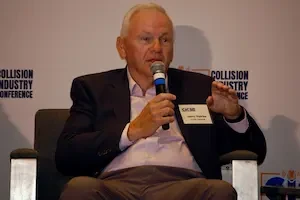
 Jake Rodenroth, chief revenue officer at Quality Collision Group (QCG) Rodenroth pointed out that the industry has been at war for too long and it can’t continue. “We have spent so much time fighting to be right that we haven't noticed the shifting landscape of vehicles and the people who operate them,” he said.
Takeaways:
Follow ALL OEM procedures: To ensure safe, repairable outcomes, following OEM procedures is paramount. This includes OEM parts and tooling identified by the OEM as approved by their engineering teams.
Deliver exceptional customer service: Customer service and kindness are firepowers, according to Rodenroth, who suggested looking for opportunities to express kindness and empathy across all industry segments.
“Whether you’re an OEM, insurer, or a shop, our communities and families are counting on us,” he reminded the industry.
Connect with young people: Rodenroth said the industry’s biggest untapped opportunity is young people, and encouraged the industry to take time to connect with the next generation.
“Instead of finding them doing something wrong, let's find them doing something right,” he said. “We cannot give up on them.”
When students and apprentices visit a collision repair facility, Rodenroth advised owners and managers to welcome their curiosity and discuss possible career paths.
Rodenroth acknowledged that the younger generation tends to have a lot of questions.
“It's not that they're needy, but they have a lot more resources than we had feeding them information, and they need to understand what the real truth is,” he explained.
Focus on what you’re “not” good at: “If you focus on the 180 degrees of your comfort zone, you never realize your 360 degrees of potential,” Rodenroth noted.
He encouraged technicians to identify the skills they lack and focus on acquiring new competencies.
Utilize your talents: Rodenroth stressed the importance of using individual talents to make suggestions on repair procedures that are big wins for everyone, not just shops, insurers, or OEMs. He noted that not every collision scenario can be simulated in CAD or engineering.
“Be a booming voice within the collision certification program you participate in,” he advised, recalling this was how he was able to author the position statement on pre- and post-scanning, bringing it to the forefront and presenting it at the OEM roundtable in 2016.
“The real question isn't about who you are as professionals, but who you are as people,” he emphasized. “Be elite and be excellent to one another.”


Stacey Phillips Ronak