Position statements from General Motors and Lucid Group, Inc. restrict parts sourcing across ADAS components, glass, and restraint systems. Ford Motor Company's latest On Target newsletter adds construction and inspection detail for two common platforms.
GM restricts ADAS component sourcing
General Motors issued an updated Advanced Driver Assistance Systems Consideration collision position statement dated July 20. It approves only new GM Genuine ADAS components for collision repairs. Salvaged, recycled, reconditioned, remanufactured, aftermarket, and secondary-market versions are strictly prohibited on Chevrolet, Buick, GMC, and Cadillac vehicles.
The restriction covers radars, cameras, sensors, control modules, wiring, brackets, and mounting hardware, among others. GM says damage, failure, or nonperformance arising from non-GM parts is not covered under its New Vehicle Limited Warranty or any GM service plan.
GM addresses glass and restraint systems
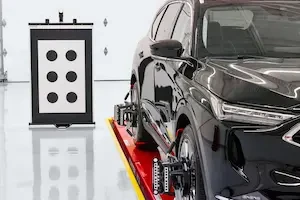
Two additional GM statements dated June 23 cover windshield replacement and supplemental restraint systems. The windshield statement prohibits aftermarket and non-GM OE glass. GM says it is critical that a service point calibration or learn procedure be performed whenever a front view windshield camera or sensor is removed, reinstalled, or replaced, or when the windshield itself is removed and replaced.
The SRS statement prohibits used, salvaged, or imitation restraint components. GM says parts from other models or model years may fit and appear similar while carrying different internal elements or calibrations. It adds a federal liability warning, saying a shop that knowingly disables a regulated safety system breaches the Safety Act and assumes liability for doing so.
Lucid sets glass reuse and repair limits
Lucid published a glass and glazing position statement dated July 29 covering all models. It names BetaPrime 5504G and BetaSeal U-428 Plus as the only approved primer and adhesive on Lucid vehicles. Lucid-trained technicians must complete all glass-triggered calibrations using Lucid tooling.
Lucid approves reuse of all fixed glass except windshields and front canopy glass, which must be replaced with new OEM glass because their condition is critical to SRS performance. Chip and crack repair on windshields and the glass canopy is capped at damage areas smaller than 1.25 inches, with none permitted within 3 inches of the glass edge or any ADAS camera. Lucid says failure to follow its procedures may result in denial of warranty coverage, with liability remaining with the facility that performed the work.
Ford details Escape body-side construction
Ford's latest On Target newsletter breaks down body-side construction on the Ford Escape. Boron steel appears at the A-pillar, A-pillar upper reinforcement, B-pillar inner, and C-pillar reinforcement. The roof side rail reinforcement is martensitic steel.
Dual-phase 800 steel is used at the A-pillar reinforcement, drain trough, body-side inner panel rear, and rocker panel reinforcement. The rear door pairs a mild steel shell with a boron steel intrusion beam and a bake-hardened 210 steel outer panel. Ford notes the information is intended as a general guideline and directs shops to the Workshop Manual for complete detail.
Ford opens Expedition seatbelt inspection series
The same issue begins a seatbelt inspection series using the 2026 Expedition, drawn from Workshop Manual Section 501-20A. Ford says emergency locking retractor mode activates during hard braking, cornering, or an impact of approximately 15 mph.
Automatic locking retractor mode, used for child seats, activates when the webbing is fully extracted and then allowed to retract. Web sensing mode responds to spool speed, locking when the webbing is extracted or retracted at a predetermined rate. Ford says the series will continue in future volumes.