Ford Motor Company and Lincoln, which refreshed all 11 collision position statements last October, released a parallel statement May 1 on ADAS integrity and repair technical imperatives.
General Motors issued an updated ADAS Considerations position statement on April 28, following a broader refresh of collision position statements dated March 9.
Across the three brands, the updates address diagnostic scanning, sensor obstruction, vehicle modifications, OE parts requirements, and warranty coverage.
Pre- and post-repair scans are required
Ford and Lincoln now require diagnostic scans both before and after any repair on a damaged vehicle. The pre-repair scan is intended to surface trouble codes that may not be reflected in dashboard warning lights, and the post-repair scan is meant to verify that everything still talks to each other and that the repair didn't leave any new codes behind.
GM's separate scanning position statement, dated March 9, takes the same approach and adds that any work disrupting battery voltage or electrical circuits warrants a follow-up scan.
Calibration is required for ADAS-related repairs
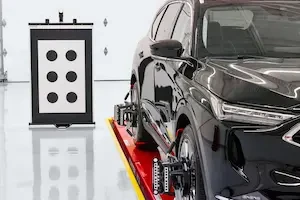
Ford and Lincoln direct shops to calibrate every ADAS component touched during a repair, whether or not a fault code shows up first. The position statement notes that a misaligned sensor will not always log a fault, and warns that skipping calibration means a vehicle can roll out the bay with driver assist features that don't work or don't work right.
Bumper repair and paint thickness limits
GM is more prescriptive than Ford and Lincoln on bumper fascia work. Under GM's bumper fascia position statement from March, repairs to ADAS-equipped fascias are limited to topcoat refinish work, and total paint build at any point on the fascia must stay at or below 13 mils. Substrate repair triggers replacement of the fascia.
Ford and Lincoln stop short of naming a specific paint thickness cap. Their statement instead warns that adding too many paint coats, with three or more cited as an example, can weaken or redirect the radar signal. Refinish work has to stay within the limits documented in the Workshop Manual. Ford had issued earlier paint thickness guidance through its On Target Vol. 1 newsletter in April.
Genuine OE parts required for ADAS components
Ford and Lincoln are now explicit that ADAS validation has only been done on Ford or Lincoln Genuine Parts. Sensors that come from a recycler, a salvage yard, an aftermarket supplier, or a reconditioning operation are off the approved list, and the statement warns those parts may not pair correctly with the vehicle's software or with the other sensors around them.
GM's latest update rejects ADAS components from "salvaged, recycled, reconditioned, remanufactured, aftermarket, or any secondary-market" sources.
Sensor field-of-view obstructions
Ford and Lincoln name several items they say sit too close to sensor zones to be considered safe and that the automakers haven't tested for that use. The list includes accessories like grille guards, light bars, and winches, along with cosmetic additions like decorative wraps, paint protection film, and heavy metallic paints.
Window tints and decals near the camera at the rearview mirror are called out specifically; tints that sit in the camera's line of sight in that area can, according to the statement, "distort light transmission and cause system failure or unintended braking."
Vehicle modifications affect ADAS coverage
Both automakers warn that ADAS performance isn't validated on vehicles modified with non-OE suspension components, non-sanctioned lift or lowering kits, or wheel and tire packages outside what the automaker has approved. Ford and Lincoln go further, excluding ADAS warranty coverage on those vehicles unless the modification is an automaker-sanctioned accessory installed to spec.
Warranty implications
Both automakers tie warranty coverage to using OE parts and approved procedures. GM's standard warranty language, which appears across its position statements, says non-GM parts, accessories, or modifications knock out coverage from GM's New Vehicle Limited Warranty and any GM service plans.
Ford goes further on liability. Its statement says the company isn't responsible for damages, injuries, or fatalities tied to repairs that use non-approved parts or procedures.