
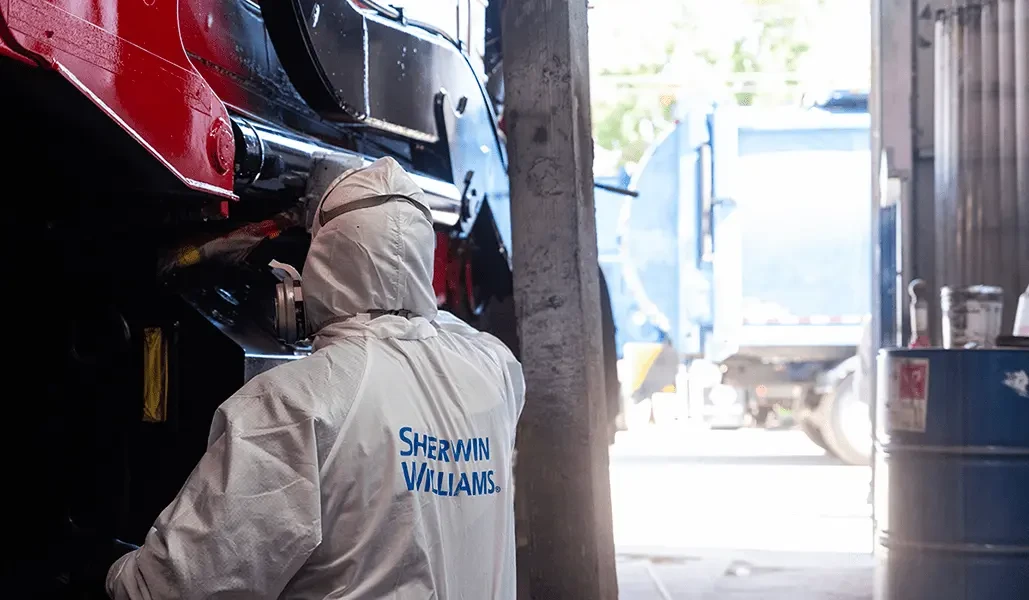
For collision repair shops navigating a market where traditional claim volume is flat, deductibles are rising and total losses are climbing, the question is no longer whether to diversify. It is where to look. For a growing number of shops, the answer is sitting in parking lots and loading docks across their own zip codes: commercial vehicle refinish.
The commercial vehicle population in the U.S. is substantial. According to the American Trucking Association (ATA), more than 15.5 million trucks are currently in service, with the U.S. Department of Transportation noting nearly 13 million of those are light- and medium-duty trucks, and specialty vehicles/delivery vans. Not to mention another 12 million recreational Vehicles, per the Recreational Vehicle Industry Association (RIVA). Then add in buses, construction equipment, emergency vehicles and municipal fleets, and the scale of the opportunity becomes clear, particularly because most of it is often unserved by traditional collision shops.
According to Dan Szczepanik, global commercial vehicle refinish marketing director with Sherwin-Williams Automotive Finishes, the majority of fleet operators do not have their own body shops. Most send their work to local shops or MSOs, work that in many markets no one is actively pursuing.
"The size of the overall commercial market is dramatically expanding," Szczepanik said. "During the pandemic, while traditional vehicle repair declined, commercial work increased significantly, and that momentum has continued."
Stan Harrison, owner of Apple Collision Centers in the greater Nashville, Tenn., area, made that move about three years ago and has not looked back. His three-location operation, spanning Gallatin, Hendersonville and Old Hickory, now generates between $500,000 and $750,000 in additional annual sales from commercial vehicle work alone.
"It's really complemented our other business," Harrison said.
Here are five signs the opportunity may be right for your shop, too.
Sign 1: Demand for traditional collision is getting harder to ignore
The traditional collision market is contracting on multiple fronts. Insurance carriers are totaling more vehicles. Repairable claims are smaller. Szczepanik described the pressure plainly.
"Traditional car repair, they're smaller repairable claims, deductibles are rising, insurance companies are totaling more vehicles, that whole pie is getting smaller," he said. "What better way to get on tract to growth than taking on a commercial vehicle with minimal complexity and relatively shorter learning curve?"
Harrison recognized the same pressure in Middle Tennessee. The market has changed dramatically, he said, but the growth in commercial companies relocating to the region and the commercial vehicle traffic that comes with them opened a door that traditional insurance-driven work could not.
Sign 2: An underserved market is creating opportunity
Most fleets are not being served well, or at all, by the shops closest to them. Dedicated fleet shops exist, but Szczepanik said they cannot handle every opportunity and often focus on a narrow niche, such as Class 8 semi-trucks. The broader commercial vehicle market largely relies on standard shops and MSOs, most of which are not actively marketing to fleet operators.
"A traditional VR shop doesn't even know it exists out there," Szczepanik said. "By knocking on the door, seeing what kind of opportunities are with their local fleets, can really open up a new opportunity in a new market that the vehicle refinish shops were not serving at all before. The barriers to get into this are much lower. It's a much easier process with simple colors, and you already have the skilled technicians, and you already have that process in place."
Sherwin-Williams can help shops identify fleet operators within a 50-mile radius as a starting point, Szczepanik said. Harrison found the same dynamic in his market.
"I don't have a lot of people doing that," Harrison said. "Everybody's chasing the insurance folks, there's nothing wrong with that, we chase them too. But there's just a market out there."
The opportunity also extends to municipal and government fleets, a segment Szczepanik said many shops never consider. Most medium-sized cities typically do not operate their own body shops, and local governments routinely seek bids to repair buses, fire equipment, police vehicles and other municipal assets. A shop that wins a municipal bid could result in work for three to five years.
Sign 3: The need for urgency unlocks margin
When a personal vehicle is in the shop, the owner is inconvenienced. When a commercial vehicle is off the road, the fleet operator is losing money, potentially thousands of dollars per day. That urgency translates directly into a willingness to pay for speed.
"When that truck's not out making deliveries, it's not out making money, it loses a lot of money," Szczepanik said. "So, your urgency as a repair shop to get that vehicle out the door, the commercial users will pay more for that. By paying more for speed, by paying more for efficiency, that's more money in that refinisher's pocket, and that commercial vehicle user loses less money. It's really a win-win."
Harrison said the severity of commercial work also tends to be larger than personal vehicle jobs, which helps on the revenue side. Apple Collision Centers markets directly to fleet operators on the uptime angle, emphasizing clear timelines, proactive communication and flexibility in scheduling repairs around when vehicles can be spared.
"We tell those people, hey, we know you have large fleets, you know you're out of production, we give you a real good time frame of what you're looking at, how long you'll be out of your vehicle," Harrison said. "We really, really cater to them."
Sign 4: Less complexity means more shop control
Three factors make commercial vehicle refinish less complex than typical collision repair: fewer ADAS systems to calibrate, simpler color schemes, and less insurance friction.
Szczepanik outlined the first two. "My car has all these ADAS controls to prevent small accidents. There's fewer of those that exist in commercial vehicles, so you don't have to deal with a lot of the ADAS recalibrations and complexities," he said. "Color schemes are very straightforward in the fleet world, and you don't have to worry about all these pearls, micas, or three stages."
On the insurance side, the difference is equally significant. Many fleet operators are self-insured, which eliminates the supplement process and reduces third-party involvement considerably. "You're simplifying all the approvals, you're reducing the third-party involvement. You don't have the supplements, you can have faster decisions and more direct customer relationships," Szczepanik said.
Harrison said the flexibility of being an independent owner has been a significant advantage in serving both self-insured and insured fleet customers.
"A lot of models can't do that," he said. "A lot of models say, well, hey, this is the only thing we can do to help you get this job fixed. Being an independent, I can do that, and it has been one of the best things, having flexibility."
Sign 5: Repetition and simplicity drive better efficiency
Once a shop earns approval to service a fleet account, the work becomes highly predictable. The same paint codes, the same vehicle configurations, the same repair procedures, repeated at volume. That repetition is the foundation of efficiency gains that are difficult to replicate in standard collision repair.
Szczepanik described how some shops pre-paint parts before vehicles arrive, so installers can go straight to work when the vehicle comes in. Harrison's team does exactly that.
"We will even go as far as pre-order some of their universal parts, and we'll go ahead and get them pre-painted, so that it cuts down on our cycle time," Harrison said. "That has made a huge difference in the production process of the commercial end of it, and it really makes our turnaround time like in half."
In some cases, vehicles arrive and the parts are already on the shelf, painted and ready to install. Harrison credits Sherwin-Williams was instrumental in helping Apple Collision Centers standardize its processes from check-in through detail.
"Sherwin-Williams was very instrumental in helping us standardize checking the car in, getting the car in process, all of our painting procedures that we go through, all of our body procedures that we go through, all the way down to the detail of it," Harrison said.
Getting started: what it actually takes
For shops interested in pursuing commercial vehicle refinish, Szczepanik said the ramp time can be as short as 30 to 60 days, provided the shop has the right paint system in place. He recommends a system designed specifically for commercial vehicle work, with fleet colors pre-matched and accessible through a dedicated color retrieval system.
Booth size is a common concern, but Szczepanik said roughly 30% of commercial vehicles can fit in a standard car booth. Shops that want to pursue larger Class 6 and 7 vehicles may need a booth upgrade. He recommends avoiding Class 8 semi-trucks as a starting point, since that segment has an established service pathway through OEM dealerships and carries more complexity.
"Just put your toe in the water and see how you can really increase your business in a short amount of time," he said.
Harrison's path was not overnight. He spent roughly a year to 18 months on training, facility upgrades and equipment before the operation reached its current form. He credits formal training at Sherwin-Williams' training centers as critical to the outcome.
"It's not complicated, it's just different," he said. "We spent a lot of time at the training center, and we had some really, really good, thorough training at the training center with the manufacturers, and that was real instrumental."
His bottom line for shops on the fence: think of it as any other customer relationship.
"Miss Jones wants to get their kids to school, so they can get to work and get their car back as soon as possible, so they can get their life back to routinely normal," Harrison said. "Just like the electric company wants to get their truck back in schedule, so he can do his routine maintenance and do his jobs that he needs to do as quick as possible. It's just understanding another customer needs."
For more information on adding commercial vehicle refinish to your shop’s capabilities, visit Sherwin-Willams Automotive Finishes.


Lisa McArdle