


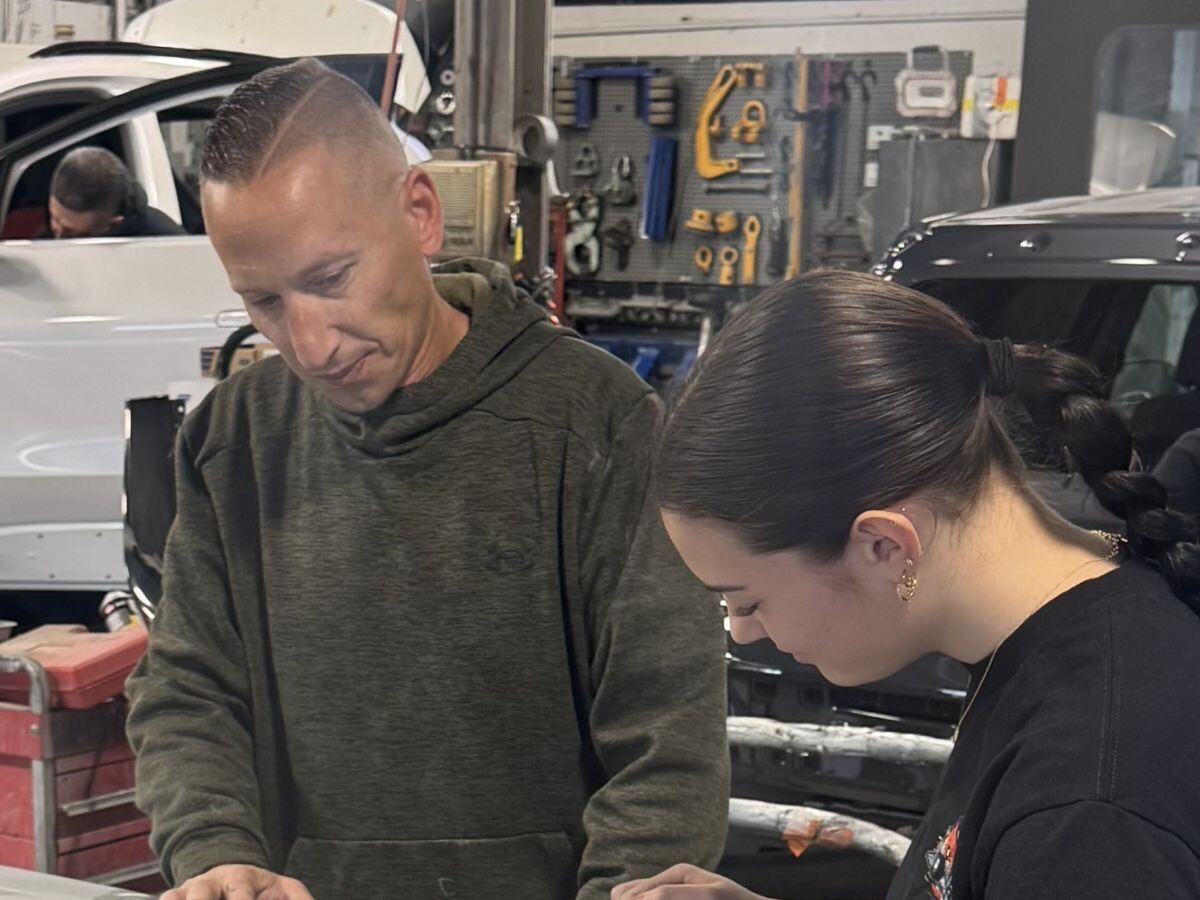
Eight months ago, Anthony DeMieri sold three businesses — Frog Hollow Collision, a mechanical shop, and a window tint and ceramic coating service — for $4 million to a local private investor. Soon after, he launched a nonprofit, Trade Up Level Up, with the tagline: “Connecting today’s tradesmen with tomorrow’s.”
The 501(c)(3) focuses on pairing experienced tradespeople with pre-apprentices, working with them, guiding them to vocational schools, and encouraging tradespeople to work with those schools at any level. The program is open to all trades, but based on his experience, this first half-year has been in collision.
“Train your hands, use your hands, you’ll never go hungry,” said DeMieri. He built a sizeable social media presence — 9,800 followers on Facebook — before starting the nonprofit. Now he’s a mentor and is looking for others, from independents to MSOs, to work with kids.
A layered approach to tech training
DeMieri’s approach tweaks traditional tech training by asking owners and operators to be personally involved — but not necessarily too much. Shop owners don’t need to go through his group, and they don’t need to commit a lot of time.
“I have a very good relationship with the local vocational school,” DeMieri said.
“Maybe you don’t want a full intern,” he added. “If you don’t want to do this all day every day, you could go to any vocational school for a half-hour, give some real-world advice. Tell them to pay attention, what they should be learning. Let them know the what the real world in the industry is like.”.
For instance, DeMieri recalls one student who insisted he wanted to be an electrician. So DeMieri took him to a job site, where the student learned that most of the company’s work was commercial and outdoors — 80 feet in the air. “He said, ‘I’m deathly afraid of heights.’” And that was that.
In other words, you don’t need $4 million. You only need an hour to find kids who deeply want this and don’t need to be cajoled or persuaded.
And DeMieri can help, because this individual effort is fueled by Facebook. “I get so many requests,” he said, adding ruefully, “I’m just one little auto body guy.” — but, matter-of-factly, that so are others.
“I’m growing this organically in my area, slowly raising the profile.”
Each one, teach one … and drag racing
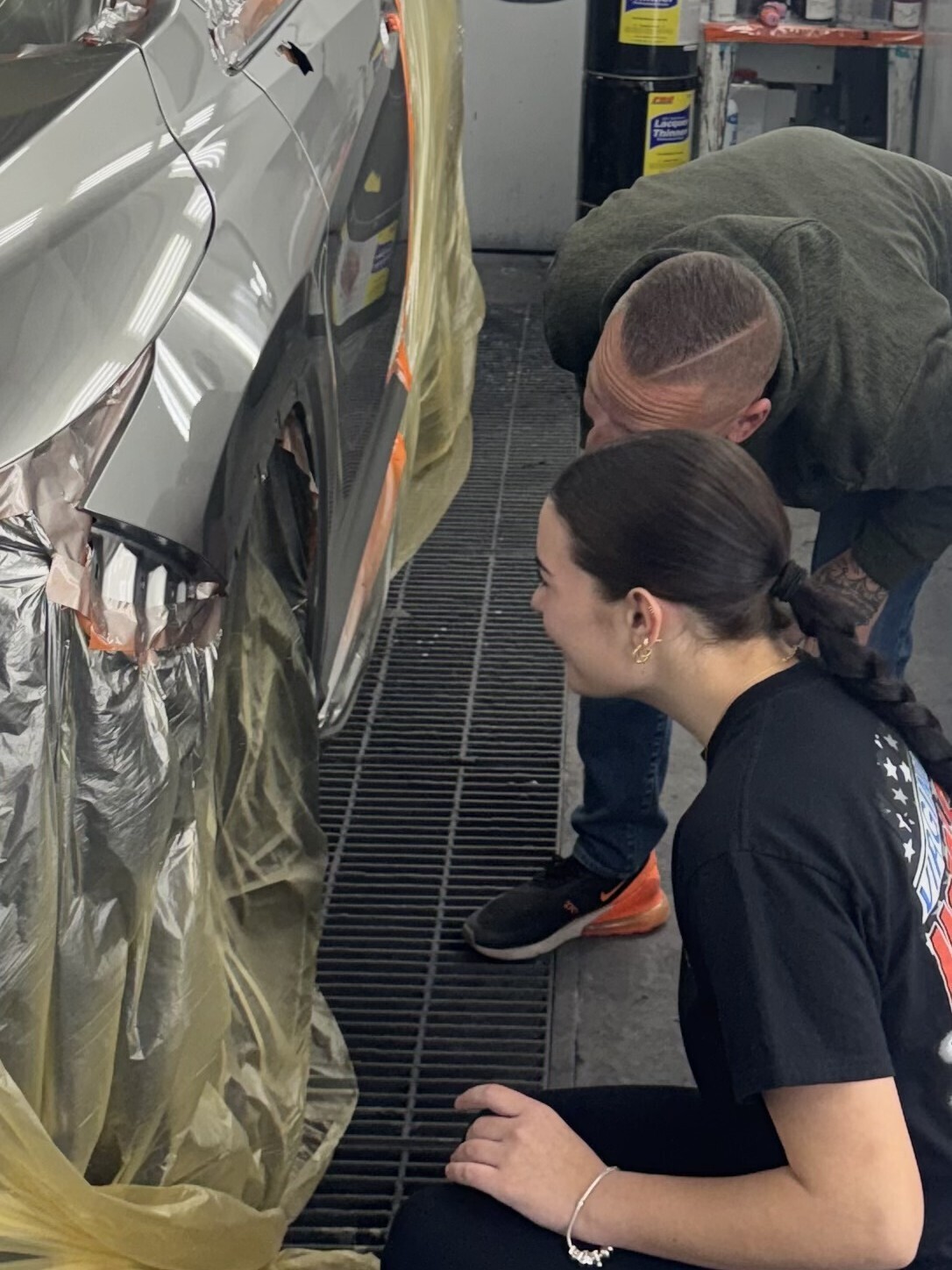 DeMieri works on body shop basics two to three days a week with Gabriella Held. Gabby turns 16 in April and is especially interested in welding. She wants to attend a local high school’s BOCES program for vocational training.
“Because I do autobody, Gabby goes hands-on,” DeMieri said.
“I grew up around cars and like working on them,” Gabby said. Each of her grandparents worked in body shops and diesel mechanics, and her uncle and father also share the passion. “I’d like to work in body shops and open one someday.”
She also drag races and ran first in points this past summer until dropping to third in the last race. The uncle, her mother’s brother, also drag races and welds.
“We’re a big car and trades family,” said Nicole Held, Gabby’s mom. She saw one of DeMieri’s social media posts and figured Gabby would be interested. “He’s advocating for the kids; she was already drag racing, good with her hands, meticulous, and likes art.”
Gabby and DeMieri began with welding, learning how metal bends, different types of welding, and the fabrication behind things, and bought a welding kit for small projects.
Since Gabby works with DeMieri and begins BOCES, Nicole noted, “It’ll be two vocational schools at once.”
Personal and purpose-driven
DeMieri owned his shop for 10 years, adding other businesses over time before selling. A five-year, $1 million consulting contract keeps him connected to the former shop, where he teaches Gabby how to weld, paint — “I love painting,” he said — and all the rest.
And he works with kids that are just like him when he was young, drawn to the trades and often judged for that.
Trade Up isn’t trying to do too much and isn’t focused on fundraising or marketing.
“It’s not a financial endeavor,” he said. Instead, DeMieri sees it benefiting shops of any size — building the business, earning recognition in their area, and continuing the work. More foundationally, and more crucially, he’s launched a commitment-based, owner and operator-driven effort.
Shop owners can decide how much to be involved and what to focus on, instead of bringing in students to do generic tasks like washing cars. Since it’s more personal, owners have a place to share their passion.
DeMieri recalled time spent with a boy who’d lost his father. “I’d bring him to the shop. All I knew to do was keep working, every day. He was feeling better, me showing him how, patting him on the back.”
Sadly, the boy later died in a collision. But during his short time with DeMieri “he was a happier kid; it changed his life.”
“Why can’t more people do this?” he asked. “It’ll be more gratifying than any dollar they’ve made, when [the students] look you in the eyes and say, ‘thank you.’”




Paul Hughes