


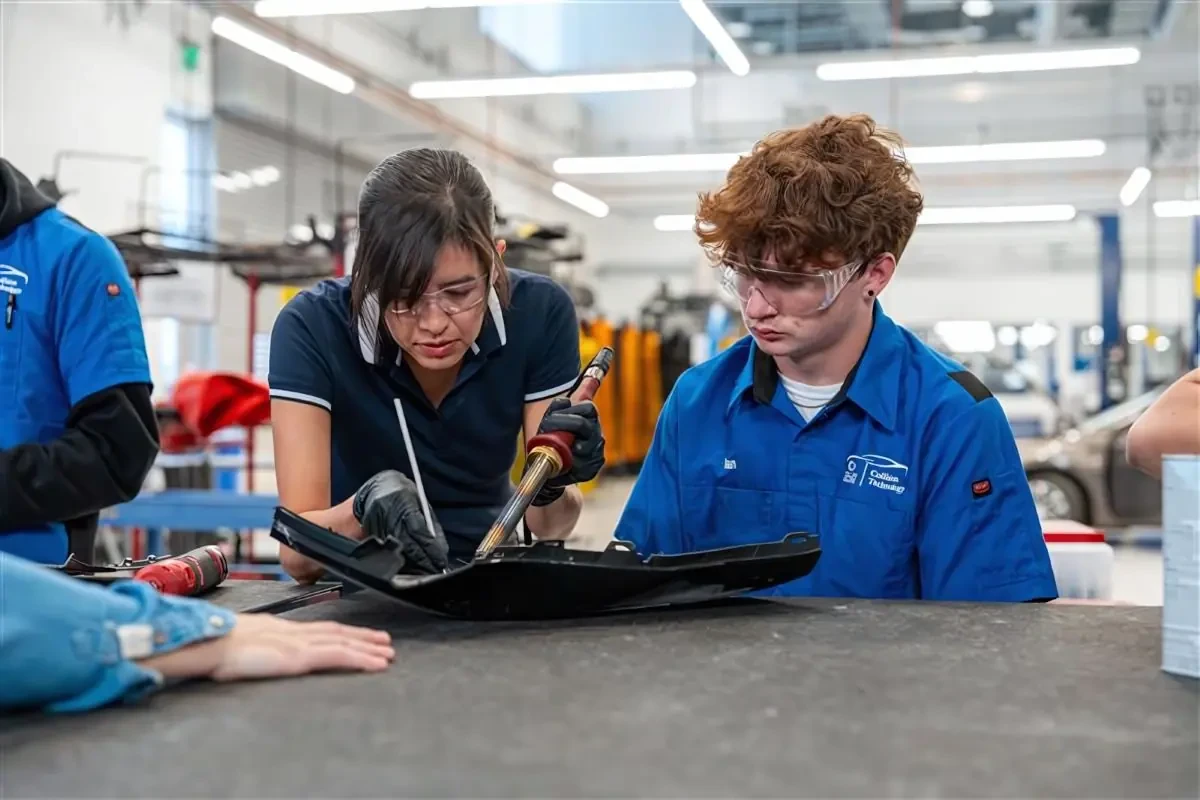
Raven Luna has spent her career preparing students for a world that keeps changing faster than the repair manuals can keep up. Now, she’s tackling that mission on a national scale.
Luna, M.Ed., Discipline Lead and Professor of Collision Technology at Collin College, was appointed to I-CAR’s Member Council this year, which is one of only two seats designated for the Education segment. It’s a shift in scale from the classroom in Allen, Texas, to conversations shaping training and talent development nationwide.
“Professionally, it means a lot to me because it helps me stay in touch with a larger community in the collision repair industry,” she says. “The Member Council is a better indicator of the industry viewed from a national level.”
A Voice for Education at the National Table
Luna’s influence at Collin College is well established. She guides students through their first spray jobs, competition setbacks, and graduation-day milestones with the same steady hand. That commitment now extends to a broader advisory role, and with it, a broader responsibility.
She’s one of two educators on a council otherwise dominated by industry operators, insurers, and suppliers. That means asking questions other members may not think to ask: How will a new policy affect programs with high enrollment but limited resources? What do updated training standards mean for high schools battling equipment shortages and instructor vacancies?
"As a representative, I must speak for others who do not have a seat at the table," she says.
Luna is candid about the challenge. Collin College is not a typical program, and she knows it.
“My experiences with Collin College are not like other schools,” she says. “I must keep a broad, generalized outlook on schools as a whole.”
Luna’s appointment comes as the collision repair industry faces mounting pressures: insurer friction, consolidation, technician shortages and vehicles that grow more complex with every model year. In that climate, she argues that education and documentation aren’t just beneficial; they’re essential.
“Having education, training, and proper documentation legitimizes what we do as an industry,” she says. “If we want to be perceived as professionals to the general public, we have to make the effort.”
She’s blunt about the pace of change. “I reflect on the short amount of time I’ve been away from working in a shop, and everything has changed so much in that time,” she says. “As educators, we have to be vigilant about what’s new because we want to provide that to our students. The same should apply for shops."
Her philosophy: invest in training proactively or pay for it reactively.
Raising the Bar Without Dismissing Reality
On the divide between minimum-compliance shops and OEM-certified facilities, Luna takes a measured view.
“I don’t want to disparage minimum compliance because that’s still better than no compliance," she says. “Some shops may not have the means or resources to be an OEM-driven facility and must find a middle ground.”
Still, she’s clear about what separates the best from the rest.
“OEM-driven facilities check all the boxes rather than just some,” she says. “It requires a lot of work and strong leadership to accomplish that and to maintain it.”
The differentiator, in her view, isn’t paperwork; it’s culture. When technicians understand the “why” behind a procedure, compliance becomes a habit rather than an obligation. That same thinking anchors her classroom.
Representation and What it Signals
Luna’s presence on the Member Council also carries meaning beyond her résumé. As a woman in a national collision repair leadership role, she represents a shift in who holds influence in the industry, even if she’s characteristically understated about it.
“None of that really has to do with being a woman,” she says with a laugh. “Although I am happy to be representative in that regard.”
Jesus Guerrero, Director of Product Management - Talent Programming at I-CAR, sees it differently.
“Women bring a wide range of strengths across leadership, communication, problem-solving, and learning styles, and Raven demonstrates this every day,” Guerrero says. “When individuals like Raven have a voice in decision-making spaces such as I-CAR’s Member Council, the industry benefits from perspectives that broaden how we approach education, skill development, and talent attraction.”
I-CAR Business Development Principal Jay McElroy agrees.
"Collision repair education has always been driven by the people who show up and do the work," he says. "Raven has done exactly that — day in and day out, in the classroom and on the floor. Having her voice on the Member Council means the decisions we make about training standards and curriculum are shaped by someone who has lived it. That perspective is critical."
Guerrero also points to what Luna’s visibility means for students, especially those who haven’t seen themselves reflected in technical leadership. Her presence, he says, helps reshape the industry narrative.
"The industry grows stronger when the people guiding it look like the workforce we're trying to build," adds McElroy. "Raven is an educator who leads by example and refuses to let the next generation settle for less than complete, safe, quality repairs. Her appointment to the Member Council means her approach to teaching, her principles, and her commitment to the craft will directly shape how I-CAR develops and delivers education at a national level. The educators, mentors, and leaders who define how we train today are the ones who determine what this industry looks like tomorrow."
What may be Luna’s most distinctive contribution to the Council is something the industry rarely discusses: how people learn, not just what they learn.
In addition to her collision repair expertise, Luna holds a master’s degree in education and is pursuing doctoral work in instructional technology. She wants to bring learning theory, adult education principles, and measurable outcomes into the conversation, whether the classroom is a community college or a productive bay.
“Many educators are trained in collision repair but may lack some of the pedagogy and technical aspects of teaching and learning,” she says. “The opportunity of being in this role is hopefully bringing instructional design methodology and relevant research to the table.”
For Luna, a well-designed training program and a well-run shop aren’t so different. Both require structure, intention and a commitment to getting better. And that is the type of vision that will guide her well in this role.
Frame by Frame is an ongoing industry spotlight series from Autobody News, highlighting the people whose experience, leadership, and commitment continue to shape the future of collision repair.


Leona Scott